An in-home private teacher: how to screen them and what rules to agree on
Which certificates to request from the Policía, Procuraduría, and Contraloría, what a certificate doesn’t tell you, and which house rules make any private lesson safer.
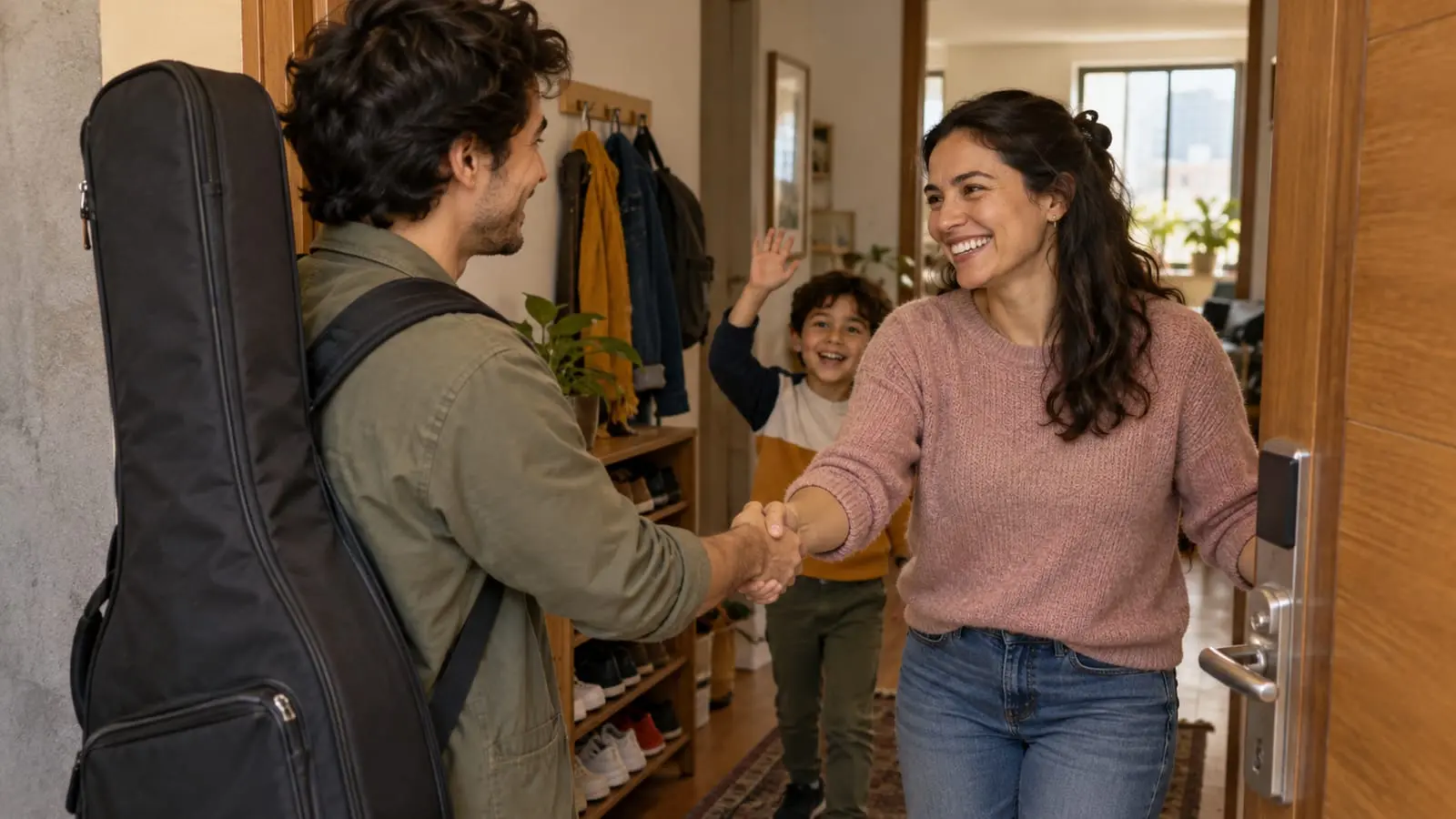
Before a private teacher gives your child lessons at home, take three steps to check their background: ask them to look up their official records (Policía Nacional, Procuraduría, Contraloría, and Registro Nacional de Medidas Correctivas) and share the certificates, talk to someone who already knows them, and agree on lesson rules in writing. The checks take just a few minutes online and are generally free.
No background check replaces your judgment, which is why this guide goes beyond certificates: what each one does and doesn't say, which house rules make lessons safe, and what to do if something feels off. It applies to any teacher, in any subject. If you're already looking, you may also find our in-home music lessons in Bogotá helpful, or our online music lessons if you'd prefer your child to learn from home by video.
In short
- Using their ID number, the teacher can look up and share their criminal records (Policía), disciplinary records (Procuraduría), fiscal liability records (Contraloría), and corrective measures under the Police Code (RNMC), all online.
- A clean certificate shows no records on file, but doesn't guarantee good treatment: follow up with references, a conversation, and an observed first lesson.
- The most protective rule is the simplest: when children are involved, an adult is always home, and the lesson takes place in a visible space or with the door open.
- Schedules, rates, cancellations, and payment methods are agreed on in writing with the responsible adult, never just with the child.
- If something makes you uncomfortable, act right away: calmly ask your child about it, suspend lessons, and if there are signs of abuse, call the ICBF's 141 helpline or the Policía.
The four official record checks to request
All four checks can be done online using the document type and number. The simplest, most respectful approach is to ask the teacher to run the checks themselves and share the certificates or a screenshot: the Police criminal records portal’s terms of use ask users to look up only their own information and consider looking up someone else’s information improper. Explain naturally why you are asking; a responsible professional will understand, because it is what any cautious family would do. The portals change their layouts from time to time, so if a link moves, go through each agency’s homepage.
| Check | Agency | What it shows | Location |
|---|---|---|---|
| Criminal records | Policía Nacional | Whether the person has court judgments currently in effect or is wanted by an authority. | antecedentes.policia.gov.co |
| Disciplinary records | Procuraduría General de la Nación | Current disciplinary sanctions, mainly for people who have worked in the public sector. | www.procuraduria.gov.co |
| Fiscal liability records | Contraloría General de la República | Whether they appear on the list of people liable for losses to public funds, meaning they have caused unresolved damage to public assets. | www.contraloria.gov.co |
| Corrective measures | Registro Nacional de Medidas Correctivas (RNMC), Policía Nacional | Citations and measures for behavior that violates the Police Code's rules on peaceful coexistence. | srvcnpc.policia.gov.co |
The Police check usually provides the most reassurance, while the corrective measures check is the one most often overlooked. Save the certificates the teacher shares, along with their dates, in case you want to compare them later. This is about mutual trust, not spying on them.
What a certificate doesn't tell you
A certificate with no entries is a good sign, but it has limits you should know about so you don't become overconfident:
- It only shows what has already reached an authority. Behavior that was never reported won't appear in any system.
- It says nothing about their teaching style. Someone can have a clean record and still be impatient, late, or simply a poor teacher.
- It's a snapshot of the day you checked. So if the relationship lasts months or years, trust is renewed through observation and communication, not an old piece of paper.
- It doesn't verify their musical training. That's what an audition, references, and a trial lesson are for.
Think of certificates as an initial screening. What really gives you confidence is the combination: documents, references, a conversation, and clear rules from day one.
References and the first conversation
Before scheduling, set aside twenty minutes for a phone or video call. It's not an interrogation; it's a conversation between two adults who want what's best for the child. Some questions that can tell you a lot:
- What age groups have you worked with, and how do you organize a first lesson for a child my child's age?
- Where have you taught before (schools, academies, other families), and who could I speak with?
- How do you communicate with parents: after each lesson, by message, or through a progress notebook?
- What do you do if the child gets frustrated, distracted, or doesn't want to play that day?
- How do you handle cancellations and makeup lessons?
If they give you references, actually call them. Ask something specific, not just “Are they a good person?”: “How did your child do with them?”, “Were they on time?”, “Would you hire them again?” Evasive answers matter too. To assess their musical and teaching skills, the trial lesson guide and 10 questions for choosing a music teacher give you a step-by-step method.
House rules that protect your child
Clear rules protect everyone: the child, the family, and the teacher, who also feels more comfortable when everything is transparent. Here are the rules we recommend for any private lesson involving minors:
- A responsible adult is home throughout the lesson. They don't have to sit beside the child, but should be available and visible from time to time.
- A visible space or an open door. The living room, dining room, or study is better than a closed room. If the instrument is in the child's bedroom, the door stays open.
- No unexpected physical contact. To correct posture, the teacher can demonstrate on their own instrument or ask permission before touching the child's hands. It's good teaching practice as well as a safety measure.
- Communication goes through the parents, not the child. Schedules, changes, and payments are arranged with the responsible adult. Avoid ongoing private conversations between the teacher and a minor through messages, social media, or video games.
- Photos and videos only with permission. Recording a short segment to help the child practice is useful; posting or sharing it without permission is not.
- No secret gifts or favors. The family should know about any gift or gesture between the teacher and child.
- You know who's coming. The person entering your home must be the person you agreed on. If the teacher sends someone else in their place, the lesson waits until you've discussed it.
These rules don't have to suggest mistrust: present them as “this is how lessons work in our home.” A good teacher accepts them without a problem. If someone takes offense or tries to get around them, that tells you something important. Our guide to how in-home music lessons work also explains what space to prepare and the family's role.
Written agreements: schedules, payments, and cancellations
A clear message before the first lesson prevents many misunderstandings. You don't need a lawyer-drafted contract; a note you can both refer to later, on WhatsApp or by email, is enough. Include these points:
| Topic | What to define |
|---|---|
| Schedule | Day, arrival time, lesson length, and what happens if the teacher is late or the child isn't ready. |
| Cancellations | How much notice is required, when a lesson can be made up, and when it is forfeited. |
| Payments | How much to pay, when, by what method, and to whom. Always ask for a payment record; avoid paying large amounts in advance to someone you've just met. |
| Material | Who brings books, sheet music, or instruments, and what the child is expected to have at home. |
| Communication | Which channel to use and at what times, with messages about the child going to the responsible adult. |
| Follow-up | How often the teacher updates you on the child's progress and what to practice during the week. |
If your child is young, it also helps to define what's expected of the family: an adult nearby to remind them to practice and help the lesson start on time. In early music education, for example, adult participation in the first few sessions often makes a big difference.
Warning signs and what to do if something feels off
Trust your intuition, but back it up with facts. These signs justify taking a pause:
- The teacher refuses to share their Colombian ID number, discuss references, or accept an adult being home.
- They insist on teaching alone with the child, behind a closed door or somewhere out of sight.
- They ask to communicate directly with the child through social media or private messages, or ask the child to keep secrets.
- They make comments or gestures involving physical contact that make you or your child uncomfortable.
- They suddenly change schedules, locations, or rates without explanation.
- Your child, who used to enjoy lessons, starts avoiding them, gets anxious before the teacher arrives, or has mood changes with no obvious reason.
One sign alone doesn't prove anything, but it deserves attention. If something worries you, speak with your child calmly, without turning it into an interrogation: “How do you feel during lessons?”, “Is there anything you don't like?” Listen without overreacting so they feel safe telling you, and suspend lessons while you find out more.
How we work at A medio tono
At A medio tono, every teacher is assessed on musical skills, teaching ability, and how they treat people before their first lesson. This is our screening of how they play, teach, and interact with others; it doesn't replace the checks each family chooses to make. That's why we encourage you to run your own checks and get to know the person before starting.
In practice, this means you know in advance who's coming, can view their profile, and can arrange schedules with the responsible adult through WhatsApp. Lessons take place in Bogotá and the surrounding area, depending on each teacher's availability, or online by video call. For young children starting from scratch, see our early music education lessons, or if your child already has an instrument in mind, our piano, violin, and guitar lessons.
Frequently asked questions
How can I check a private teacher's background?
An ID number can be used to check criminal records on the Policía Nacional website, disciplinary records through the Procuraduría, fiscal liability records through the Contraloría, and corrective measures through the Police’s RNMC, all online. The most respectful approach is to ask the teacher to run these checks and share the certificates with you, because the Police portal asks users to look up only their own information. Check how each portal currently works.
Is it mandatory to request a private teacher's background records?
Families aren't required to, but it's a sensible practice when someone will be alone with or near a minor. Do it respectfully and with their knowledge, and follow up with references and a conversation beforehand.
Is it safe to have an in-home teacher with children at home?
It can be if you combine screening with clear rules: an adult always at home, lessons in a visible space or with the door open, communication through parents, and written agreements. No measure eliminates every risk, but these greatly reduce the chance of problems and help you spot them early.
Do I need to be present for the entire lesson?
With young children, it's best to stay nearby, especially at first, and help them practice during the week. With older children, it's enough for an adult to be home and the door to remain open. A minor should never be left alone with the teacher without anyone at home knowing.
What should I do if my child says something during the lesson made them uncomfortable?
Listen calmly, thank them for telling you, and don't pressure them with questions. Suspend lessons while you find out more, and if there are signs of abuse or mistreatment, contact the ICBF's 141 helpline or the Policía. Verify the current contact channels and seek professional support.
Sources
We checked the facts in this article against these sources on October 22, 2026.