Llanero music: harp, cuatro, maracas, and the rhythms of joropo
Joropo is played with harp, cuatro, and maracas, moving between 3/4 and 6/8. What each instrument does, how golpes sound, and what you can start practicing now.
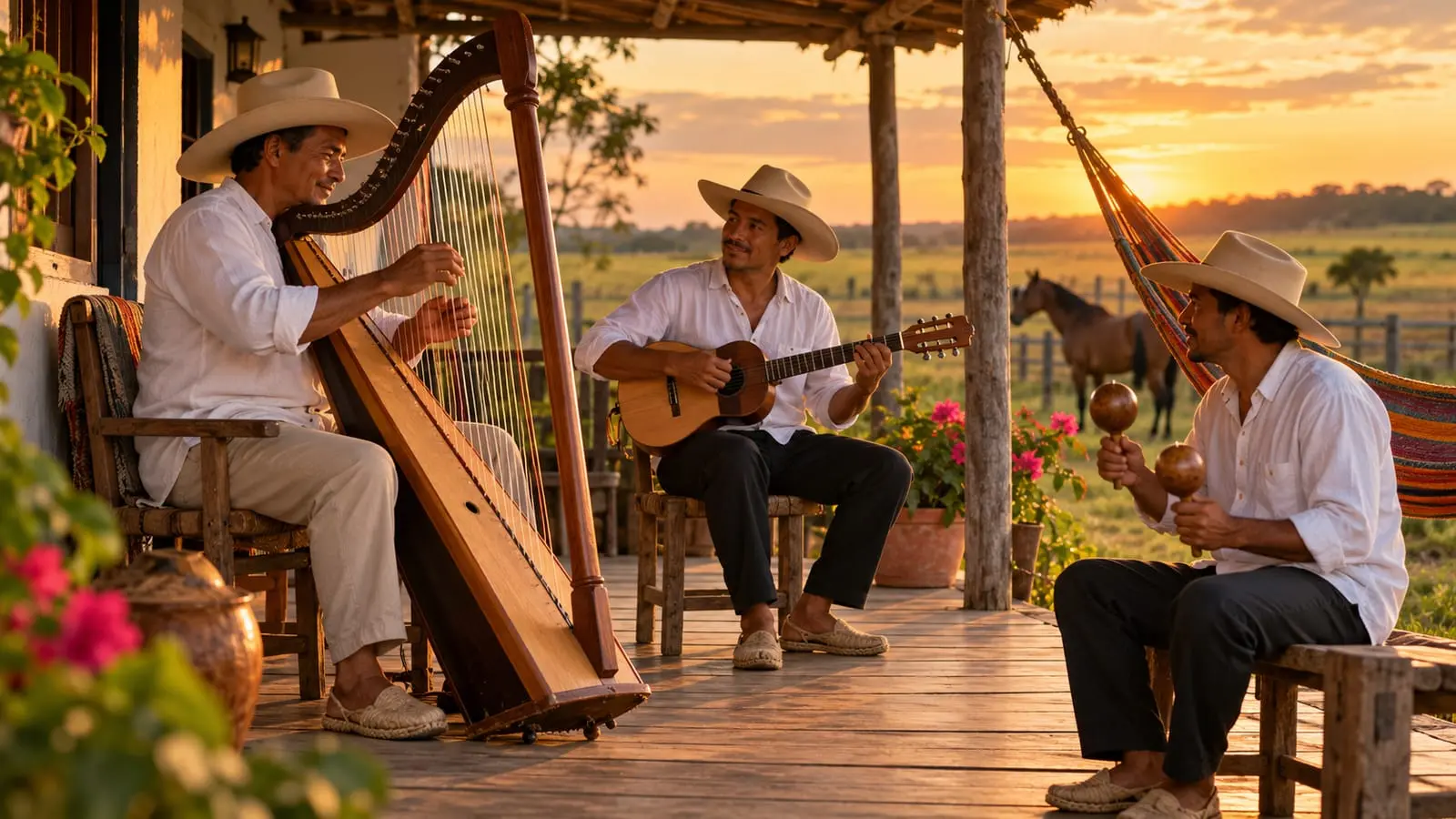
Llanero music is played with three basic instruments: the llanero harp, which carries the melody and bass; the cuatro, a small four-string guitar that marks the rhythm and harmony; and maracas, which define the rhythmic feel. Many ensembles add the bandola llanera and bass. Together, they play joropo, the music and dance of the Llanos Orientales, the Orinoquía region Colombia shares with Venezuela.
Here, we explain what each instrument does, how pasaje and golpe sound, why joropo moves between 3/4 and 6/8, and what UNESCO recognized. A medio tono currently doesn’t offer harp or cuatro lessons, but the rhythm, harmony, and pulse joropo requires are developed in guitar lessons and percussion lessons. This guide shows you how.
In short
- The basic llanero ensemble is harp, cuatro, and maracas; many groups add bandola llanera and bass.
- Joropo is both music and dance, performed in forms such as pasaje (more lyrical and relaxed) and golpe (faster and more energetic).
- Its rhythmic hallmark is hemiola: alternating between 3/4 and 6/8 using the same eighth notes.
- The cuatro llanero is tuned A-D-F♯-B, with the first string lower in pitch than the second.
- In 2017, UNESCO added the work songs of the Llanos of Colombia and Venezuela to its urgent safeguarding list.
What are llanero music and joropo?
The Llanos Orientales, or Colombian Orinoquía (departments such as Meta, Casanare, Arauca, and Vichada), are a vast savanna where life revolves around cattle, rivers, and horses. From that life came a music of singing, footwork, and storytelling: joropo. Colombia shares it with the Venezuelan Llanos, and each side has its own nuances.
Joropo is both a musical genre and a celebration with partner dancing, featuring stamping and brushing footwork. It includes many named forms, the golpes and pasajes, and two broad rhythmic families we’ll explore below. To place it alongside the country’s other music, see Colombia’s traditional instruments.
The instruments of joropo, one by one
| Instrument | What it is | What it does in the ensemble |
|---|---|---|
| Llanero harp | Nylon-string harp with a wide soundbox. Played with the fingertips of both hands | Carries the melody with the right hand and the bass with the left, often adding fast scales as ornamentation |
| Cuatro | Small guitar with four single nylon strings, tuned A-D-F♯-B | Rhythmic and harmonic engine: dry, fast strumming that articulates the chords |
| Maracas (capachos) | Two rattles, traditionally made from totumo or tapara gourds with seeds inside | Define the feel of joropo with fast, precise figures |
| Bandola llanera | String instrument played with a pick, distinct from the Andean bandola | Takes the harp’s melodic role in some ensembles |
| Bass | Electric or acoustic bass | Reinforces the low end, especially in modern groups |
The llanero harp
It’s the lead voice. With more than thirty strings, it spans deep lows to brilliant highs. The harpist does two jobs at once: the right hand sings the melody and variations, while the left plays the bass notes that sustain the harmony. Those virtuosic runs are a source of llanero pride.
The cuatro
Small but essential. Its four single strings are A, D, F♯, and B, from the 4th to the 1st, with the 1st lower in pitch than the 2nd: a reentrant tuning. Played open, the four strings sound like a B minor seventh chord, giving it a compact sound. If you have one, tune it with the cuatro llanero tuner, which also explains other tunings.
Maracas, bandola, and bass
Maracas look simple, but the player marks eighth notes precisely and varies the accents with each golpe; the whole ensemble wavers if they’re out of place. The bandola llanera adds a plucked melody, brighter and drier than the harp. Finally, the bass anchors everything from below, giving modern joropo its full sound.
Pasajes and golpes: the forms of joropo
Not all joropo is the same. Broadly speaking, pasaje is slower, sung, and lyrical, often telling a story or expressing longing for the plains. Golpe is faster, more energetic, and more dance-oriented. Some golpe names you’ll hear again and again:
- Seis por derecho: one of joropo’s most traditional golpes.
- Pajarillo: a well-known golpe, even outside the Llanos.
- Zumba que zumba: another classic golpe in the llanero repertoire.
For a pasaje, listen to “Ay, mi llanura” by Arnulfo Briceño; for a golpe, try “Pajarillo.” Pay attention to the harp and the hand strumming the cuatro, and you’ll hear the difference in speed and character.
Joropo also has two rhythmic systems, por derecho (or atravesao) and por corrío. The first includes golpes such as seis por derecho and pajarillo; the second includes golpes por corrío. The nuances vary from one teacher to another, so take this as a general guide.
3/4 and 6/8: joropo’s time signatures
Joropo lives at the intersection of two meters. In 3/4, you count three beats of two eighth notes each; in 6/8, you count two beats of three eighth notes. The eighth notes stay the same, but the accents fall in different places, and joropo alternates between the two. This alternation is called hemiola, and it gives the music its sway.
| Time signature | Eighth notes | Where the accents fall |
|---|---|---|
| 3/4 | 1 2 3 4 5 6 | On 1, 3, and 5 (three groups of two) |
| 6/8 | 1 2 3 4 5 6 | On 1 and 4 (two groups of three) |
To feel it, count six eighth notes and walk, emphasizing 1-3-5, then 1-4, switching every two measures. The joropo metronome loads both time signatures at the same eighth-note speed; start slowly. If the meters feel unfamiliar, review musical time signatures explained, and to compare with Colombian Andean music, read bambuco, pasillo, and cumbia explained.
The work songs of the Llanos and UNESCO
In 2017, UNESCO added the work songs of the Llanos of Colombia and Venezuela to the List of Intangible Cultural Heritage in Need of Urgent Safeguarding. These are songs sung while working with cattle: milking, herding, and cattle driving. The inscription recognizes their immense value and a risk: that their transmission between generations may be lost.
Keep the distinction in mind: the inscription covers those work songs, not joropo as a whole. The work songs share joropo’s territory and culture, but they’re a tradition of their own, performed with the voice and without the harp, cuatro, and maracas ensemble. If you need details or the current status, check the latest information on UNESCO’s official website.
How to explore this music if you play guitar or percussion
Harp and cuatro are usually learned from teachers rooted in the llanero tradition, at cultural centers and llanero music schools, and by ear in the region itself. There’s no substitute for that. But other lessons can build skills that make a difference when you start learning them:
| Skill | Why it matters in joropo | Where to develop it |
|---|---|---|
| Fast, precise strumming | The cuatro thrives on dry, fast strumming | Guitar lessons; start with basic strumming patterns |
| Pulse in 3/4 and 6/8 | Hemiola requires steadiness | Metronome practice on guitar or percussion |
| Precise shaker technique | Maracas carry the rhythmic feel | Percussion lessons, with shakers and Latin rhythms |
| Harmonic ear | Recognizing chord changes in pasaje | Ear training |
If percussion is your thing, see how it connects with Latin instruments in drums or Latin percussion. And if you already play guitar, remember that the cuatro has its own tuning and technique; your harmonic ear will help, but your hands will be learning from scratch.
Better with a teacher
A medio tono teachers are evaluated on musicianship, teaching skills, and personal qualities before giving their first lesson. A guitar or percussion teacher can help you strengthen your pulse, strumming, and ability to read different meters you’ll later use in llanero music, in Bogotá and surrounding areas (depending on each teacher’s availability) or by video call from anywhere.
Frequently asked questions
What instruments are used in llanero music?
The basics are the llanero harp, cuatro, and maracas. Many ensembles add bandola llanera and bass.
What is joropo?
It’s the traditional music and dance of the Llanos of Colombia and Venezuela. It’s performed in pasajes and golpes, and its hallmark is alternating between 3/4 and 6/8.
How do you tune the cuatro llanero?
To A, D, F♯, and B, from the fourth string to the first, with the first lower in pitch than the second. In Colombia, this is known as temple natural. You can check it with the website’s free tuner.
Is joropo in 3/4 or 6/8?
Both: it alternates between the two using the same eighth notes. That alternation is called hemiola and is the basis of its sway.
What did UNESCO recognize from the Llanos?
In 2017, it added the work songs of the Llanos of Colombia and Venezuela to its urgent safeguarding list. This covers the songs of cattle work, rather than joropo as a whole.
Sources
We checked the facts in this article against these sources on October 22, 2026.