Piano parts explained: keys, hammers, strings, and pedals
A piano has 88 keys, more than 200 strings, and three pedals. We explain how they work together from the moment you press a key until the note sounds, and how upright, grand, and digital pianos differ.
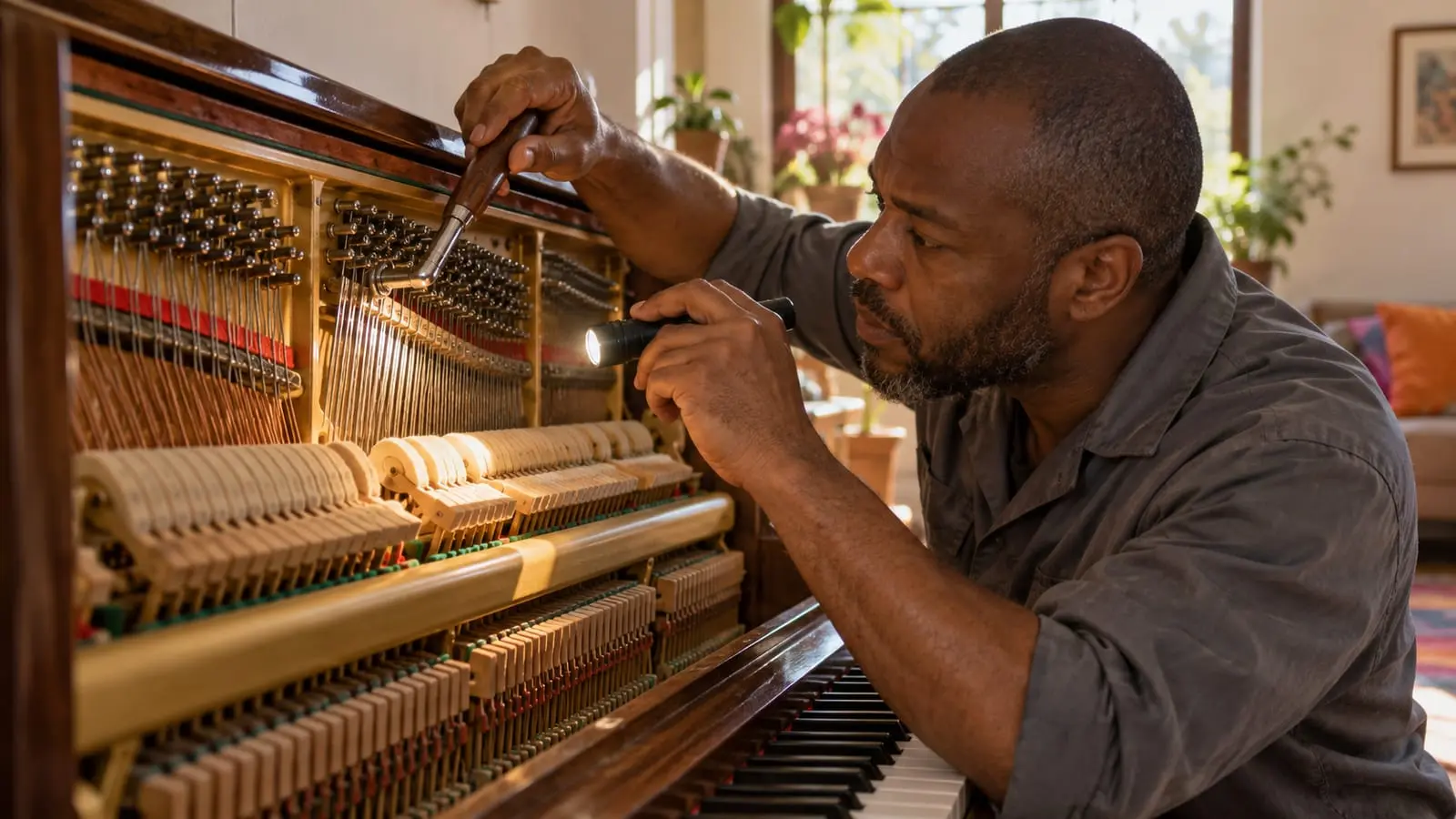
An acoustic piano has 88 keys (52 white and 36 black), more than 200 strings, one felt hammer per key, dampers that stop the sound, and three pedals. When you press a key, a mechanism launches a hammer against that note's strings; the strings vibrate, and the soundboard amplifies the sound. When you release the key, a felt damper drops onto the strings and silences them.
Knowing the parts of a piano helps you play better: you understand why the weight of your hand changes the sound, what each pedal does, and what happens when the instrument needs tuning. Here you'll find each part and its function, the path of a note, the differences between upright, grand, and digital pianos, and a section for kids. If you'd like to learn with guidance, see our piano lessons at home in Bogotá or online.
In short
- A standard piano has 88 keys: 52 white and 36 black, ranging from the lowest A (A0) to the highest C (C8), just over seven octaves.
- Sound follows a path: key, action, hammer, string, bridge, and soundboard; the damper stops it when you release the key.
- It's called a piano because, unlike the harpsichord, it lets you play softly (piano) or loudly (forte) depending on how hard you press the key.
- There are three pedals: the right sustains the sound, the left softens it, and the middle varies by piano.
- A digital piano has no hammers or strings: it uses sensors, recorded sounds, and speakers, which is why you can play it with headphones.
Piano parts at a glance
A piano looks like a piece of furniture, but inside it's a machine with thousands of parts. These are the parts worth knowing, from the ones you can see to the ones hidden inside.
| Part | What it is | What it's for |
|---|---|---|
| Keyboard | The 88 keys, white and black | The interface: each key activates a note |
| Mechanism (action) | Levers and parts made of wood, felt, and metal | Turns finger movement into a hammer strike |
| Hammers | Felt heads over a wooden core | Strike the strings and immediately bounce back |
| Strings | Tensioned steel strings; the bass strings are copper-wound | Vibrate and produce the note |
| Dampers | Felt pieces resting on the strings | Stop the vibration when you release the key |
| Tuning pins and pinblock | Steel pins set into a wooden block | Hold each string and allow its tension to be adjusted for tuning |
| Bridge and soundboard | Wooden bridge on a large wooden panel, usually spruce | Transfer string vibrations to the air and amplify the sound |
| Harp or iron frame | Cast metal structure | Withstands the enormous tension of the strings |
| Pedals | Two or three levers at floor level | Modify the sound using your foot |
| Lid, music rack, and bench | Cabinet, sheet music support, and seat | Protect the piano, hold sheet music, and seat you at the right height |
A fun fact: piano strings exert several tons of combined tension, which is why the inner frame is made of iron rather than wood. It's also why moving an acoustic piano is a job for professionals.
How a piano works: the path of a note
When you press a key, this happens in less than a tenth of a second:
- The key goes down and acts as a lever: the other end rises.
- The action pushes the hammer toward the strings. Just before the strike, a part called the escapement releases the hammer so it can move freely.
- The hammer strikes that note's strings and immediately rebounds, so it doesn't stop the sound it just created.
- The damper lifts as soon as the key goes down, letting the string vibrate freely.
- The strings vibrate and move the bridge, which transfers the vibration to the soundboard.
- The soundboard amplifies the sound and projects it through the air to your ears.
- When you release the key, the damper drops onto the strings and stops them.
The key to this design is that how hard you press changes the hammer's speed, which changes the volume and tone color. That's why it's called a piano: the name comes from pianoforte, “soft and loud.” Earlier, harpsichords plucked the strings, so touch couldn't change the volume. The piano's inventor, the Italian Bartolomeo Cristofori, solved that problem around 1700.
The keys: how many there are and how to find your way around
A standard piano has 88 keys: 52 white and 36 black. They range from the lowest A (called A0) to the highest C (C8), a span of just over seven octaves. Most grand pianos, studio uprights, and full-size digital pianos have this range. Some concert pianos have up to 97 keys, while electronic keyboards usually have 49, 61, or 76.
| Instrument | Typical number of keys | Detail |
|---|---|---|
| Acoustic piano (upright or grand) | 88 | 52 white and 36 black |
| Full-size digital piano | 88 | Weighted keys that imitate a piano's feel |
| Keyboard or synthesizer | 49, 61, or 76 | Fewer octaves; keys are usually light |
| Toy keyboard | A few, sometimes 25 or 37 | Smaller keys; for play, not serious practice |
The black-key trick
The black keys come in groups of two and three, and that's your map. C is the white key just to the left of each group of two black keys; F is to the left of each group of three. From there you can find the other white notes: C, D, E, F, G, A, B. The black keys are sharps and flats (C♯ is the same as D♭).
Middle C is the C roughly in the middle of the keyboard, and it's key number 40 counting from the lowest note. To see how the white notes work on their own, explore the C major scale, which uses only white keys.
Registers: low, middle, and high
The keyboard runs from left to right, low to high. Bass strings are long, thick, and copper-wound; treble strings are short and thin. That's why low notes sound deep and full, while high notes are bright and short-lived.
- Low register (left): where the left hand usually plays bass notes and chords. Written in bass clef.
- Middle register (center): around middle C, where most melodies and beginner exercises take place.
- High register (right): bright notes that decay quickly, often used for ornaments and right-hand melodies. Written in treble clef.
Learning both clefs together is part of becoming a pianist; bass clef is explained in how to read bass clef.
The pedals: three pedals, each with a purpose
Many acoustic pianos have three pedals; others, especially in Europe, have only two. Pianists mainly use the right pedal and occasionally the left. The middle pedal varies the most.
| Pedal | Name | What it does |
|---|---|---|
| Right | Sustain (damper pedal) | Lifts all the dampers: notes keep sounding after you release the keys |
| Left | Una corda (soft pedal) | Softens and mellows the sound; on a grand, it shifts the action, and on an upright, it moves the hammers closer to the strings |
| Central | Sostenuto or practice mute | On many grands, sustains only notes already held down; on many uprights, lowers a felt strip for quieter practice |
The right pedal is released and pressed again whenever the harmony changes, and the technique is learned more with your ears than your foot. Find the full explanation and exercises in how to use the piano pedal.
Upright, grand, digital piano, and keyboard: what changes
The basic parts are the same, but their arrangement changes. In an upright piano, the strings and soundboard stand vertically against the wall, and the hammers strike sideways and return with help from springs. In a grand, everything is horizontal, and gravity brings the hammers back down, making the action faster for repeating notes. A digital piano has none of that: sensors sit under each key, and the sounds are recordings of real pianos.
| Part | Upright | Grand | Digital | Keyboard |
|---|---|---|---|---|
| Keys | 88 | 88 | 88 weighted keys | 49, 61, or 76, light keys |
| Strings and hammers | Yes, vertical | Yes, horizontal | No | No |
| Sound | Acoustic | Acoustic | Recorded, through speakers | Synthesized or recorded |
| Pedals | Two or three | Three | One or three, depending on the model | Pedal input |
| Tuning | Periodically, by a technician | Periodically, by a technician | Not required | Not required |
| Headphones | No, except special systems | No, except special systems | Yes | Yes |
| Space | Wall space | A room | Little | Very little |
If you’re deciding what to buy, the difference between a digital piano and a keyboard lies in the weight and response of the keys; we explain it in digital piano or keyboard: differences, and cover the full buying process in how to choose your first piano or keyboard. A concert grand piano is between 2,2 and 3 meters long; small grand pianos are much shorter, and uprights fit against a wall.
Piano parts for kids
- Count the black keys. Ask your child to find the groups of two and three black keys and count how many groups there are on the piano.
- Bear and bird game. Play low and high keys; your child tells you which is the bear and which is the bird.
- Find the Cs. Use the black-key map to find every C on the keyboard.
- Loud and soft. Play the same key in two ways and discover how the volume changes. This helps your child understand why it's called a piano.
If your child is starting out, piano for kids: a parent's guide covers age, instruments, and the first few lessons.
Care: which parts need attention
Knowing the parts also tells you what to care for. An acoustic piano is sensitive to changes in humidity and temperature because the soundboard wood and tuning pins shift, putting the instrument out of tune. If a pedal squeaks or a key sticks, that's a job for a technician, not hardware-store lubricant. Find cleaning and placement habits in how to care for and clean a piano.
A digital piano doesn't need tuning, but it does have sensors, a pedal, and cables to check if something stops responding. In both cases, clean the keys with a soft, slightly damp cloth and dry them immediately.
Getting to know the piano with a teacher
A good first lesson usually includes a tour of the instrument: where to sit, how the keys are arranged, what each pedal does, and how to place your hands. With a teacher at home or online, that knowledge turns into practice right away, and you learn to play with proper technique instead of guessing. Every A medio tono teacher is assessed for musical skill, teaching ability, and personal qualities before starting.
If you live in Bogotá or the surrounding area, you can take lessons at home, depending on each teacher's availability. If you're in another city or prefer to stay home, online music lessons work with your piano or keyboard and a camera showing your hands. And if you're still deciding, how long it takes to learn piano gives you a realistic idea of the first few months.
Frequently asked questions
How many keys does a piano have?
A standard piano has 88 keys: 52 white and 36 black. They range from the lowest A to the highest C, just over seven octaves. Electronic keyboards usually have 49, 61, or 76 keys.
What are the main parts of a piano?
The keys, action, hammers, strings, dampers, bridge and soundboard, iron frame, and pedals. In a digital piano, these are replaced by sensors, recorded sounds, speakers, and a pedal input.
How does a piano produce sound?
When you press a key, the action launches a felt hammer against that note's strings. The strings vibrate, and that vibration travels through the bridge to the soundboard, where it's amplified. When you release the key, a damper stops the string.
What do the piano's three pedals do?
The right pedal sustains notes after you release the keys, the left softens the sound, and the middle depends on the piano: on many grands, it sustains only certain notes, while on many uprights, it lowers the volume for practice.
What's the difference between an upright and a grand piano?
In an upright, the strings and action stand vertically, taking up little space; in a grand, they're horizontal, allowing faster note repetition and a fuller sound. Both have 88 keys.
Sources
We checked the facts in this article against these sources on October 22, 2026.