Parts of the violin and bow
Every part of the violin and bow: where it is, what it does, and how to care for it. Includes the violin's soundpost, bass bar, and rosin.
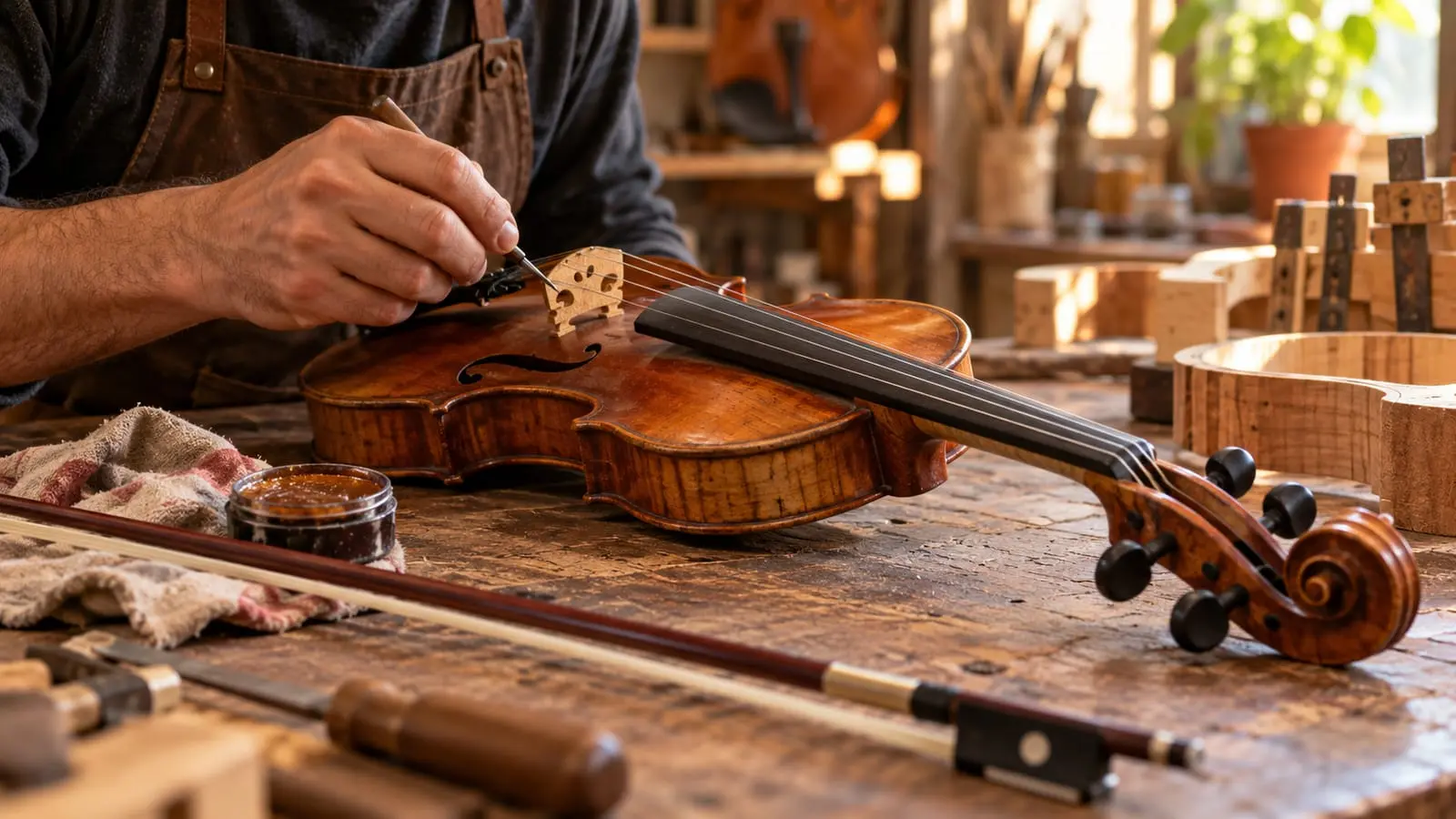
The main parts of the violin are the scroll, pegbox and pegs, nut, neck and fingerboard, soundbox (top, back, and ribs, with f-holes), bridge, soundpost, bass bar, tailpiece with fine tuners, chin rest, end button, and four strings. The bow has a tip, stick, hair, frog, and screw. Knowing the names helps you understand your teacher, make a good purchase, and care for the instrument.
This guide walks through each piece from top to bottom and explains its function. If you're starting out, it's best to see them with the violin in your hands and a teacher pointing them out; that's the first step in violin lessons at home in Bogotá or online. Here's the complete map to review whenever you like.
In short
- The violin has four strings tuned in fifths: G, D, A, and E, from lowest to highest.
- Sound starts in the string, travels through the bridge to the top, and is transferred by the soundpost to the back; that's why the bridge and soundpost are very delicate parts.
- The soundpost is a small wooden cylinder inside the violin, between the top and back; it's not visible from the front, and only a luthier should move it.
- The bow has horsehair that needs rosin to grip the string; it's tightened for playing and loosened for storage.
- For a child, the most important thing isn't the name of each part, but having a violin that fits.
Violin parts and what each one does
The violin is easier to understand in three sections: the head (top), neck, and soundbox (bottom). This table covers them in that order:
| Part | Where it is | What it's for |
|---|---|---|
| Scroll | The spiral ornament at the top end | Finishes the pegbox. It's mainly decorative and often reflects each luthier's distinctive style. |
| Tuning machines | Below the scroll, with two side walls | Houses the pegs; the ends of the strings wind around them here. |
| Tuning pegs | Four, two on each side of the pegbox | Turn to tighten or loosen each string for tuning. |
| Barre | A small piece at the end of the fingerboard, beside the pegbox | Marks the start of the vibrating string length and spaces the strings with grooves. |
| Neck | The long, rounded piece that supports the left hand | Connects the pegbox to the body and supports your hand. |
| Fingerboard | The smooth black board on the neck | Where you press the strings with your fingers; usually made of ebony. |
| Soundboard (top) | The front face of the body, facing you | Receives vibration from the bridge and amplifies it; usually made of spruce. |
| Back | The back face of the body | Reflects and enriches the sound; usually made of maple. |
| Ribs (sides) | The side walls, with C-shaped curves | Join the top and back and enclose the air that resonates. |
| F-holes | Two f-shaped openings, one on each side of the bridge | Let sound out and allow the top to vibrate freely. |
| Bridge | Upright wooden piece under the strings, between the f-holes | It raises the strings and transfers their vibrations to the top. It is usually not glued in place; string tension holds it in position. |
| Soundpost | Wooden cylinder inside the body, beneath the treble foot of the bridge | Connects the top to the back and distributes vibration. |
| Bass bar | A wooden bar glued inside the top, beneath the bass foot of the bridge | Reinforces the top and distributes the vibration of the lower strings. |
| Tailpiece | The dark piece below the bridge, near the bottom | Anchors the string ends at the body end of the instrument. |
| Fine tuners | Small screws on the tailpiece | They allow precise tuning adjustments; student violins usually have one per string, or at least one on the E string. |
| Chin rest | To the left of the tailpiece, where you rest your chin | Provides support when holding the violin. |
| End button | The small pin at the lower end of the body | Secures the tailpiece with a cord (the tailgut). |
| Strings | Four, between the tailpiece and pegs | Produce sound: G, D, A, and E. |
Some parts don't come with the violin. The shoulder rest, fitted to the back to support the instrument on your shoulder, is an optional accessory used by many, but not all, violinists. Your teacher will tell you if you need one.
How sound is produced: string, bridge, top, and soundpost
When the bow rubs a string, it vibrates, but a string alone is barely audible. The bridge takes that vibration and transfers it to the top, which amplifies it. The soundpost, fitted between the top and back, makes the back vibrate too. The air inside the body resonates and escapes through the f-holes. That's why the violin is so powerful for its size: the entire body takes part.
The violin's soundpost
It's a small wooden cylinder about as thick as a pencil. It isn't glued: pressure holds it in place between the top and back, near the bridge foot on the E-string side. In Spanish it's called “alma,” meaning “soul,” because although hardly anyone sees it, the violin doesn't sound the same without it: its position changes the volume and tone color.
If it falls, the violin sounds muffled, dull, or buzzy, and you may hear rattling inside the body when you move it. If this happens, don't try to put it back yourself: take it to a luthier. A useful tip: change strings one at a time; if you loosen them all at once, the bridge and soundpost can fall.
The bass bar
It's glued lengthwise inside the top, beneath the bass foot of the bridge (the G-string side). Its job is to stiffen the top and distribute vibration; it also helps the top withstand string pressure.
Strings, pegs, and fine tuners
The four strings are tuned in fifths. From lowest to highest: G, D, A, and E. They can be steel, synthetic-core, or gut, and each type has a different sound. Your teacher can help you choose.
| Piece | When to use it | Care |
|---|---|---|
| Tuning pegs | When the string is far out of tune or you've just replaced it | Turn them in small increments, pushing gently toward the pegbox as you turn. If they slip or stick, take the instrument to a luthier. |
| Fine tuners | For small adjustments once the string is close to pitch | Don't turn them all the way to the limit; if a fine tuner is too low or too high, adjust with the peg. |
For a relaxed tuning session, use the violin tuner and follow the steps in how to tune a violin. Young children usually need an adult or their teacher to tune for them; pegs take strength and practice.
Bow parts and their functions
The bow is half the instrument. Made of a wooden (or carbon-fiber) stick and horsehair, it has these parts:
| Part | Where it is | What it's for |
|---|---|---|
| Tip (head) | The upper end | Holds the hair at one end; this is the lightest part of the bow. |
| Stick | The long, thin, slightly curved stick | Provides the structure; its flexibility gives the bow its spring. |
| Hair (horsehair) | The white fibers between the tip and frog | Rubs against the string to make it sound. Avoid touching the hair with your fingers so it doesn't pick up oils. |
| Frog (heel) | The piece at the lower end, where you hold the bow | Holds the hair at the base; your middle and ring fingers rest here. |
| Screw | At the end of the frog, the piece you turn | Tightens or loosens the hair by moving the frog. |
| Winding and leather grip | The wrapped section of the stick, next to the frog | Protects the stick and gives your thumb and index finger a grip. |
Before playing, turn the screw until the gap between the stick and hair at the middle of the bow is about a pencil's width. Loosen it when you're done. If you leave the bow tight, the stick loses its curve over time. To learn how to hold it, see how to hold a violin bow.
Rosin: what makes the bow produce sound
Bare bow hair slips over the string and produces almost no sound. Rosin is a solid substance made from the resin of certain trees; rubbing it onto the hair leaves a fine powder that helps it grip the string and make it vibrate.
- Before playing, run the bow over the rosin from tip to frog several times, without pressing hard.
- A new bow needs more at first; after that, only occasionally, depending on how much you play.
- If it sounds scratchy and sticky, there's too much; if it slips, there's too little.
- When you're done, wipe the dust off the top and strings with a soft cloth.
Find more on cleaning the violin and bow in how to clean and care for a violin.
Violin parts for kids: how to teach them
Children find it easier to learn the parts when they connect them to body parts or images. Here are a few ideas many teachers use:
- Head, neck, and body. The scroll is the “head,” the neck is the “neck,” and the soundbox is the “body.”
- A pointing game. The teacher names a part and the child touches it; then they switch roles.
- A drawing sheet. Add labels to a drawing of the violin, remembering the bow too.
- The four strings. Sing G, D, A, E while touching each string with a finger.
But size comes before names: a violin that's too large makes everything harder. Check the chart in how to choose your first violin and its size and our guide to violin for kids.
What about viola and cello?
The viola and cello have almost the same parts, but they're larger and tuned differently. The cello also has an endpin (the metal support that rests on the floor) instead of resting on the shoulder. For the differences between violin and viola, see violin or viola.
Learning the parts with a teacher
You don't need to memorize the names before your first lesson. A violin teacher teaches them as you set up your instrument: how to tighten the bow, apply rosin, where to rest your chin, and which side has the E string. They also check that the bridge is straight, the strings are properly seated, and the instrument is the right size—things beginners often find hard to spot.
At A medio tono, violin lessons are available at home in Bogotá and surrounding areas, depending on each teacher's availability, or online by video call. If you have questions about the instrument you have at home, tell your teacher in the first lesson so you can check it together. You can also view profiles in the teacher directory.
Frequently asked questions
How many parts does a violin have?
It depends on how you count, but the main ones are the scroll, pegbox, pegs, nut, neck, fingerboard, top, back, ribs, f-holes, bridge, soundpost, bass bar, tailpiece, fine tuners, chin rest, end button, and four strings. The bow has its own tip, stick, hair, frog, and screw.
What is a violin's soundpost, and what does it do?
It's a small wooden cylinder inside the violin, between the top and back, held in place by pressure rather than glue. It transfers vibration from the top to the back and has a strong effect on volume and tone. If it falls, a luthier must reset it.
What does a violin bridge do?
It raises the strings and transfers their vibrations to the top. It is usually not glued in place: string tension holds it in position, so check it whenever you tune to make sure it is not leaning toward the fingerboard.
What are the parts of a violin bow?
Tip, stick, horsehair, frog (heel), and screw, plus the winding and leather grip that protect the holding area. The screw tightens or loosens the hair.
Why does a bow need rosin?
Because bare bow hair slips over the string. Rosin leaves a fine powder that helps the hair grip the string and make it vibrate as the bow moves.
Sources
We checked the facts in this article against these sources on October 22, 2026.