Vallenato instruments: accordion, caja, guacharaca, and the modern ensemble
The three traditional vallenato instruments, what the modern ensemble adds, how paseo, son, merengue, and puya sound, and how vallenato differs from cumbia.
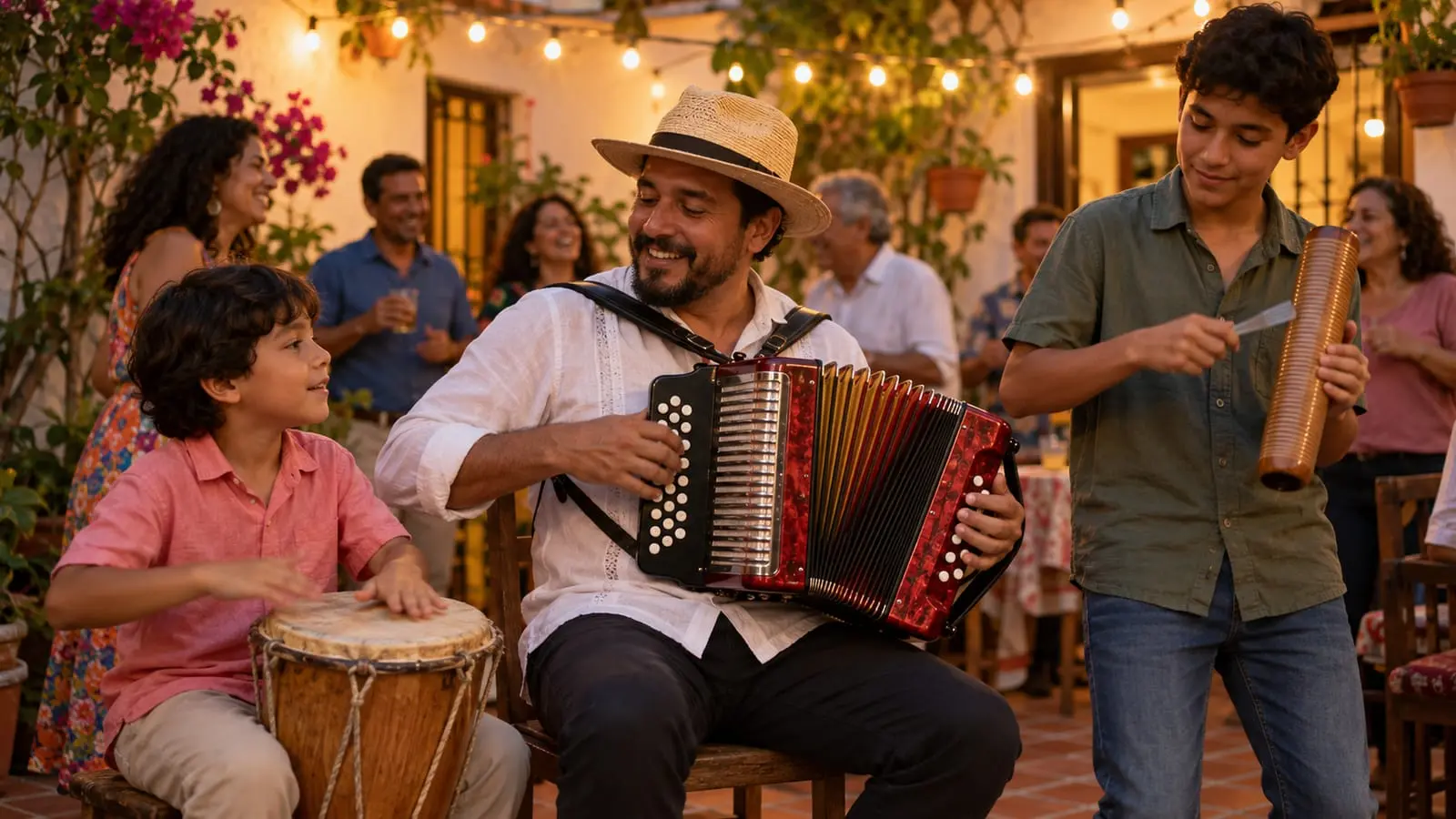
The three traditional vallenato instruments are the diatonic accordion, the vallenato caja, and the guacharaca. They’re often described as bringing together three roots: the accordion came from Europe, the caja evokes African heritage, and the guacharaca is associated with Indigenous scrapers. Today, vallenato ensembles often add electric bass, congas, guitar, and backing vocals, especially in recordings and live performances.
Here, we look at what each instrument does, how a modern ensemble comes together, what the four styles are (paseo, son, merengue, and puya), and how vallenato differs from cumbia. To place it on the country’s musical map, explore Colombia’s traditional instruments by region. And if you feel like playing, below we explain where to start with percussion lessons in Bogotá or online.
In short
- The traditional vallenato trio consists of diatonic accordion, caja vallenata, and guacharaca.
- The accordion carries the melody and harmony; the caja and guacharaca carry the pulse and rhythmic character.
- The modern ensemble adds electric bass, congas, guitar, and backing vocals to that trio.
- The four styles are paseo, son, merengue, and puya; paseo and son are in duple meter, while merengue and puya are in triple meter.
- In 2015, UNESCO added the traditional vallenato music of Magdalena Grande to its urgent safeguarding list.
The three traditional instruments
Vallenato was born in Colombia’s Caribbean region, around Valledupar (Cesar) and extending through La Guajira and Magdalena. Its traditional format is a trio, and each instrument has a clear role:
| Instrument | What it is | What it does in the group | Associated cultural root |
|---|---|---|---|
| Accordion | Diatonic button accordion with bellows | Melody with the right hand; bass and accompaniment with the left | European |
| Caja vallenata | Small drum played with the hands | Marks the pulse and accents of the style | African |
| Guacharaca | Cane or metal scraper rubbed with a trinche | Subdivides the pulse with a continuous, dry sound | Indigenous |
The singer is usually the accordion player or a vocalist performing alongside them. That’s why vallenato is understood as music of song and storytelling: the voice tells the story, and the trio supports it.
A closer look at each instrument
The accordion
It’s a diatonic button accordion: not all chromatic notes are available, and each button produces a different note when the bellows open and close. The right hand plays melodies and ornamentation; the left plays bass notes and chords. It’s said to have arrived on the Caribbean coast through the ports in the 19th century, and local culture adopted and transformed it until it became a symbol of the genre.
The caja vallenata
It’s a small drum played with the hands. It maintains the style’s pulse and accents, and its character changes the most between a paseo and a puya. A good caja player doesn’t just “keep time”: they drive and support the accordion and singer.
The guacharaca
It’s a scraper: a grooved cane or metal tube rubbed with a trinche, a kind of pronged comb. It subdivides the pulse with a continuous, dry, bright sound that fills the space between caja strokes. It looks simple, but keeping the subdivision in time takes control and stamina.
The modern vallenato ensemble
In today’s vallenato, the trio expands. Here’s what you’ll usually hear in a recording or live:
| Instrument | Role | Related lessons |
|---|---|---|
| Electric bass | Chord roots and rhythmic drive; reinforces what the accordion’s bass side used to do | Electric bass lessons |
| Congas | Tone color and groove that complement the caja | Percussion lessons |
| Guitar | Harmony and rhythm on acoustic or electric guitar | Acoustic guitar lessons |
| Lead and backing vocals | Storytelling melody, harmonies, and responses | Singing lessons |
| Keyboards and other instruments | Additional tone colors depending on the group | Depends on the project |
Instrumentation varies between groups, and many artists keep the traditional trio format for part of their repertoire. Understanding the bass’s role in this context helps you decide whether to learn guitar or bass.
The four vallenato styles
Vallenato isn’t a single rhythm: it includes four styles. Each has its own speed and character, with the biggest changes in what the caja and guacharaca play:
| Style | Character | Meter feel | How it feels |
|---|---|---|---|
| Paseo | Moderate; the most common in songs | Duple | Lilting and narrative, ideal for telling a story |
| Son | Slow and lilting | Duple | Relaxed, with space between the accents |
| Merengue | Lively and bouncy | Ternary; usually written in 6/8 | Livelier, with a three-part lilt |
| Puya | Very fast and virtuosic | Triple meter | Fast and demanding for accordion and percussion |
Paseo has no fixed tempo: according to the Plan Especial de Salvaguardia for vallenato music, it covers a very wide range. To practice with a click, use the vallenato metronome and set the tempo to the song you’re listening to. You’ll notice that each style has its own feel, as is true of Colombian rhythms in general.
Difference between cumbia and vallenato
Both come from Colombia’s Caribbean region and are danced at celebrations across Colombia, but they sound different and are structured differently:
| Aspect | Cumbia | Vallenato |
|---|---|---|
| Place of origin | Colombian Caribbean, in ensembles of gaitas, drums, and millo | Valledupar and the region of Cesar, La Guajira, and Magdalena |
| Traditional instruments | Tambor alegre, llamador, tambora, maracas, guache, and gaitas or caña de millo | Accordion, caja vallenata and guacharaca |
| Time signature | Duple | Four styles: paseo and son in duple meter; merengue and puya in triple meter |
| Leading role | Percussion and flutes weave the musical texture | The accordion and voice carry the melody and story |
| Character | Lilting, for circle dancing | Song and storytelling; danced in pairs |
To explore the rhythmic side in more depth, see our guide to instruments of Colombia’s Caribbean music, covering cumbia, porro, and wind bands.
Heritage and festivals: why vallenato matters
In 2015, UNESCO added traditional vallenato music of the Magdalena Grande region to the List of Intangible Cultural Heritage in Need of Urgent Safeguarding. The inscription recognizes this tradition’s value and the need to protect its transmission, especially among younger generations.
Another major reference point is the Festival de la Leyenda Vallenata, held in Valledupar since 1968, which brings together accordion, caja, and guacharaca players for competitions and tributes. If you want to attend or learn about the categories, check dates and current information at the festival’s official source.
How to get into vallenato as a musician
Vallenato accordion is a highly specialized path usually learned from teachers rooted in the tradition, and it isn’t something we offer. But vallenato has many entry points for anyone who wants to play in an ensemble:
- Percussion: caja, guacharaca, and congas. In percussion lessons, you work on the pulse, subdivisions, and accents of each style. This guide to drums or Latin percussion is also useful.
- Electric bass: learn to sustain the root note and the rhythmic drive of each style. Start with electric bass lessons.
- Guitar: accompany songs with chords and strumming patterns. We have a complete guide to playing vallenato on guitar.
- Singing: singing vallenato takes diction, storytelling, and accurate pitch in a middle register; explore our singing lessons.
In every case, listening a lot and playing along with recordings is the best school. A good teacher helps you work out what each instrument does and turn that listening into daily practice.
Learn these instruments with a teacher
At A medio tono, you can take percussion, electric bass, guitar, and singing lessons at home in Bogotá and surrounding areas (depending on each teacher’s availability) or by video call from any city. You can ask your teacher to work with vallenato songs you like, adapted to your level.
Explore in-home music lessons in Bogotá or online music lessons, and message us on WhatsApp to tell us which instrument you’d like to play.
Frequently asked questions
What are vallenato's three instruments?
The diatonic accordion, caja vallenata, and guacharaca. The accordion carries the melody and harmony, the caja marks the pulse and accents, and the guacharaca subdivides with its scraping sound.
What instruments are used in modern vallenato?
Alongside the traditional trio, you’ll commonly hear electric bass, congas, guitar, and backing vocals. Instrumentation varies by group and recording.
What are the styles of vallenato?
Four: paseo, son, merengue, and puya. Paseo is the most common in songs, son is more relaxed, merengue and puya are in triple meter, and puya is very fast.
What’s the difference between cumbia and vallenato?
Cumbia is associated with the gaita and drum ensembles of the Caribbean and is played with drums and gaitas or caña de millo. Vallenato comes from the Valledupar region, is played with accordion, caja drum, and guacharaca, and encompasses four styles, two of them in triple meter.
Which vallenato instrument can I learn at A medio tono?
You can study percussion, electric bass, acoustic guitar, and singing, all useful in a vallenato ensemble. We don’t offer accordion lessons.
Sources
We checked the facts in this article against these sources on October 22, 2026.