Parts of the guitar and what each one does
A clear guide to guitar parts and their functions: acoustic, classical, and electric, with a table of what to check when buying and a version for kids.
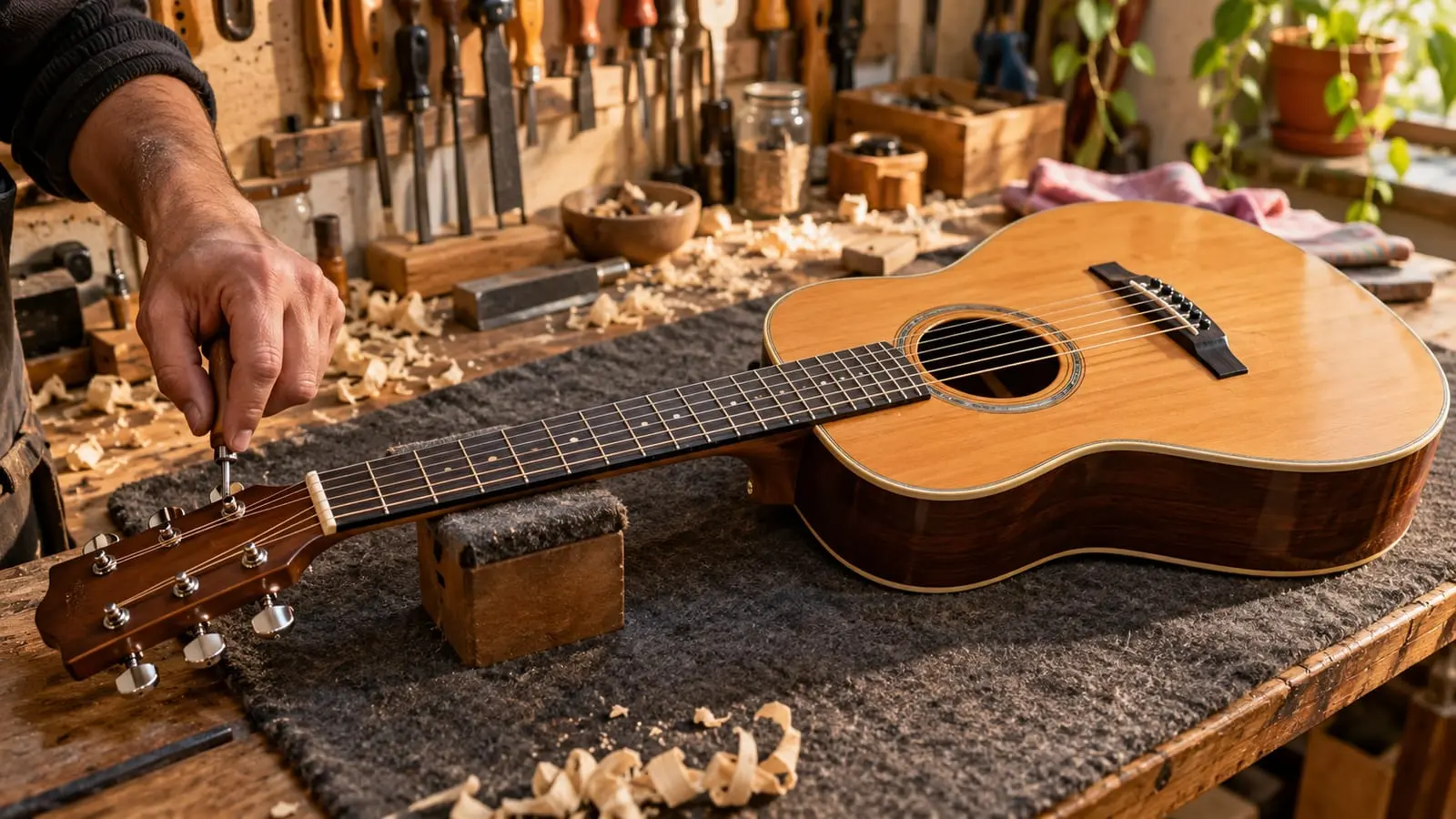
The guitar has three main areas: the head (headstock and tuning pegs, where the strings are tightened), the neck (nut, fretboard, and frets, where you press the strings to play notes), and the body (top, sound hole, bridge, and back, which amplify the sound; on an electric guitar, the pickups and amplifier do that). Knowing each part helps you tune, make an informed purchase, and understand what your teacher says in class.
This guide explains each part, what it does, and what to look for when buying or inspecting a guitar. If you're just starting and want someone to guide you with your instrument in hand, you can take guitar lessons at home in Bogotá or online, as well as electric guitar lessons.
In short
- The guitar is divided into the head (headstock and tuning pegs), neck (nut, fretboard, and frets), and body (top, sound hole, bridge, sides, and back).
- The tuning pegs tighten the strings and set their pitch; the nut and saddle define the two ends of each string's vibrating length.
- On an acoustic guitar, sound starts with the string and is amplified by the body; on an electric guitar, pickups capture it and external equipment amplifies it.
- Classical guitars use nylon strings and have wider necks; steel-string acoustic guitars use steel strings and usually have an adjustable truss rod.
- The most useful things to check when buying are string height, fret condition, and whether the neck is straight.
Acoustic and classical guitar parts in a table
This table walks through the guitar from top to bottom. It applies to both nylon-string classical guitars and steel-string acoustic guitars; we'll look at their differences below.
| Part | Where it is | What it does | What to check when buying |
|---|---|---|---|
| Headstock (head) | Top end of the guitar | Holds the tuning pegs and anchors the ends of the strings. | Check for cracks or repairs at the joint where it meets the neck. |
| Tuning pegs (machine heads or tuners) | On the headstock | Tighten or loosen each string to tune it. | Check that they turn smoothly without slipping and hold their tuning. |
| Nut | Piece at the end of the neck, just before the headstock | Marks the start of each string's vibrating length and keeps the strings spaced apart. | Check that the strings aren't too high over the first few frets; that's where the basic chords are played. |
| Neck | Long section extending from the body | Holds the fretboard and withstands string tension. | Check that it looks straight from the side, with no twisting. |
| Fretboard (fingerboard) | Top surface of the neck | The surface where you press down the strings. | Check that it's smooth, with no splinters or heavily worn areas. |
| Frets | Small metal bars across the fretboard | Each fret defines a note; the distance from one fret to the next is a semitone. | Check for buzzing, ends that stick out, or deep grooves. |
| Truss rod (neck rod) | Inside the neck, accessible through the sound hole or headstock | Counteracts string tension and lets you adjust the neck's curvature. | Have your teacher or a luthier confirm that it hasn't reached the limit of its adjustment. |
| Frog | Where the neck meets the body | Joins the two pieces. | Check for gaps or cracks. |
| Top (soundboard) | Front face of the body | Vibrates with the strings and projects the sound. | Check for warping, cracks, or loose joints. See “solid or laminated top” in the first guitar guide. |
| Sound hole (opening) | Round opening in the top | Lets air and sound out of the body. | Check that the edge isn't splintered. |
| Bridge | On the top, below the sound hole | Anchors the strings and transfers their vibration to the top. | Check that it's securely glued, with no lifting at the edges. |
| Saddle (bridge saddle) | Piece on top of the bridge | Defines the other end of the strings' vibrating length. | Check that it's secure and at a reasonable height. |
| Sides (ribs) | Sides of the body | Give the soundbox its shape and depth. | Check for cracks. |
| Back | Rear face of the body | Closes the body and reflects sound. | Check that it doesn't rattle or buzz when tapped and has no cracks. |
| Strings | From headstock to bridge | Produce sound by vibrating. | Check that they're new or in good condition; replacing them is inexpensive compared with other repairs. |
To check string height and other practical details, see how to choose your first acoustic guitar. There we explain “action” with reference measurements.
How the parts work together to produce sound
When you pluck a string, it vibrates between the nut and saddle. That vibration travels through the bridge to the top, which moves like a membrane and makes the air inside the body vibrate; sound comes out through the sound hole and also radiates from the rest of the body. That's why a guitar made with better wood or better craftsmanship sounds fuller: the top responds better.
Notes change when you shorten the string's vibrating length. When you press a string down behind a fret, the fret acts as a temporary nut. Each fret is a semitone higher than the last, and at fret 12 the string sounds an octave above the open string. That's why the neck has markers (dots) at certain frets, usually 3, 5, 7, 9, and 12: they help you find your way around.
Strings: names, numbers, and tuning
Strings are numbered from the thinnest and highest-pitched (the 1st) to the thickest and lowest-pitched (the 6th). In standard tuning, they are E (1st, high), B, G, D, A, and E (6th, low). To tune them, use our guide to how to tune a guitar and the online guitar tuner.
Classical or acoustic guitar: how their parts differ
Both are “acoustic” because they produce sound without amplification, but they're built differently. Those differences determine how they feel to play:
| Part | Classical guitar (nylon) | Acoustic guitar (steel) |
|---|---|---|
| Strings | Nylon; the three bass strings have metal winding. | Steel; more tension and brightness. |
| Neck | Wider, around 52 mm at the nut, and generally without an adjustable truss rod. | Narrower, around 43 to 45 mm, with an adjustable truss rod. |
| Tuning machines | Slotted (with openings); strings wind around posts parallel to the headstock. | Solid, with posts perpendicular to the headstock. |
| Bridge | Strings are tied to the bridge. | Strings are held in the bridge with bridge pins (small pegs). |
| Body | Lighter, with a more delicate top. | Sturdier, sometimes with a pickguard (a plastic piece below the sound hole). |
| Feel | Gentle on fingertips, with a warm sound. | Requires more left-hand strength, with a brighter sound. |
For a child who's starting out, nylon is usually gentler on fingertips, as we explain in guitar for kids. Changing strings involves different steps for each type, covered in how to change guitar strings. And if you're deciding between guitar and another Colombian string instrument, see guitar or tiple.
Parts of the electric guitar
Electric guitars share the headstock, neck, fretboard, frets, and nut with acoustic guitars. The body is different: it's solid (or semi-hollow) and doesn't amplify sound on its own. The strings vibrate above magnets, and that movement is converted into an electrical signal.
| Part | What it does | What to check |
|---|---|---|
| Pickups | Capture string vibrations and convert them into an electrical signal. They come in single-coil versions (clearer sound) and humbuckers (thicker sound with less noise). | Check that every string sounds at an even volume, with no unusual buzzing. |
| Pickup selector | Lever or switch for choosing which pickup or combination is active. | Check that it doesn't make noise or cut out when moved. |
| Potentiometers (knobs) | Control volume and tone (usually one or two of each). | Check that they turn without crackling or sudden volume changes. |
| Fixed or tremolo bridge | Holds the strings and lets you adjust their height; a tremolo has a bar for raising or lowering the pitch slightly. | Check that the tremolo returns to pitch; fixed bridges are more stable and simpler for beginners. |
| Jack (output) | Socket where the cable to the amplifier plugs in. | Check that the cable fits snugly and the sound doesn't cut in and out. |
| Strap buttons | Points where the strap attaches. | Check that they're securely fastened. |
An electric guitar also needs an amplifier and a cable. To decide which guitar to buy first, see how to choose your first electric guitar and acoustic or electric guitar: which to learn first. For care tips, see how to clean and care for an electric guitar.
Guitar parts for kids: the simple version
For a young child, technical names can wait. These comparisons help them understand the teacher's instructions and care for their instrument:
| Part | How we explain it | What it does |
|---|---|---|
| Head and tuning pegs | The head and little keys | The little keys turn to make the strings sound in tune. |
| Neck | The arm | This is where they put the fingers of their left hand (or right hand if they're left-handed). |
| Frets | The little metal lines | Each little line changes the note. |
| Strings | The threads that make sound | They make sound when plucked; there are six. |
| Sound hole | The round hole | That's where the sound comes out. |
| Body | The belly | It's the box that makes the sound bigger. |
| Bridge | The string holder | Holds the strings at the bottom. |
Instrument size matters for kids, too; we explain it in the section on 1/2, 3/4, and 4/4 sizes in our first acoustic guitar guide.
Learning guitar parts with a teacher
Knowing the names isn't a vocabulary test: it lets you understand advice like “raise the saddle,” “press just behind the fret,” or “loosen the 5th-string tuning peg a little.” A guitar teacher usually goes over the parts in the first few lessons, showing them on your own instrument.
- They teach you to tune with the tuning pegs without overtightening the strings.
- They tell you if your guitar has a string height or fret problem that's making it harder to get a clear sound.
- They show you where to place your fingers in relation to the frets and how to use the neck markers to find your way around.
- If it's electric, they help you understand the knobs, selector, and how to connect the amplifier.
- They guide you when buying a guitar or checking a used one.
At A medio tono, guitar lessons are available at home in Bogotá and surrounding areas, depending on each teacher's availability, and online from anywhere, with the teacher checking your instrument on camera. If your guitar has a serious neck or top problem, the teacher will point it out and suggest taking it to a luthier.
Frequently asked questions
What are the main parts of a guitar?
The main parts are the head (headstock and tuning pegs), neck (nut, fretboard, and frets), and body (top, sound hole, bridge, sides, and back). There are also six strings. Electric guitars add pickups, a selector, potentiometers, and an output jack.
What does a guitar's truss rod do?
It is a rod inside the neck that counteracts string tension and lets you adjust the neck’s curvature. Steel-string acoustic and electric guitars usually have one; classical guitars, which bear less tension, generally do not. Adjusting it is delicate work, so consult your teacher or a luthier.
What's the difference between the nut and the saddle?
These two pieces define the ends of the string's vibrating length. The nut is at the end of the neck beside the headstock, and the saddle sits on the bridge, on the body. Both affect string height.
How many frets does a guitar have?
It depends on the model. A classical or acoustic guitar usually has between 18 and 20, while an electric guitar may have 21 or more. The first few frets are enough to get started.
Which electric guitar parts aren't found on an acoustic guitar?
Pickups, a pickup selector, volume and tone potentiometers, an output jack, and, on some models, a tremolo. It also needs an amplifier and a cable to play at volume.
Sources
We checked the facts in this article against these sources on October 22, 2026.