Music lessons in English in Bogotá
Which instruments you can study in English in Bogotá with A medio tono, which teachers offer it, what's available for piano and singing, and how lessons in Spanish work for someone learning the language.
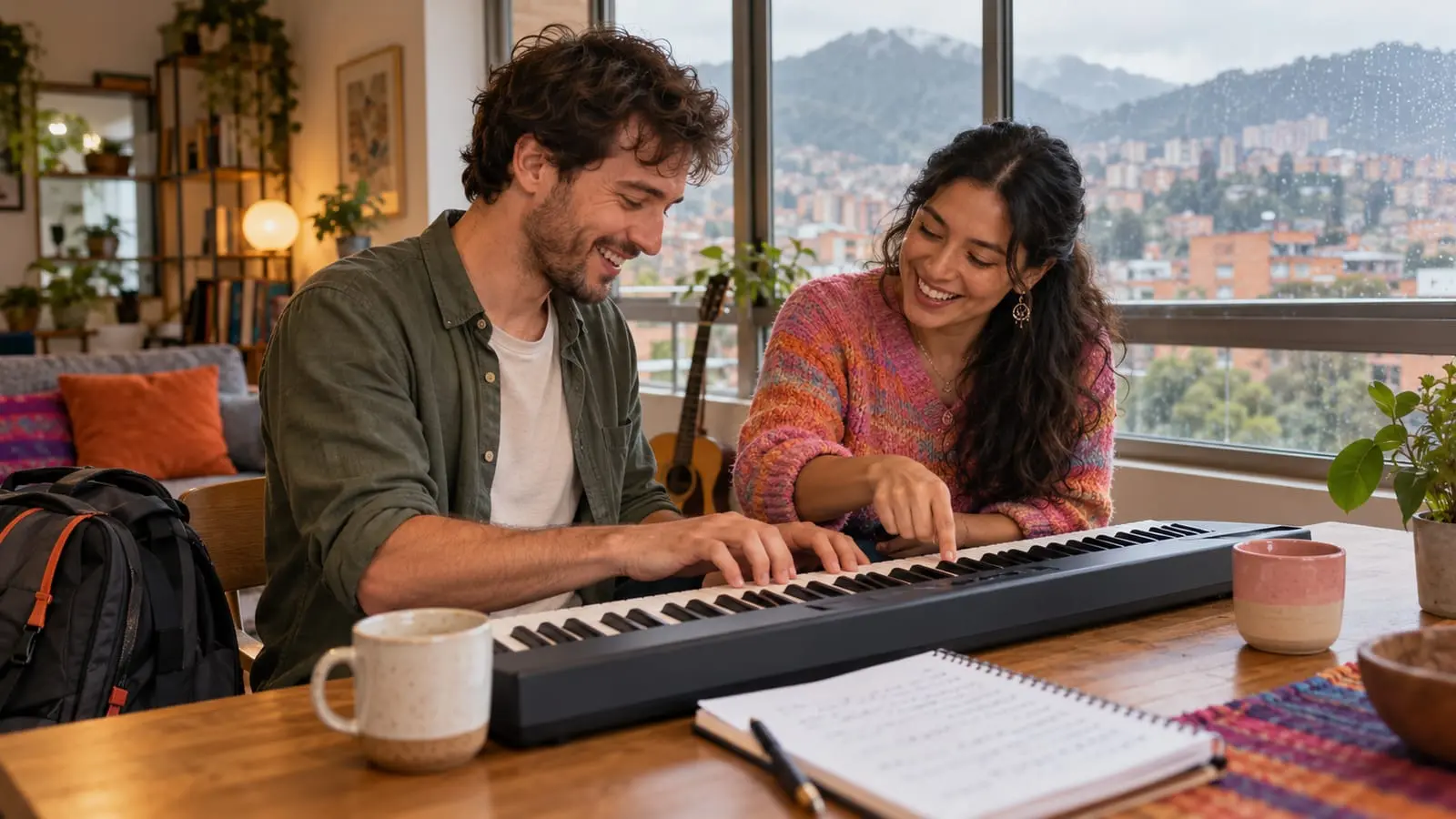
Yes, you can study music in English in Bogotá. At A medio tono, three teachers currently teach in English: Leila Fernández (violin and early childhood music), Sergio Ramírez (acoustic guitar and tiple), and Mateo Mancipe (double bass and music theory). You can take in-home music lessons in Bogotá or online lessons by video call, including from another city or country.
An honest clarification so you don't waste your time: none of our piano or singing teachers currently teach in English. Below, we explain your options if that's your instrument and how lessons in Spanish can work for someone just starting to learn the language. This guide is for international families, families with children in bilingual schools, and adults living in Colombia.
In short
- You can take lessons in English in violin, early childhood music, acoustic guitar, tiple, double bass, and music theory, with three different teachers.
- There are currently no piano or singing teachers who teach in English; those lessons are in Spanish.
- Lessons can take place at home in Bogotá and the surrounding area, depending on each teacher's availability, or online from anywhere.
- Many musical terms are almost the same in both languages, and for a beginner, lessons in Spanish can be good language practice.
- Before you start, tell your teacher your level of Spanish and music experience, and agree on which parts of the lesson will be in each language.
Summary in English
The rest of this article is in Spanish because most people who find it are looking for information in that language, such as families with children in bilingual schools who want to know what we offer. If your Spanish is basic, the summary above covers the essentials.
Teachers who teach in English
Each teacher's profile lists the languages they teach in. These three list Spanish and English, with online and in-home lessons in Bogotá:
| Teacher | Instruments and subjects | Formats | Languages |
|---|---|---|---|
| Leila Fernández | Violin and early childhood music | At home and online | Spanish and English |
| Sergio Ramírez | Acoustic guitar and tiple | At home and online | Spanish and English |
| Mateo Mancipe | Double bass and music theory | At home and online | Spanish and English |
Leila: violin and early childhood music
Leila describes herself as a teacher who believes we learn through movement, laughter, and enjoyment. If you're looking for violin lessons in English or a first music lesson for a young child, she's the one to choose. To learn what to expect with children, read violin for kids: a parent's guide and what is early childhood music?.
Sergio: acoustic guitar and tiple
Sergio introduces himself as a teacher with fun facts and even more unusual examples. Acoustic guitar is the most common starting point for adults and teens; the tiple is Colombia's quintessential instrument, a great way to connect with the country's music if you live here. If you're deciding between guitar and piano, see piano or guitar: which should you choose as your first instrument?.
Mateo: double bass and music theory
Mateo is a double bassist and theory teacher. According to his introduction, his specialty is explaining harmony with absurd examples and reminding you that mistakes can sound musical too. He's the choice for anyone who plays or wants to play double bass, and for anyone who wants to understand the theory behind any instrument in English: reading music, scales, and chords. What is a half step in music? gives you an example of how these concepts are explained.
What if you want piano or singing lessons?
It's the most common question from people searching for “piano lessons near me” in Bogotá, and here's the current answer: our piano and singing teachers teach in Spanish. We want to be clear so you don't waste your time.
You have three reasonable options:
- Start with lessons in Spanish. For a beginner, this works better than you might think (we explain below).
- Choose an instrument with a teacher who teaches in English. If you want to learn music in general and aren't set on piano, you can choose guitar, violin, or double bass.
- Study theory in English with Mateo and take piano lessons with a piano teacher in Spanish. That way, you can make sure you understand the concepts in your own language.
If teacher availability changes, you'll see it in the teacher directory, where each profile lists the languages they teach in.
Lessons in Spanish can work for a beginner
Music has a shared language: sheet music, notes, rhythm, and the teacher's demonstrations are the same in any language. Much of an instrument lesson doesn't rely on words: the teacher plays, you imitate; the teacher points something out, you adjust.
- Very similar vocabulary. Piano, violin, guitar, note, scale, rhythm, tempo, chord, melody, harmony, forte, and piano are very similar in English and Spanish.
- Repeated instructions. Just a few words, always the same: “softer,” “again,” “slower.” You learn them in two or three lessons.
- Good language practice. If you're learning Spanish, talking about something concrete and enjoyable with a patient adult helps more than textbook vocabulary.
- Visual support. Your teacher can demonstrate on the instrument, write on the sheet music, or share their screen during an online lesson.
There are limits, though: if you need someone to explain abstract concepts in English (harmony or a difficult technique), or if the student is a child who doesn't speak Spanish yet, it's best to choose one of the three teachers above. And if you're taking piano or singing lessons, tell your teacher your level of Spanish before the first lesson so they can take it into account.
| Your situation | The most practical choice |
|---|---|
| Young child who only speaks English | Violin or early childhood music with Leila, in English |
| Teen at a bilingual school who wants to play guitar | Acoustic guitar with Sergio, in English or a mix of both languages |
| Adult learning Spanish who wants piano lessons | Piano lessons in Spanish, with basic vocabulary agreed on from the first lesson |
| Someone who needs to understand theory for an exam or audition | Music theory with Mateo, in English |
How to arrange lessons in English or bilingual lessons
When you write to us on WhatsApp, tell us three things: the instrument you want, the student's age, and how much Spanish they speak. That helps us connect you with the right person. Then, in your first conversation with the teacher, it's worth agreeing on:
- Which language the lesson will be in: all English, all Spanish, or a mix. Many students start in English and gradually add words in Spanish.
- How to handle vocabulary. Some teachers make a list of terms in both languages (for example, “bar” and “compás,” “sharp” and “sostenido,” “flat” and “bemol”).
- What kind of music you want to play: international repertoire, Colombian music, school songs, or songs you listen to at home.
- The format: at home in Bogotá and the surrounding area, depending on each teacher's availability, or online.
If you've never had lessons at home, what to expect from in-home music lessons explains the space you need, punctuality, and the family's role.
At home in Bogotá or by video call
All three teachers offer both formats. The difference is in your circumstances, not the quality:
| At home in Bogotá | Online | |
|---|---|---|
| Ideal for | Young children and first instrument lessons | Anyone who travels, lives outside Bogotá, or prefers not to spend time commuting |
| Advantage | The teacher sees your posture and instrument up close | Works from any city or country, with more flexible scheduling |
| You need | A quiet space at home | Good internet and a device with a camera and clear audio |
If your family spends half the year in Bogotá and the other half in another country, online lessons let you keep the same teacher. Find details about this format in online music lessons.
How a teacher supports you through this process
Every A medio tono teacher is evaluated on musicianship, teaching skills, and personal qualities before their first lesson. For a student switching languages, schools, or countries, that third part matters: someone patient who doesn't make you feel bad for not finding a word.
- Your teacher adjusts the pace of the lesson to your Spanish level and music experience.
- They can combine both languages: instructions in English, musical vocabulary in Spanish, or the other way around.
- They choose repertoire you enjoy and can use where you live, such as songs for school or Colombian music if you'd like to explore it.
- They share updates on practice at home so the adult supporting the child knows what to repeat.
For help choosing the right teacher, see how to choose a music teacher. When you're ready, use the button on this page to write to us on WhatsApp and tell us which instrument interests you.
Frequently asked questions
Does A medio tono offer piano lessons in English in Bogotá?
Not currently. Our piano teachers teach in Spanish. If you're a beginner, lessons in Spanish can work with agreed-upon basic vocabulary. If you need English to understand theory, you can combine piano lessons with music theory with Mateo Mancipe, who teaches in English.
Which instruments can I study in English?
Violin and early childhood music with Leila Fernández, acoustic guitar and tiple with Sergio Ramírez, and double bass and music theory with Mateo Mancipe. All three also teach in Spanish.
Are lessons in English in person or online?
Both. You can take them at home in Bogotá and the surrounding area, depending on each teacher's availability, or by video call from anywhere.
My child attends a bilingual school. Can they learn music in English?
Yes, for violin, early childhood music, acoustic guitar, tiple, double bass, or music theory. For other instruments, lessons are in Spanish, and many bilingual children quickly pick up the musical vocabulary.
I don't speak Spanish. Can I still start?
Yes, with the three teachers who teach in English. Write to us on WhatsApp with your instrument and Spanish level, and we'll connect you with the right teacher.
Sources
We checked the facts in this article against these sources on October 22, 2026.