How to Prepare for a Youth Orchestra Audition
Scales, a prepared piece, sight-reading, and sometimes an interview: common youth orchestra requirements, an 8-week plan, and what the panel listens for.
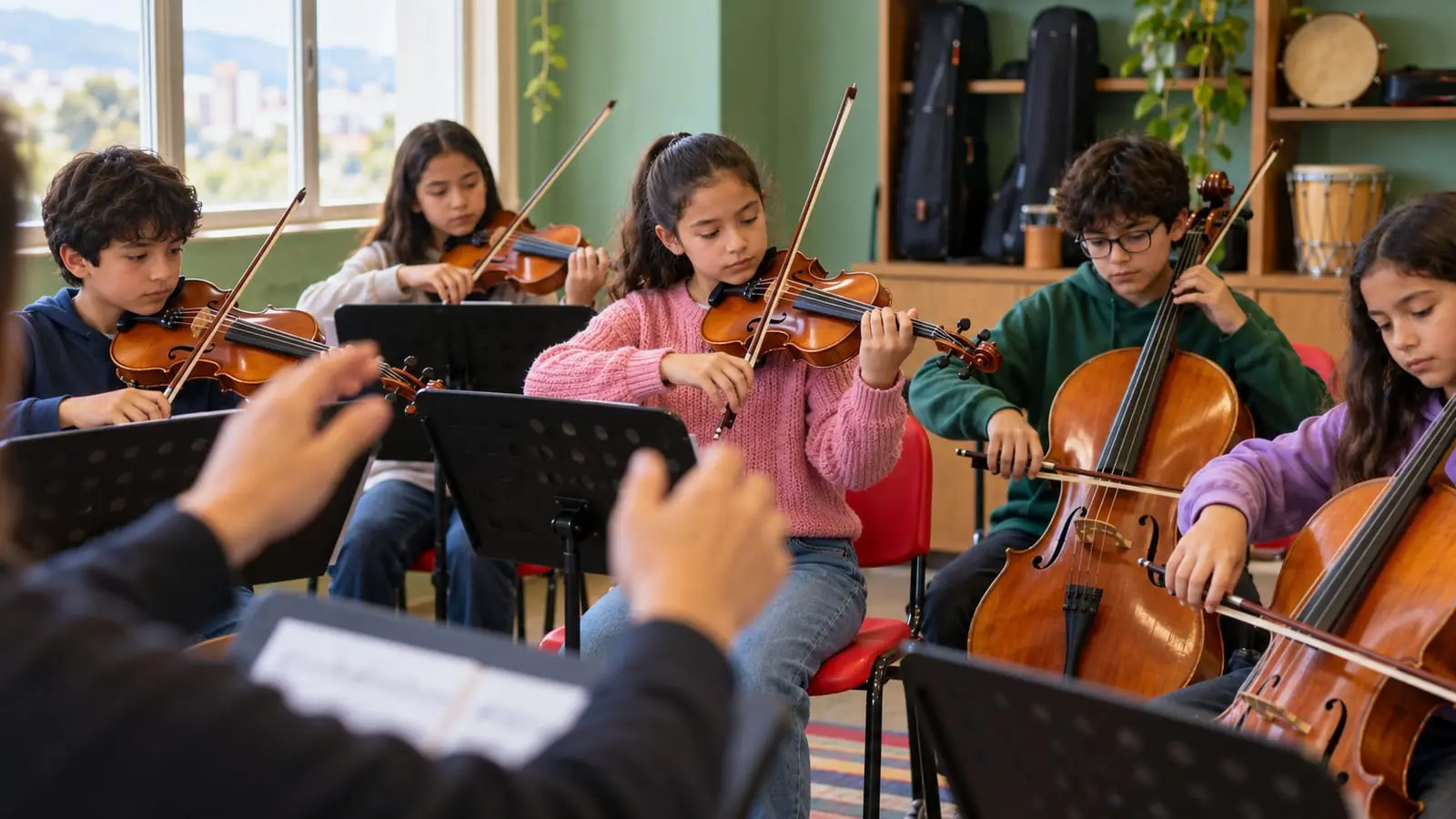
For a youth orchestra audition, prepare what most ask for: scales and arpeggios, a piece or excerpt you know well, sight-reading, and sometimes a short interview. What really impresses the panel is a clean tone, secure intonation, a steady beat, and a sense that you can play with others, rather than the hardest piece. Eight weeks of organized practice can get you ready.
Each audition announcement lists its own requirements, so start by reading them carefully from beginning to end. This general guide covers strings and winds: it explains what is assessed, how to organize your weeks, what to do on audition day, and how a teacher can help. If you already play an orchestral instrument and would like guidance, you can start with in-home violin lessons in Bogotá or online lessons, or lessons on your own instrument.
In short
- Read the official audition announcement first: each orchestra sets its pieces, scales, age limits, and dates. Don't take anything for granted.
- Scales, a prepared piece or excerpt, and sight-reading are almost always assessed; sometimes there is an interview.
- The panel listens to tone, intonation, rhythm, reading, and your approach to teamwork; difficulty alone earns no points.
- Choose repertoire you can play comfortably: a well-played intermediate piece is worth more than a difficult one you struggle with.
- Eight weeks is enough for a solid plan: technical foundations, your piece, reading, mock auditions, and final adjustments.
What youth orchestra auditions usually require
Colombia has many kinds of youth orchestras: programs such as Filarmónica Joven de Colombia, city and locality orchestras, ensembles in Fundación Nacional Batuta programs, and school and university orchestras. Each has its own levels and rules, and age, skill, repertoire, and date requirements change with each audition cycle. Always check the orchestra's official source for current information.
Even so, the auditions have a lot in common:
| Part | What it is | What the panel assesses |
|---|---|---|
| Scales and arpeggios | Selected keys, sometimes from memory, at a specified tempo | Intonation, consistency, basic technique, tone |
| Prepared piece or movement | A piece from the solo repertoire, sometimes with piano accompaniment | Musicality, technical control, style, confidence |
| Orchestral excerpts | Passages from symphonic repertoire published in advance in the audition announcement | Steady beat, precision, character, and how your part sounds within an orchestra |
| Sight-reading | A melody you see for the first time, with a few seconds to look it over | Reading rhythms and notes, ability to keep going |
| Interview | A brief conversation in some audition processes | Motivation, discipline, previous experience, and availability |
Not every audition includes all of these elements. Highlight the requirements in your announcement and build your plan around them. If you are also considering a university degree, the structure is similar to the music entrance exam.
What the panel really listens for
Youth orchestra evaluators are looking for more than soloists: they want musicians who can join a section and contribute. That changes the priorities.
- Tone. A clear, controlled sound, without strain, throughout your range.
- Intonation. The most noticeable issue and the hardest to hide. Tune before going in and make corrections calmly.
- Rhythm and beat. Avoid speeding up in easy passages or slowing down in difficult ones.
- Reading. How quickly you understand unfamiliar music and whether you recover from a mistake.
- Attitude. How you greet people, respond, and behave when something goes wrong. An orchestra works as a team, and it shows.
How to choose and prepare your repertoire
If the announcement provides a list of pieces or excerpts, your job is to master them. If the choice is open, work with your teacher to choose a piece that shows your tone and musicality without pushing your technique to its limit.
| Family | Typical solo piece | What to focus on |
|---|---|---|
| Violin, viola | An intermediate concerto movement or a character piece, with a supporting étude | Intonation when shifting positions, even bowing, rhythm in fast passages |
| Cello, double bass | An intermediate sonata or movement | Intonation in the high register, clean string crossings, an unforced tone |
| Flute, clarinet | A sonata or concerto movement, or a competition piece at your level | Breathing, clean articulation, intonation across registers |
| Trumpet | A concerto movement or an intermediate piece | Embouchure, endurance, clean attacks, intonation in the high register |
For orchestral excerpts, the rule is simple: play them as if you were in the orchestra. That means a steady beat, clear dynamics, and clean playing rather than showing off. Listen to the passage within the complete work so you understand what your instrument does in the ensemble; playing an accompanying line is different from carrying the melody.
Scales and arpeggios
They may seem basic, but they are the first thing the panel hears. Practice them with a tuner and metronome, at two or more tempos and with different rhythms. If you need a theory refresher, see major and minor scales explained and practice with pages such as G major, D major, or A harmonic minor. For strings, use the violin tuner or your instrument's tuner before each session.
Sight-reading: the most underpracticed part of the audition
People rehearse their piece endlessly and barely practice reading, so it is often their weakest area. It takes consistent work, not one day of intense practice.
- Look before you play. Check the key signature, time signature, dynamics, and any passages that look challenging.
- Count a measure before starting and begin confidently.
- Don't stop. If you miss a note, keep going; maintaining the beat matters more than correcting it.
- Read in groups, not note by note: look for motifs, intervals, and rhythmic patterns.
- Practice every day with unfamiliar passages slightly easier than your repertoire.
For a method to train rhythm and melody, see rhythmic and melodic reading for the entrance exam. For ear training, see how to train your musical ear and the site's ear training tool.
An 8-week preparation plan
With 30 to 60 minutes a day, depending on your level and age, this sequence works well. If the audition timeline is shorter, condense the early weeks and keep the final weeks for mock auditions.
| Week | What to do | What should be clear |
|---|---|---|
| 1 | Read the announcement, list requirements, choose repertoire with your teacher, and record a baseline performance | What is required and where you stand today |
| 2 | Slow scales and arpeggios with a tuner; read through the whole piece slowly | Notes, fingerings, bowings, or breathing points established |
| 3 | Work on the piece in sections; review orchestral excerpts; start daily sight-reading | Solutions are in place for difficult passages |
| 4 | Gradually increase the tempo with a metronome; refine tone and intonation | Play the entire piece at a moderate tempo |
| 5 | Play the whole piece without stopping; record and listen back; work on dynamics and phrasing | Musicality: more than correct notes |
| 6 | First mock audition for family or friends; rehearse walking in, greeting the panel, and tuning | How you feel in front of an audience |
| 7 | Second mock audition with the full program in order, in a different space; practice interview | Endurance and managing nerves |
| 8 | Light review, rest, prepare your materials and logistics; don't change fingerings or bowings | Arrive calm, not exhausted |
For a steady approach to repertoire practice, how to practice music at home and how to use a metronome to practice offer a method. If you are required to play from memory, see how to memorize a piece of music; otherwise, playing from the score is perfectly acceptable.
On audition day
Audition day matters a lot, but you can prepare for it. These tips help you arrive calm:
- Bring everything you need. Your instrument, scores (and copies for the panel, if requested), music stand, tuner, spare strings, reeds or valve grease, water, and ID.
- Arrive early so you can warm up without rushing and get familiar with the space.
- Warm up with your usual routine, not the entire piece; save your energy.
- Tune when you enter and take a moment before starting.
- If you make a mistake, keep going. The panel pays more attention to how you recover than to a single error.
- Greet the panel and say goodbye politely. It is part of the audition.
Nerves are normal, and you can learn to manage them. Find practical techniques in how to overcome stage fright and a rehearsal schedule in how to prepare for your first recital. If there is an interview, practice simple answers with help from the music admissions interview.
How a teacher helps you prepare
A teacher helps with the things that are hardest to do alone: choosing the right repertoire, listening to your intonation with a fresh ear, organizing mock auditions, and providing new sight-reading material each week. Teachers also know the style of orchestra auditions and can rehearse your entrance and interview with you.
At A medio tono, we have teachers for violin, viola, cello, double bass, flute, trumpet, and clarinet. You can take in-home music lessons in Bogotá, depending on each teacher's availability, or online music lessons if you live in another city. If you are looking for your next step after the audition, see where to study music in Bogotá.
Frequently asked questions
What is required at a youth orchestra audition?
The usual requirements are scales and arpeggios, a prepared piece or movement, orchestral excerpts published in advance, sight-reading, and sometimes an interview. Exact requirements vary by orchestra and audition cycle, so check the current official information.
How much time do I need to prepare?
An 8-week plan with 30 to 60 minutes of daily practice is usually reasonable if you already play at a certain level. If your current ability is far from the requirements, you will need longer, and it is worth discussing this with your teacher.
Do I have to play from memory?
It depends on the audition requirements. Many auditions allow or require you to play from the score. Check the rules: if memorization is not required, bringing the score is fine, and orchestras use scores anyway.
What should I do if I make a mistake during the audition?
Keep playing without stopping or reacting visibly. The panel values continuity and how you recover; stopping and starting again stands out more than a missed note, unless they explicitly allow it.
Does preparing with a private teacher help?
Yes. A teacher helps you choose repertoire, improve intonation and tone, train sight-reading, and run mock auditions. Lessons can be at home in Bogotá, depending on each teacher's availability, or online.
Sources
We checked the facts in this article against these sources on October 22, 2026.