Dyslexia and music: can a child with dyslexia learn to read sheet music?
Reading notation may be harder, but playing, listening to, and enjoying music are still possible. Practical strategies for families and teachers, without medical promises.
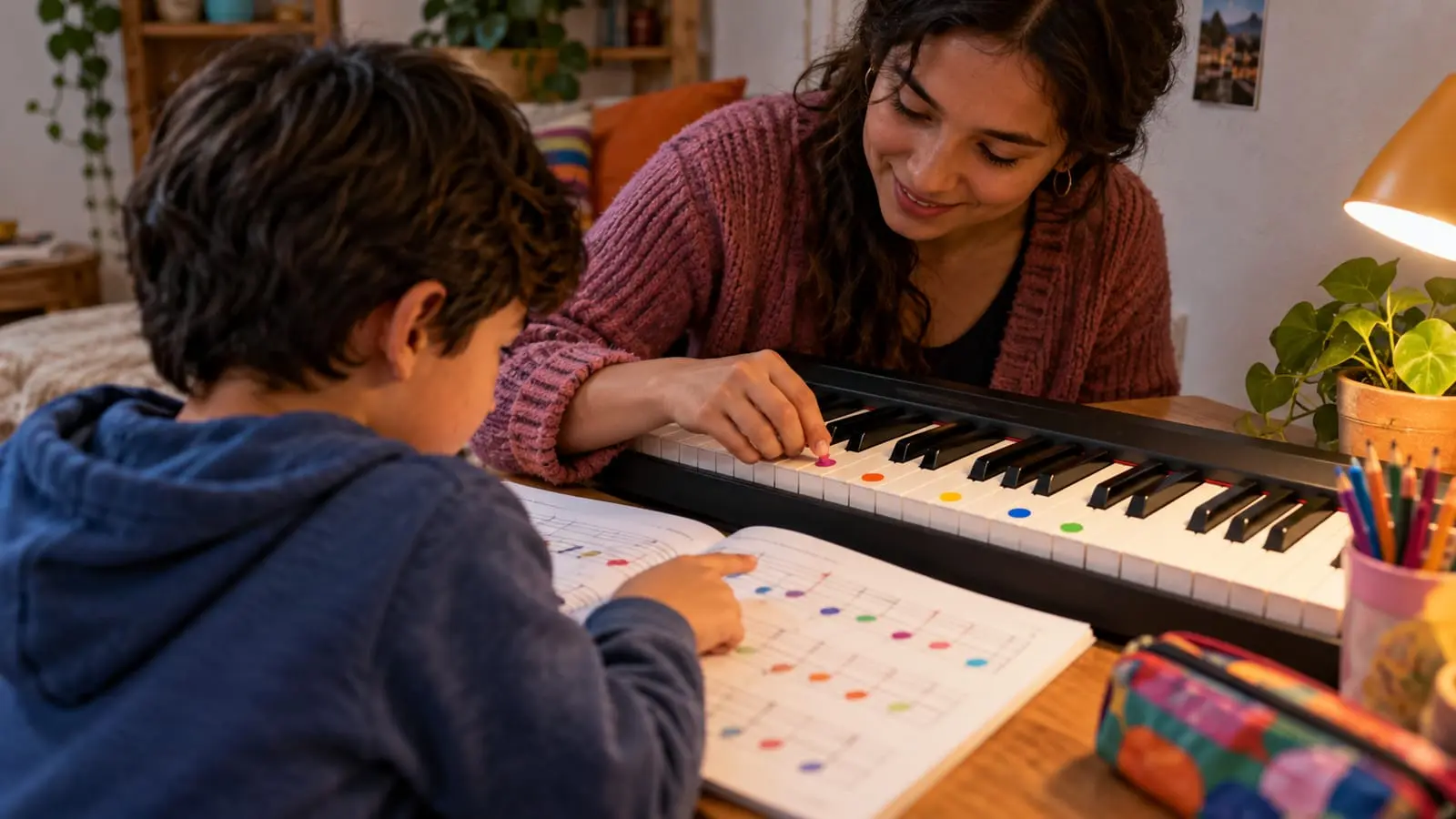
Yes, a child with dyslexia can learn an instrument and can also learn to read sheet music, although reading may take more time or require support. Dyslexia primarily affects reading text, and musical notation is another symbol system that some children find confusing. That's why lessons should also include learning by ear, breaking sheet music into small sections, and using color, larger print, and repetition.
This guide is not a treatment or a substitute for an evaluation by the professionals supporting your child. It covers music education: how to organize lessons so your child can make progress and enjoy learning. If you're looking for a place to start, piano lessons and early music education let children work with listening, rhythm, and movement before moving to the page.
In short
- Dyslexia doesn't prevent children from learning music: it changes the approach, which often relies more on listening, enlarged visual materials, and small steps.
- Learning by ear and imitation isn't a shortcut: it's a valid way to start and often keeps motivation up while reading skills develop.
- Enlarged sheet music with fewer measures per line, color cues, and a reading window or ruler to cover the rest can help.
- For guitar, chord symbols and tablature are a valid starting point; reading staff notation can come later.
- Neither music nor music lessons treat or cure dyslexia: evaluation and learning support are the responsibility of specialized professionals.
What dyslexia is and how it relates to reading music
Dyslexia is a specific learning difficulty that is most noticeable when reading and writing words: connecting letters with sounds, reading fluently, or spelling can be difficult. It has nothing to do with intelligence, and every child experiences it differently. Diagnosis is made by specialized health or education professionals, not a music teacher.
Reading sheet music isn't the same as reading text, but it shares some demands: recognizing symbols quickly, following a line from left to right, connecting a symbol to a sound or key, and keeping several things in mind at once. Piano music also requires reading two staves at the same time. If any of these tasks are difficult for your child at school, they may also be difficult when reading music.
There is also research exploring the relationship between rhythm processing and reading skills. Some researchers, such as Usha Goswami at Universidad de Cambridge, have studied how tracking rhythm and meter relates to reading. These findings are still being studied; they don't prove that playing an instrument improves text reading, and that outcome shouldn't be promised.
What may be harder and what helps
Not all children with dyslexia have the same difficulties. This table brings together those that come up most often in lessons and the adjustments that tend to help:
| What may be difficult | What it looks like in lessons | What helps |
|---|---|---|
| Naming notes quickly | Takes time to name C, D, E or confuses lines and spaces. | Learn a few notes at a time, using reference points, and repeat them through games. |
| Following a line from left to right | Skips measures or loses their place when moving to a new line. | Use a card to cover what comes next and an arrow at the start of each line. |
| Telling similar symbols apart | Confuses note values or time signatures, or the treble clef with the bass clef. | Enlarged sheet music with fewer symbols per page and one new symbol at a time. |
| Keeping the sequence in memory | Forgets the order of notes or sections. | Work on short phrases with a recording for support, and review in short, frequent sessions. |
| Reading and playing at the same time | The rhythm falls apart when reading; when playing, stops looking at the music. | Separate the tasks: listen and sing first, then play, then read. |
| Coordinating both hands | Confuses left and right or the two piano staves. | Start with one hand, use color marks for each hand, and add the other later. |
None of these difficulties determines a child's future. They can be worked on through smaller steps, more spaced repetition, and more ways to access the same information.
Start with listening, rhythm, and movement
A child can start making music long before reading it. Singing, imitating a melody, walking to a beat, and clapping rhythmic patterns are real steps in learning music, not a consolation prize. When reading comes later, there's already an inner sense of music to support it.
- Rhythm echo: the teacher claps a short pattern and the child repeats it; then they play the patterns on the instrument.
- Melody imitation: the teacher plays two or three notes and the child repeats them. Later, the child learns familiar songs by ear.
- Feeling the beat through movement: walking, swaying, or playing a drum to a song's beat. The metronome can help once the child can feel the beat.
- Rhythm syllables: saying “ta” and “ti-ti” while reading note values helps connect what children see with the sound.
- Recordings: the teacher records the week's piece slowly and at normal speed so the child can practice by listening.
For listening games, see how to train your musical ear and our ear training tool. For younger children, music games for kids at home offers rhythm and listening ideas without sheet music.
How to adapt sheet music
When it's time to read, the layout of the sheet music matters. These inexpensive adaptations can be made at home or in lessons:
- Enlarge it: photocopy the sheet music at a larger size, with more space between staves and fewer measures per line.
- One thing at a time: work on one measure or phrase and cover the rest with a sheet of paper or a card with a reading window.
- Purposeful color cues: highlight reference notes (such as middle C or the G on the treble clef) or assign a color to each hand. This is a support that is gradually removed to avoid dependence.
- Paper and contrast: some children read more easily on softly colored or less glossy paper. There's no universal rule; try different options with your child.
- Mark the route: arrows at the end of each line, measure numbers, and a box around repeats.
- Write in note names: this can be a bridge at first, but if it becomes a habit, the child stops looking at the notes themselves. Use it sparingly and phase it out.
Reference points are key. Learning three or four “anchor” notes first and reading the rest by distance (up a step, down a skip) reduces the burden of naming every note. To review the basics, see how to read sheet music: a beginner's guide and how to read the bass clef when it's time to work on the left hand.
When to start reading
There's no set age. Many teachers introduce reading gradually and only once a child can play several pieces by ear and feel the rhythm. If reading causes distress, you can pause and return to it later. A child who enjoys playing and keeps going will read better in the long run than one who quits. For more on timing, read how long it takes to learn to read sheet music.
Which instrument to choose and how to start
There's no instrument specifically “for dyslexia.” The best choice is the one that interests your child, with a clear way to get started. Here are a few options:
| Instrument | How to start | Things to consider |
|---|---|---|
| Piano | Five-finger hand positions, patterns on black and white keys, and songs learned by ear. | Two staves can be demanding; work with one hand at a time. |
| Guitar | Chord symbols, chord diagrams, and tablature. See how to read tablature. | Tablature shows where to fret, not the rhythm; rhythm is learned by ear or through strumming patterns. See guitar strumming patterns. |
| Introductory music | Singing, rhythm, movement, and play without sheet music. | Ideal as a first step for young children. |
| Percussion | Learning rhythms by imitation, with the body and drums. | Reading can come later, using simple rhythmic notation. |
| Singing | Learn songs by ear, with lyrics printed in large type if needed. | Reading lyrics and reading notes go hand in hand; one does not replace the other. |
For guitar, chord diagrams and tablature are perfectly valid forms of reading music. Tablature tells children which string and fret to play, so they can play real songs very early on. The diagrams on our chord page show where to place their fingers. Staff notation can be added later if the child wants.
How to organize lessons and practice at home
- Lessons with short, varied activities: a few minutes of rhythm, then listening, reading, and play. A 30-minute lesson is often a good starting point.
- Just one new goal per lesson: a new note, a new rhythm, a new measure. Everything else is review.
- Spaced repetition: a little every day. Five or ten minutes daily are more effective than half an hour once.
- Short, specific instructions: one instruction at a time, explained and demonstrated.
- Celebrate what works: playing a song well by ear is making music, too. Avoid comparisons with siblings or classmates.
- Patience with mix-ups: if the child confuses left and right or C and D, correct gently and find another way to show it.
To build a home routine, see how to motivate your child to practice their instrument. If attention is also a challenge, music and ADHD offers ideas for short activities and visual schedules. If your child is on the autism spectrum, music lessons for children with autism discusses routine and sensory input.
What to tell the teacher and what our lessons are like
A brief conversation before starting can save weeks of trial and error. Tell the teacher whatever you think would be useful, without needing to go into the diagnosis:
- What makes reading difficult at school and which strategies have helped there.
- What the child likes about music: songs, characters, instruments.
- Whether the child gets frustrated quickly and what helps them calm down.
- What adaptations the child uses at home or school (large print, colored paper, breaks).
- Whether the child prefers to start by playing by ear before looking at sheet music.
With A medio tono, you can request in-home music lessons in Bogotá and nearby areas, depending on each teacher's availability, or online lessons from any city. Teachers are evaluated on musical ability, teaching skills, and interpersonal qualities before their first lesson. You can message your teacher on WhatsApp about your child's needs so they can adapt the lesson. Music lessons are education, not therapy or academic support, and do not replace evaluation or support from specialized professionals.
If you're still unsure how to choose a teacher, read how to choose a music teacher.
Frequently asked questions
Can a child with dyslexia learn to read sheet music?
Yes, although they may need more time and support. Enlarged sheet music, fewer measures per line, reference points, color cues that are gradually removed, and starting with listening and rhythm before reading can help. Every child progresses at their own pace.
Which instrument is best for a child with dyslexia?
No instrument is best based on diagnosis alone. Choose according to your child's interests. Piano makes the layout of notes visible, guitar lets children start with chord symbols and tablature, and percussion develops rhythm without sheet music. Trying short lessons can help you decide.
Does music help treat dyslexia?
We can't claim that music treats or cures dyslexia. Research explores the relationship between rhythm and reading, but it doesn't replace professional evaluation or support. Music lessons are for learning and enjoying music.
Can children play by ear without reading sheet music?
Yes, many people play very well by ear, and it's a valid way to make music. Still, learning to read opens up more repertoire and possibilities. Ideally, develop both approaches at a pace the child can manage, and decide with the teacher when to introduce reading.
Should I tell the music teacher my child has dyslexia?
It's helpful to share what's useful: what your child finds difficult, what helps, and how reading makes them feel. That lets the teacher adapt materials and pacing from the start. You don't have to share the full diagnosis; provide as much detail as you're comfortable with.
Sources
We checked the facts in this article against these sources on October 22, 2026.