Music lessons for children with Down syndrome: how to choose and what to expect
How to choose an instrument, what routines work, which visual supports to use, and how to work with families and therapists, without making promises music can't keep.
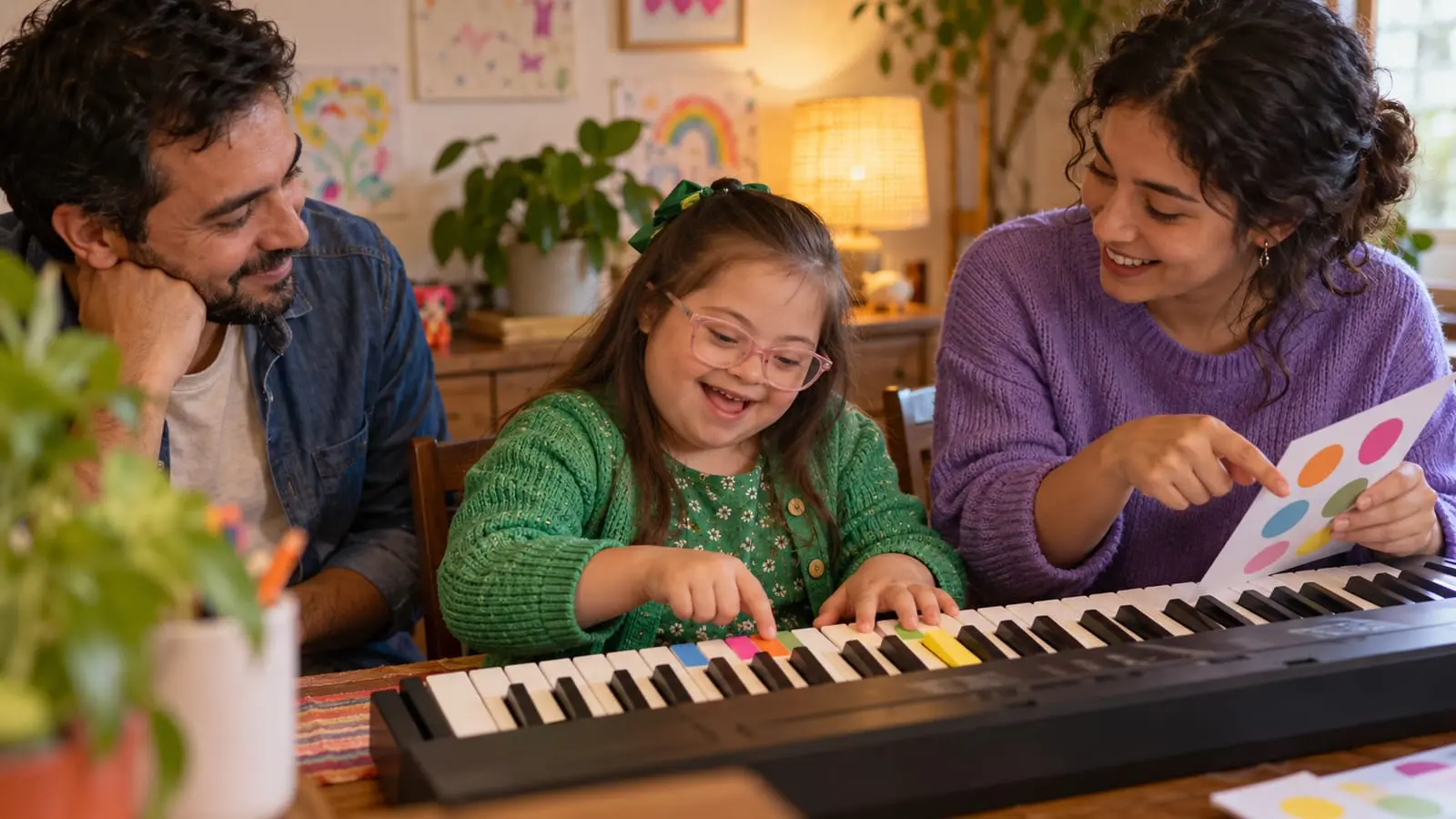
Yes, a child with Down syndrome can take music lessons and enjoy them: singing, keeping a beat on a drum, playing keys, and learning songs. What usually makes the difference is the teaching approach rather than the diagnosis: lessons with clear routines, small steps, visual supports, plenty of repetition, and a patient teacher who starts with what that child enjoys. At A medio tono, lessons can be at home in Bogotá, depending on each teacher's availability, or online.
A clarification from the start: music lessons are not music therapy and don't replace therapy, school support, or guidance from the professionals supporting your child. This guide is about teaching and doesn't claim to know more than your child's pediatrician or therapists. Nor do we claim our teachers are Down syndrome specialists: we offer music teachers who adapt their teaching to each student using the information the family shares.
In short
- A child with Down syndrome can learn music; every child progresses at their own pace, without comparison to others.
- Percussion, singing, piano, and early childhood music are good starting points, depending on the child's interests and what feels physically comfortable.
- Lessons work best with a consistent routine, small steps, visual supports, and plenty of repetition with variations.
- Music lessons and music therapy are different: neither replaces the other or the child's therapies.
- Before starting, talk with your child's therapists and tell the teacher what helps at home and at school.
Music lessons and music therapy: understanding the difference
Both can be part of a child's life, but they have different goals and are led by different professionals:
| Aspect | Music lesson | Music therapy |
|---|---|---|
| Goal | Learning music: singing, playing, keeping a beat, and having fun. | Therapeutic goals defined by a professional together with the family. |
| Who leads it | A music teacher. | A music therapist with specialized training. |
| How progress is assessed | Songs, technique, and independence with the instrument. | According to the professional's plan. |
| When to seek it out | When the child wants to learn or enjoy music. | When recommended or considered by the professionals supporting the child. |
If your child already receives occupational therapy, speech therapy, or physical therapy, music lessons complement them by offering another space for enjoyment, but they don't do the same work. Ask the professionals who know your child any questions about development, health, or therapy.
A note on language: say “a child with Down syndrome,” not “a Down”: the person comes before the syndrome. Ask the teacher to use the language your family prefers.
What learning music offers (and what we don't promise)
Music is something most children enjoy, and that already matters. Learning songs, playing with someone else, and showing what they've learned at home gives children a space for their own achievements, separate from therapy or school. It's reasonable to expect enjoyment, routine, time with an adult who believes in the child, and the pride of playing something.
We don't promise that music will improve your child's language, attention, or development. Some families notice progress in those areas and others don't, and it can't be attributed to lessons alone. Be wary of anyone who guarantees medical or therapeutic results from music lessons. What we can assure you of is an experience designed to help your child participate and feel capable.
How to choose an instrument
There isn't an instrument “for Down syndrome.” Choose based on the child's interests, age, and physical comfort with each instrument. A practical point: many children with Down syndrome have low muscle tone (hypotonia), small hands, or less finger strength. That doesn't stop them from playing, but it's worth choosing instruments and positions that don't require too much strength or precision at first, and asking their physical or occupational therapist if there's anything to keep in mind.
| Option | Benefits | Things to consider |
|---|---|---|
| Percussion | Immediate response, whole-body movement, rhythms learned through imitation and played with others. | Start with lightweight instruments (tambourine, cajón, claves, practice pad); adjust the volume if it bothers the child. |
| Piano or keyboard | The keys are visible, pressing them produces sound, and colors or stickers can help guide the child. | Moving fingers independently and with even pressure takes time; start with one finger or both hands together. |
| Singing | No instrument needed; start with songs the child already knows and bring gestures, words, and melody together. | If some words are hard to articulate, don't correct the melody as though it were a test. A speech therapist can offer guidance. |
| Introductory music | Singing, rhythm, movement, and play with small instruments, ideal for younger children. | Large groups can be overstimulating; private lessons allow adjustments at the beginning. |
If this is your child's first experience with music, the most sensible approach is to start with percussion, singing, or early childhood music and see what they respond to. Later, with interest and consistency, they can move on to piano or another instrument. What is early childhood music? explains in more detail how this first stage is structured.
What an effective lesson looks like
A 30- to 45-minute lesson with short segments is often more manageable than a long lesson with a single activity. Here's an example structure:
- Hello song (the same one every time), using the child's name.
- Body warm-up: clapping, stepping, tapping a beat on the legs with the hands.
- Main activity: a drum rhythm, a three-note piano melody, a song with gestures.
- Review something the child already knows, so every lesson includes a sure moment of success.
- Musical play, free or chosen by the child: improvising, playing with the teacher, dancing.
- Goodbye song (always the same one).
Some ideas that help many children, always adapted to each child:
- Visual supports. A strip of photos or drawings of the activities, crossed off as they're completed; song lyrics with pictures; colored piano keys.
- Model and repeat. The teacher plays and the child imitates; then repeat at a different tempo, with a different sound, or in a different order to avoid monotony.
- Small steps. Just one new idea per lesson and one instruction at a time, using simple words.
- Time to respond. Wait without immediately repeating the question; some children need more time to process and answer.
- Movement. Stand up, walk to the beat, and make music with the body before moving to the instrument.
- Breaks. If the child gets tired or distracted, switch activities rather than insist.
To work gently on keeping a beat, the metronome can help some children feel a slow, steady tempo, always at a low volume and without pressure. Others do better with the teacher's own beat, which adapts to them.
Working with the family and therapists
You know your child; their therapists know their development. A ten-minute conversation before the first lesson saves weeks of trial and error. Tell the teacher:
- What your child likes: songs, characters, rhythms, instruments.
- What your child finds difficult or upsetting: loud sounds, waiting, changes of plan, certain movements.
- How your child communicates and the best way to give instructions: gestures, pictures, short sentences.
- What strategies you use at home, at school, or in therapy, to keep things consistent.
- Whether the therapists have recommendations about posture, using the hands, or anything else worth following.
With your permission, the teacher can speak with one of the therapists to coordinate their approach, for example on posture when sitting at the piano or the words used to give instructions. If the therapists can't or don't want to, that's fine: you're the link. For other useful questions when choosing a teacher, see how to choose a music teacher.
What to do at home
Short, frequent practice works better than one long session: five or ten minutes at the same time of day, with an adult offering support and encouragement. Repeating the song from the lesson, tapping its rhythm on the table, or simply listening to the music they're working on already counts as practice. If practice becomes a battle, talk with the teacher: it can be shortened or changed.
Private or group lessons, at home or online
At first, private lessons let you adjust the pace, volume, and activities. Later, a small group or playing with a sibling can bring joy and motivation if the child enjoys it. Find more guidance in private or group music lessons.
With in-home lessons, the teacher comes to a familiar space, which helps the child feel secure. Online lessons offer a consistent structure, but many children need an adult beside them. There's no single answer: try it and adjust. If you're interested in the online format, explore online music lessons.
Celebrating progress at their own pace
Measure progress against the child's own starting point. An achievement might be playing a short song all the way through, keeping a beat for a verse, asking for a favorite instrument, or learning a note's name. Staying in the lesson and enjoying it counts too. Some ways to recognize progress:
- Record a short video each month to see what changes; slow progress is easier to see over time.
- Keep a notebook or board with stickers for each song learned.
- Invite the family to a mini concert at home.
- Check in with the teacher from time to time about what's working and what to change.
There will be good days and difficult days, and a bad day doesn't erase what's been learned. Avoid comparisons with siblings or classmates. And if lessons cause ongoing distress, it's okay to take a break or change the format or instrument. For a similar perspective on another kind of support, you can read music lessons for children with autism and music and ADHD; every child is different, and what works for one won't necessarily work for another.
How an A medio tono teacher supports you
Every A medio tono teacher is evaluated on musicianship, teaching skills, and personal qualities before their first lesson. We don't present our teachers as therapists or Down syndrome specialists: they're music teachers willing to listen to the family and adapt their lessons. To get started:
- Write to us on WhatsApp and tell us your child's age, what they enjoy, and which instrument interests you.
- Tell us what adaptations help (routines, pictures, timing) so we can look for a teacher with the right patience and willingness to adapt.
- You can view profiles in the teacher directory before deciding.
- After the first few lessons, adjust the duration, format, and repertoire together.
Frequently asked questions
Which instrument is best for a child with Down syndrome?
No instrument is best based on diagnosis alone. Percussion, singing, and piano are common options; choose based on your child's interests and comfort. Starting with early childhood music or lightweight percussion and seeing what they respond to is a good way to decide.
Does music help improve language or attention in children with Down syndrome?
We can't make that claim. Music lessons offer a space to learn and enjoy music, and some families notice benefits, but therapeutic results aren't promised. For any questions about language, attention, or development, consult the professionals supporting your child.
Do music lessons replace music therapy?
No. Music therapy is a separate profession with therapeutic goals and specialized training. Music lessons teach music, even when the teacher adapts their teaching approach to the student.
At what age can a child with Down syndrome start?
Like any child, they can take part in early music activities based on singing, play, and movement from a young age. Their interest and comfort determine when to start, not a fixed age; if you're unsure, talk with their therapists.
How long should a lesson last?
It depends on the child. Lessons lasting 30 to 45 minutes with short segments and changes of activity often work better. Adjust this with the teacher as you see how your child responds.
Sources
We checked the facts in this article against these sources on October 22, 2026.