School-break music courses in Bogotá: making the most of December and the midyear break
School breaks are the best time to start an instrument or make faster progress. We explain how to organize private lessons at home or online and what you can achieve in 4 to 6 weeks.
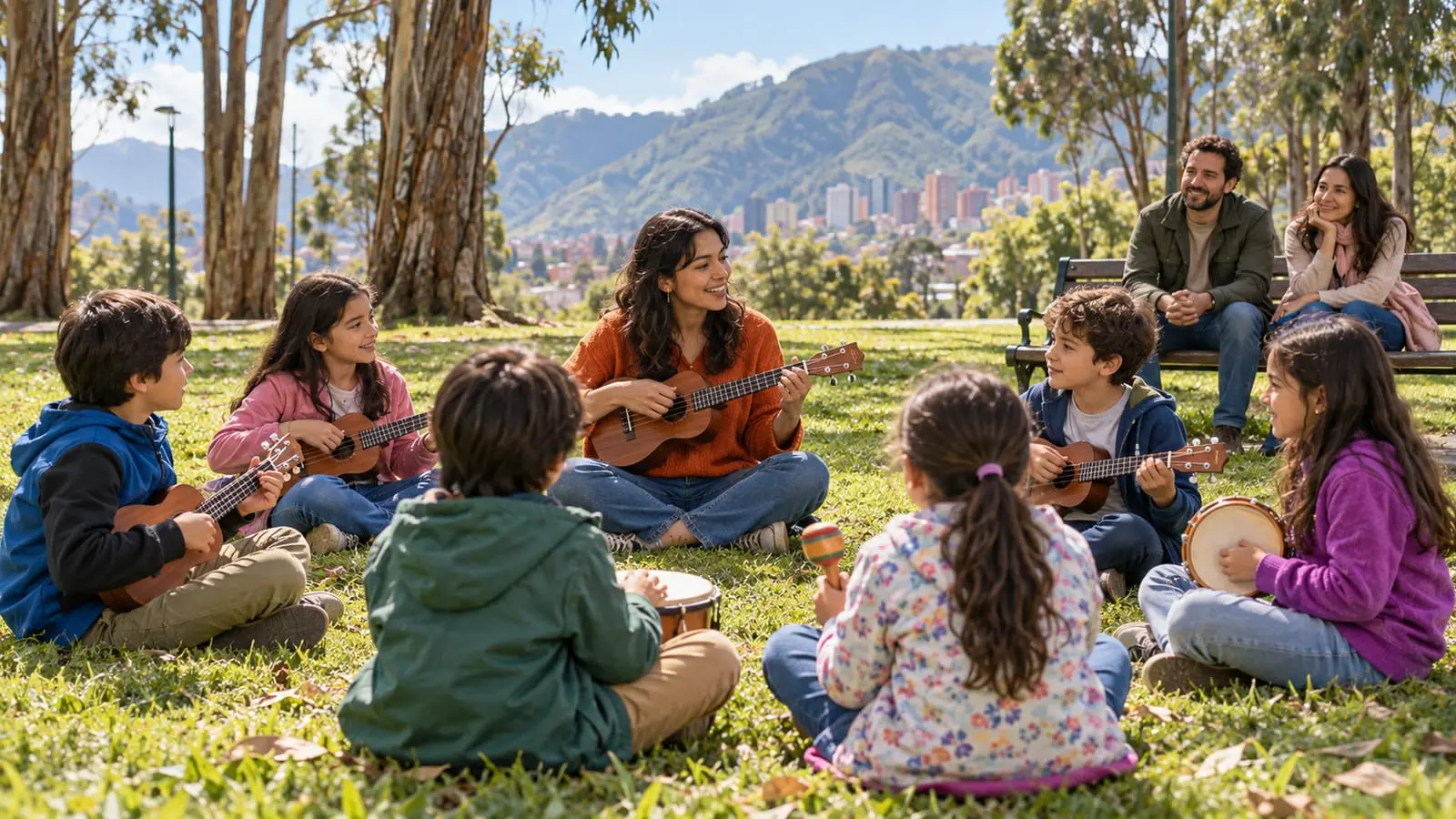
You do not need a special course to enjoy music during school breaks in Bogotá: the most effective approach is to start or step up private lessons with a teacher, with more weekly sessions than usual and short daily practice. With in-home music lessons in Bogotá or online lessons, the schedule works around your family, rather than the other way around.
School breaks offer an advantage the rest of the year does not: time without homework or early starts, and energy for something new. In 4 to 6 weeks, a beginner can get through the hardest first steps on an instrument. Here we explain how to organize it, what to expect by instrument and age, and how to keep the momentum when school starts again.
In short
- You do not need a fixed school-break course: you can start private lessons and increase from one to two or three sessions a week during the break.
- Under calendar A, the long break usually runs from late November or early December to mid-January, and the midyear break falls in June and July; confirm the exact dates with your school's calendar.
- In 4 to 6 weeks, a beginner can play their first complete songs, but not master the instrument: the real gains are a good start and a habit.
- Short, frequent sessions are more effective than a few long ones, especially for children: 30 to 45 minutes, plus 5 to 30 minutes of daily practice depending on age.
- Continuity matters most: plan now how to keep going in February with one weekly lesson.
School-break course or private lessons: which is right for you?
Many families search for a “school-break music program” expecting a group that meets for a few weeks. Some places offer this, and it can be a fun way to socialize. But if you want your child, or yourself, to really start playing, more frequent private lessons tend to be more useful because the teacher adapts the pace to one person.
At A medio tono, we do not offer a school-break package or a fixed intensive course. What you can do is take regular lessons in piano, guitar, singing, percussion, or introductory music and request more weekly sessions during the break, at home in Bogotá and surrounding areas (depending on each teacher's availability) or by video call.
| Aspect | School-break group program | More frequent private lessons |
|---|---|---|
| Learning pace | Follows the group's pace. | Adapts to the learner: repeat what is difficult and move ahead when things come easily. |
| Schedule | Fixed, at a set place and time. | Arranged with the teacher; at home or by video call. |
| Repertoire | Determined by the program. | Starts with what the student enjoys. |
| After the break | The course ends. | You can continue with one weekly lesson. |
| Social interaction | High: children meet other children. | Low, unless you organize a small family concert. |
If your child is between 3 and 7 and does not yet know which instrument they want, introductory music lessons are a good starting point: rhythm games, singing, and exploring instruments. Find more details in what is introductory music education?.
When school breaks happen and how to plan for them
At schools following calendar A, the most common in Colombia, the school year runs from January or February to November. The long break usually starts in late November or early December and ends in mid-January, with a midyear break usually falling between June and July. Calendar B schools have different dates, and each institution sets its own: check your school's calendar before planning.
Remember that December in Bogotá brings Christmas novenas, travel, and family gatherings. It helps to do two things:
- Start as early as possible. If lessons start in the first week of the break, there are more useful sessions before Christmas.
- Account for travel dates from the start. If you will be away for a week, tell the teacher: they can assign specific tasks or teach online from wherever you are if the connection is good.
How to step things up without burning out
Making lessons more intensive doesn't mean two-hour classes. It's better to increase frequency than duration: reviewing a little and often usually works better than a few long sessions, and a young child tires much sooner than an adult.
| Age | Lesson length | Lessons per week | Daily practice |
|---|---|---|---|
| Ages 3 to 5 | 30 minutes | 1 to 2 | 5 to 10 minutes, with play |
| Ages 6 to 8 | 30 to 45 minutes | 2 | 10 to 15 minutes |
| Ages 9 to 12 | 45 minutes | 2 to 3 | 20 to 25 minutes |
| Teens and adults | 45 to 60 minutes | 2 to 3 | 20 to 40 minutes |
These figures are guidelines, not rules: the right lessons are the ones you can happily sustain. If your child finishes every session exhausted, reduce the frequency. If they ask for more, there is no need to hold them back, but leave some days off from the instrument.
A day of music during the break
- A short practice session in the morning, when energy is higher, is better than a long one at night.
- Warm up and review the teacher's assignments with the metronome or a supporting recording.
- Free playing time: play anything you like, without corrections. This is often the most enjoyable and motivating part.
- One day off from the instrument each week, or two if you are traveling.
If you need ideas for organizing your home routine, find practical guidance in how to practice music at home and how to motivate your child to practice.
What you can achieve in 4 to 6 weeks
With lessons several times a week and daily practice, a beginner can come away with something concrete that truly feels like their own. This is about a good start, not mastering the instrument. These are realistic goals, always depending on age, consistency, and starting point:
| Instrument | Realistic goal | What makes it possible |
|---|---|---|
| Acoustic guitar | Switch between 4 or 5 open chords and accompany one or two simple songs with a basic strumming pattern. | Daily chord-change practice with a slow metronome. Fingertip calluses develop in a few weeks. |
| Piano | Play a simple melody with each hand separately and then together, and read a few notes in treble and bass clefs. | Correct hand position from the start and short repetitions. A keyboard works for practice. |
| Singing | Sing a complete song with good breathing and pitch in a comfortable range. | Short breathing and warm-up exercises; for children, protect the voice without strain. |
| Percussion and drums | Keep a steady beat, play a basic 4/4 rhythm with your hands or on a pad, and begin learning the first rudiments. | Practice pad and metronome; you do not need a full drum kit to start. |
| Introductory music (ages 3 to 7) | Follow the beat, imitate short rhythms and melodies, sing more in tune, and recognize the sounds of several instruments. | Play, repetition, and plenty of music at home. The goal here is enjoyment, not performance. |
Every instrument has its own timeline, and the chart shows only the first stage. To find out how long it takes to go further, see how long it takes to learn guitar and how long it takes to learn piano.
A 4-to-6-week plan, step by step
This outline is a guide for guitar or piano; the teacher adjusts it for each student. Other instruments involve different content, but the logic is the same: foundations, first pieces, and consolidation.
| Week | Acoustic guitar | Piano |
|---|---|---|
| 1 | Posture, tuning, string names, and first chords (such as E minor and A minor). | Posture, hand position, notes on the keyboard, and using all five fingers of one hand. |
| 2 | More open chords and the first slow changes with a metronome. | Both hands separately, plus the first beat and note-value exercises. |
| 3 | Basic strumming pattern and a first complete song with 3 or 4 chords. | Simple melody with the right hand and basic accompaniment with the left. |
| 4 | Second song and smoother chord changes. | Both hands together in a short piece; first notes on the staff. |
| 5 to 6 | A personal repertoire, a small family “concert,” and a plan to keep going. | Review, a piece ready to play for the family, and a plan to keep going. |
If you already play, an “intensive course” means something different: a specific goal, such as a challenging song, a new rhythm, audition preparation, or moving into a different style. In that case, tell your teacher your goal in the first lesson. For guitar, see in-home guitar lessons in Bogotá or online lessons; for piano, see piano lessons.
What does not change when you move faster
- Technique still comes first. A bad habit, such as a tense hand, can lead to pain or stalled progress later.
- Do not skip the basics. Rushing music reading or work on the beat usually costs more time later.
- Short daily practice beats a weekend marathon. This is especially noticeable in children.
Which instrument to choose for starting during the break
School breaks are a good time to try something. If you are unsure, these pointers can help:
- Piano: visual and organized, ideal for understanding music; you can make good progress in the first few weeks. See piano for children.
- Guitar: best for those who want to accompany songs; the first few weeks take patience as fingertips adjust. Young children need the right size, as explained in guitar for children.
- Percussion and drums: for anyone who needs to move. A pad and drumsticks are enough to start; see drums for children.
- Singing: no instrument to buy; extra care is taken with children's voices. Read singing for children.
If you do not have an instrument yet, do not buy a large one before the first lesson: ask the teacher what you need. We have guides to choosing a guitar or piano: your first acoustic guitar and your first piano or keyboard. And if you are thinking of a gift for this season, see musical gifts for children.
How we help during the break
A medio tono connects families with music teachers who teach in your home in Bogotá and surrounding areas, depending on each teacher's availability, or by video call from any city in Colombia or abroad. Every teacher is assessed for musical ability, teaching skills, and personal qualities before their first lesson.
- Message us on WhatsApp with the student's age, instrument, weeks off, and available days.
- We suggest a teacher, and together you decide how many sessions per week, how long each one lasts, and the goal for the break.
- The teacher assigns short tasks and repertoire the student enjoys, so there is motivation alongside the exercises.
- Plan for continuity: at the end, the teacher suggests how to continue with one weekly lesson when school starts.
If you would rather stay home in December or travel frequently, online music lessons let you keep going wherever you are. It all depends on the instrument and your connection.
What happens when the break ends
The biggest risk of starting during the break is not learning too little: it is stopping in February. Between school, homework, and activities, music gets pushed to the bottom of the list. Some ways to avoid this:
- Keep a fixed weekly lesson at a time that does not conflict with school.
- Reduce practice to 10 or 15 minutes a day rather than stopping altogether.
- Set a date for a small goal, such as playing for the grandparents at a birthday celebration.
- If enthusiasm drops, do not see it as a failure: it happens to almost everyone. See my child wants to quit their instrument: what should I do?.
If the next stage calls for a stronger ear or steadier rhythm, the free ear training and tuner tools can support practice between lessons.
Frequently asked questions
Are there music courses during school breaks in Bogotá?
Yes, several institutions and academies offer them; programs and dates change each year, so check each one's current information. At A medio tono, we do not offer a fixed school-break course: you can start private piano, guitar, singing, percussion, or introductory music lessons and increase weekly sessions during the break.
When are school breaks in Colombia?
Under calendar A, the long break usually runs from late November or early December to mid-January, and there is usually a midyear break between June and July. Calendar B has different dates, and each school sets its own, so check your institution's calendar.
How much can a child learn in 4 to 6 weeks of lessons?
Enough for a good start: on guitar, a few chords and one or two simple songs; on piano, a melody with both hands; in introductory music, following the beat and imitating rhythms. It depends on age, consistency, and starting point; it is a solid beginning rather than mastery of the instrument.
How many lessons a week should you take during the break?
For children ages 6 to 12, two or three lessons of 30 to 45 minutes usually work well, with short daily practice. Younger children need shorter sessions. What matters is that the frequency stays enjoyable and sustainable; reduce it if the student gets tired.
Can school-break lessons be taken online?
Yes. Online music lessons work well for guitar, piano, singing, percussion, and theory, as long as you have a good connection and a quiet space. They are useful if you are traveling or would rather avoid commuting in December. For very young children, in-person lessons are sometimes better.
Sources
We checked the facts in this article against these sources on October 22, 2026.