How to Play Bambuco on Guitar and Tiple: Strumming, Chords, and Your First Songs
Bambuco plays with two pulses at once, which makes it tricky at first. We explain 6/8 versus 3/4, a basic strumming pattern, simple progressions, and how to practice.
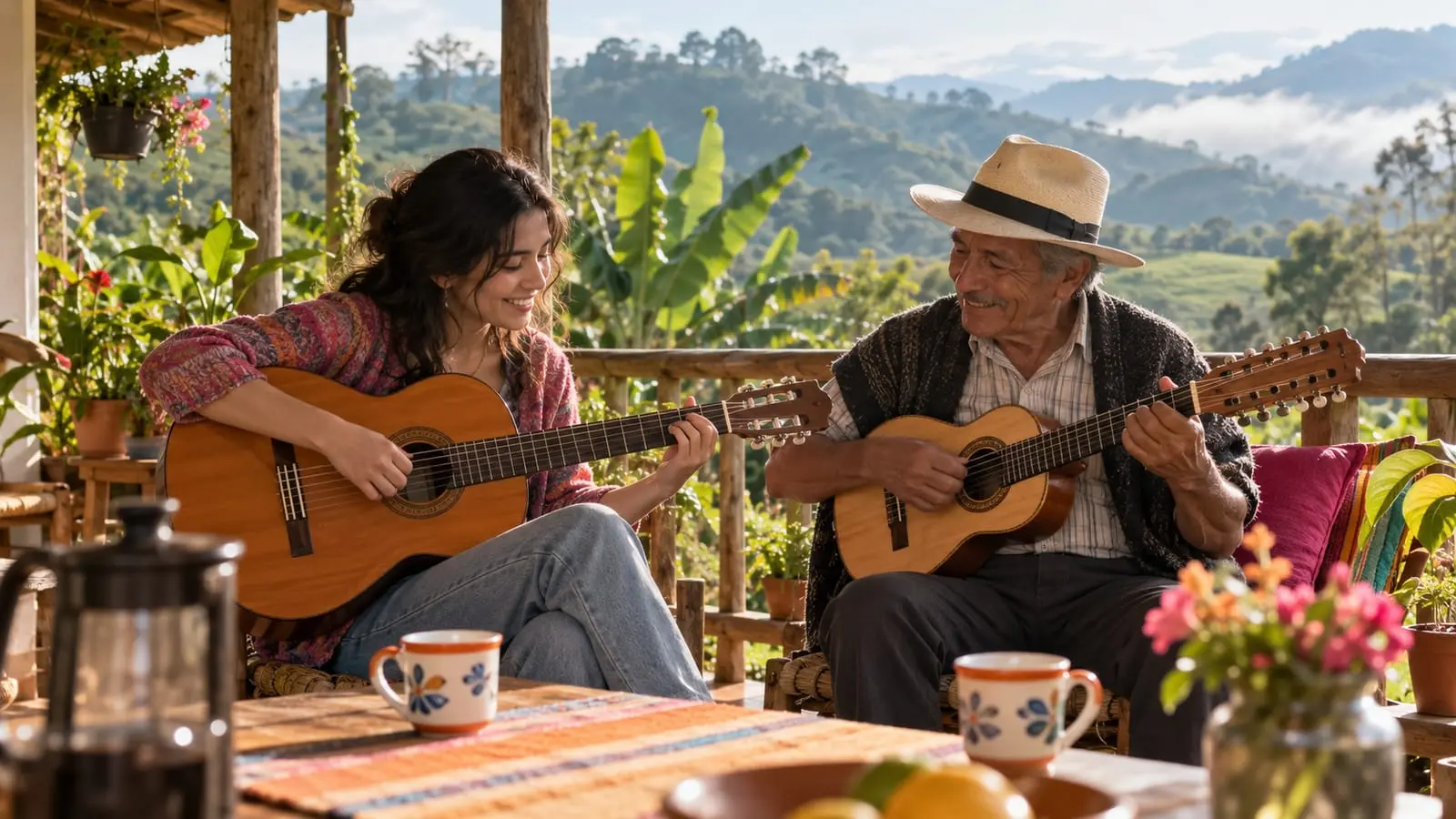
To play bambuco on guitar or tiple, you need three things: a feel for counting the meter in 6/8 (two groups of three eighth notes) or 3/4 (three groups of two), a basic strumming pattern that alternates bass notes and chords with shifted accents, and a few progressions, such as D major with G and A7, or E minor with A minor and B7. The rest comes from listening a lot and refining the sway.
The hard part of bambuco is feeling it, rather than reading it. If you are starting out, in-home guitar lessons in Bogotá or online lessons, or tiple lessons, are a great way to learn, because strumming is much easier to pick up when you can watch it up close. Here is a roadmap for practicing at home.
In short
- Bambuco is written in 6/8 or 3/4, and neither is wrong: the rhythm combines a pulse of two groups of three with another of three groups of two.
- A good first step is to separate two layers: bass notes outline 6/8 (beats 1 and 4), while chords emphasize 3/4 (beats 1, 3, and 5 of the six eighth notes).
- With D major, G major, and A7, or E minor, A minor, and B7, you can already accompany many simple bambucos.
- On both tiple and guitar, strumming varies by region and performer; the pattern here is a starting point, not the one definitive bambuco pattern.
- Practice slowly with a metronome and listen to bambuco recordings: you learn the sway more through your ears than through the score.
6/8 or 3/4? Why it is written both ways
Six eighth notes can be grouped in two ways: 3 + 3, which gives 6/8, or 2 + 2 + 2, which gives 3/4. Bambuco makes you feel both almost simultaneously, so scores use either time signature. This blend is known as sesquialtera or hemiola. To learn more, read Colombian rhythms: bambuco, pasillo, and cumbia and time signatures explained.
| Eighth note | 1 | 2 | 3 | 4 | 5 | 6 |
|---|---|---|---|---|---|---|
| Counted in 6/8 | ONE | two | three | FOUR | five | six |
| Counted in 3/4 | ONE | and | TWO | and | THREE | and |
In practice, bass notes usually follow the 6/8 feel, on beats 1 and 4, while chords and melody tend to emphasize 3/4, on 1, 3, and 5. That interplay creates the sway that keeps bambuco from sounding like a waltz. Playing it too rigidly loses the very thing that makes it bambuco.
The basic strumming pattern, counted step by step
Real bambucos include variations, muted strokes, and rhythmic shifts that change by region and performer, learned through listening and working with a teacher. This pattern is an entry point that combines both layers in your right hand. Try it on a muted string first, without changing chords, to establish the motion.
| Eighth note | 1 | 2 | 3 | 4 | 5 | 6 |
|---|---|---|---|---|---|---|
| Count in 6/8 | ONE | two | three | FOUR | five | six |
| Count in 3/4 | ONE | and | TWO | and | THREE | and |
| Right hand (guitar) | Bass note (thumb) | — | Chord ↓ | Alternating bass note (thumb) | Chord ↓ | Chord ↑ |
| Accent | Strong | Middle | Soft | Middle | Soft |
- Learn just the bass line. Play the chord root on 1 and the fifth or alternate root on 4, without strumming a chord, counting aloud in 6/8.
- Add chords on 3 and 5. Use the backs of your fingers for a short, crisp downstroke, without dragging too much.
- Add the upstroke on 6. Make it a light touch on the higher strings.
- Keep the rest on beat 2. It gives your hand a breath; without that space, the pattern sounds cramped.
- Count in 3/4 and listen again. The same pattern should feel like three beats.
On the tiple
The tiple has twelve strings in four courses of three, and usually does not play individual bass notes like the guitar. Its role is strumming and harmony: it follows the same accent pattern using strokes with several fingers, and this is where each player adds their own touch. It is tuned D, G, B, and E, like the guitar's four highest strings, so many chord shapes transfer; see how to tune the tiple and the tiple tuner.
To really learn tiple strumming, it is best to watch: hand position, muting, and force are hard to explain in writing. If you don't have a tiple yet, get advice before buying; read how to choose a tiple or bandola.
Chords and progressions to get started
Many bambucos move between a key's tonic and dominant, with occasional stops on the fourth degree. These two progressions make a good starting vocabulary:
| Key | Progression | Scale degrees |
|---|---|---|
| D major | D · G · A7 · D | I · IV · V7 · I |
| E minor | E minor · A minor · B7 · E minor | i · iv · V7 · i |
In D major, A7 creates tension that calls for a return to D; in E minor, B7 serves that role. To understand why they work, the circle of fifths shows it at a glance, and you can explore the D major scale to get clear on the melody notes. There is also a guide to basic guitar chords for beginners.
How to change chords without losing the beat
- Change chords on beat 1, the strongest beat, and prepare the next chord during 5 and 6.
- Practice just the change, without strumming, for one minute per chord pair.
- If a chord doesn't sound clean, stop and check one finger at a time; see finger pain when playing guitar if you feel discomfort.
- On the tiple, try each shape slowly before adding it to the strumming pattern: twelve strings require greater precision.
How guitar and tiple work together
In the classic Andean trio, the roles are divided: the bandola carries the melody, the tiple provides strumming and harmony, and the guitar handles the bass. When you play bambuco with someone else, it helps to give each player a different role instead of both doing the same thing.
| Instrument | What it does | What to watch for |
|---|---|---|
| Guitar | Bass and harmony; mark beats 1 and 4 clearly. | Keep the bass from covering the melody or speeding up. |
| Tiple | Strumming and chords with 3/4 accents. | Even volume and clean muting. |
| Bandola | Melody, ornaments, and countermelodies. | Come in with the accompaniment's beat. |
| Voice | Phrase freely over the meter. | Have the accompaniment follow it without losing the beat. |
If you play alone, you can combine both ideas on guitar: bass notes and chords, as in the pattern above. To learn more about the format, see Colombian Andean music: a beginner's guide and why learn tiple and bandola. The Andean bandola is the natural third instrument in the group.
First songs and what each one develops
These traditional and classic pieces, listed by title, are useful for starting to accompany. Look for recordings featuring tiple, bandola, and guitar, and work with the version you prefer or your teacher recommends:
| Piece | Skills it develops |
|---|---|
| Soy colombiano | Accompany a melody you already know by ear. |
| Cuatro preguntas | Keep a steady beat while the voice phrases freely. |
| Brisas del Pamplonita | Endurance and chord changes in a longer piece. |
| La guaneña | Learn a melody from the oral tradition by ear. |
In Colombian songs to learn on tiple or guitar, we sort them by difficulty. An honest recommendation: if you are just starting, learn a pasillo or carranga first and move on to bambuco once your beat is steady. To review strumming in other styles, see guitar rhythms: basic strumming patterns.
How to practice with a metronome and recordings
The bambuco metronome lets you switch between 6/8 and 3/4 while keeping the same eighth notes, so you can hear the same speed grouped in threes or twos. Its reference tempos come from a sample of recordings, not a fixed rule: start much slower and increase gradually.
- Slow and clean. Play the pattern on a single chord until you no longer need to think about your right hand.
- Change chords. Move from D to G and from G to A7 on beat 1 without breaking the pattern.
- Alternate 6/8 and 3/4 on the metronome. Without changing your hand motion, feel how the accent shifts.
- Play along with a recording. Imitate the tiple's sway, even if you don't get the whole pattern right.
- Record your practice. What you hear differs from what you feel; listening back will tell you what to adjust.
Find more strategies in how to use a metronome to practice. Ten or fifteen minutes a day accomplish more than an hour on Sunday.
Common mistakes
- Playing it like a waltz. Without bass notes on 1 and 4 and cross-rhythmic chords, it loses its sway.
- Strumming everything loudly. The music lies in subtle accents, not volume.
- Rushing. Bambuco has a lilting flow; speeding up is the easiest way to lose the beat.
- Changing chords late. If you reach 1 still on the previous chord, the measure falls out of place.
How a teacher helps you with bambuco
Bambuco is learned through watching and listening. At A medio tono, we connect students with guitar, tiple, and bandola teachers who offer in-home lessons in Bogotá and nearby areas, depending on each teacher's availability, or video lessons from any city in Colombia or abroad. Each teacher is assessed for musicianship, teaching skills, and interpersonal qualities before their first lesson.
- Shows you the strumming pattern up close, with the right hand in view, and corrects muting and accents.
- Organizes repertoire for your level: from a pasillo or carranga to a bambuco.
- Teaches you to listen to recordings and distinguish the two rhythmic layers.
- Helps you play with others, such as guitar with tiple, and move from accompanying to ensemble playing.
If melody is your thing, explore the Andean bandola; if you prefer the strumming instrument, tiple lessons are the way to go. Message us on WhatsApp and tell us what instrument you have and what music you want to play.
Frequently asked questions
Is bambuco in 6/8 or 3/4?
Both are used, and neither is wrong. Bambuco combines a pulse of two groups of three eighth notes (6/8) with one of three groups of two (3/4), which is why it is written both ways. What matters is feeling the sway between them.
What is the basic bambuco strumming pattern?
There is no single pattern: it varies by region and performer. One starting pattern is a bass note on beat 1, a downstroke chord on 3, an alternating bass note on 4, a downstroke chord on 5, and a light upstroke on 6. It is an entry point; a teacher can show you variations and muted strokes.
What chords do I need to play bambuco?
To start, D major, G major, and A7, or E minor, A minor, and B7 are enough. Those two progressions let you accompany many simple bambucos. You can add other chords later as each piece requires.
Is bambuco played the same way on tiple and guitar?
It follows the same accent idea, but the roles differ. In the Andean trio, the tiple provides strumming and harmony, and the guitar handles the bass. The tiple is tuned like the guitar's four highest strings, so many chord shapes transfer, although its twelve strings feel different.
Is bambuco hard for a beginner to learn?
It is one of the more challenging Andean rhythms, because of the beat rather than the chords. It usually helps to develop a steady strumming pattern first and start with a pasillo or carranga. With short daily practice and a teacher showing you up close, it is entirely achievable.
Sources
We checked the facts in this article against these sources on October 22, 2026.