How to Play Colombian Pasillo on Guitar and Tiple
Pasillo is played in 3/4, with bass on the first beat and shifted chord entries. Strumming patterns, progressions, and exercises for guitar and tiple, from slow pasillo to the lively fiestero style.
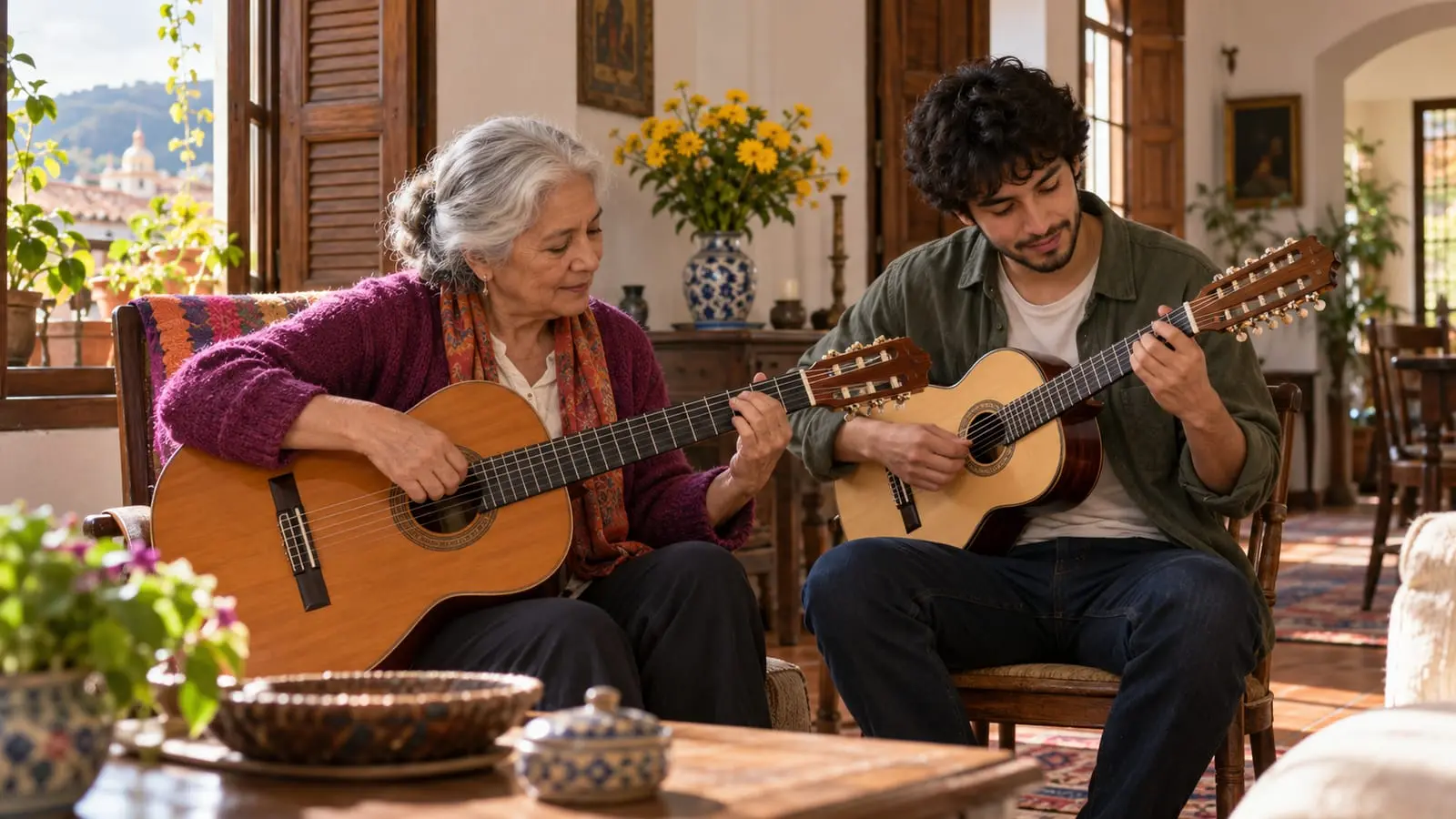
Colombian pasillo is written in 3/4, three beats per measure, and played on guitar and tiple with the bass on the first beat and chords through the rest of the measure, with a slight shift on the second beat that sets it apart from a waltz. It looks simple on paper, and it is easy to get started: the challenge is keeping the first beat clear as the tempo rises and giving your right hand that distinctive Andean sway.
Here you will find the beat step by step, a basic strumming pattern for guitar and another for tiple, chord progressions with diagrams, the difference between slow and fiestero pasillo, and a practice plan. If you would rather have a teacher correct your right hand, try in-home tiple lessons in Bogotá or online lessons, or acoustic guitar lessons.
In short
- Pasillo is in 3/4: the main accent falls on the first beat, usually marked by the bass.
- A common guitar pattern: bass on 1 and chords on the second half of 2 and on 3; the shift on the second beat distinguishes it from a waltz.
- On the tiple, strumming defines the feel; practice first with muted strings, counting aloud.
- Slow pasillo accompanies a song, while fiestero showcases instrumental skill: learn them in that order, increasing the metronome gradually.
- The most common progression is in a minor key, using tonic, subdominant, and dominant, often moving to the relative major in the second section.
What pasillo is and why it feels different from a waltz
Pasillo arrived with the European waltz in the 19th century and developed into a distinct genre in the Andes: danced with shorter steps (hence the name), sung, or played instrumentally, it is now one of the most recognizable rhythms in Colombian Andean music. It is also practiced in other Andean countries; in Ecuador, for example, it has a distinctive character. Here we focus on Colombian pasillo.
It shares a time signature with the waltz, but the accompaniment differs. This table sums up what you will hear when you listen to them back to back:
| Pasillo | Waltz | Bambuco | |
|---|---|---|---|
| Time signature | 3/4 | 3/4 | 6/8 or 3/4, with interlocking pulses |
| Typical accompaniment | Bass on 1; chords with a shift on 2 | Bass on 1 and evenly spaced chords on 2 and 3 | Strumming with accents alternating between two and three |
| Feel | Three beats with a forward push | Three regular dance beats | Swaying between two pulse patterns |
| Tempo | Slow and sung, or fast and virtuosic | Usually moderate | Moderate, with many variations |
| Where you will hear it | Andean songs, estudiantina ensembles, trio, bandola | Ballroom, popular song | Andean music, song, and dance |
For an overview of Colombian rhythms, see our guide to bambuco, pasillo, and cumbia explained.
The beat in 3/4: counting, accents, and subdivision
Before picking up your instrument, feel the meter. Count aloud 1 and 2 and 3 and: the numbers are the beats, and each “and” marks the halfway point. When you strum, your right hand moves down on the numbers and up on the “ands,” without ever stopping, like a pendulum.
- Open the pasillo metronome, set to 3/4 with an accent on the first beat and eighth-note subdivisions.
- Tap 1 with your foot, then clap softly on the second half of 2 and again on 3.
- Sing or hum the melody of a pasillo you know over that groove.
- Increase the tempo by 4 BPM only when the pattern feels automatic.
That clapping pattern is the backbone of the accompaniment: a strong 1 and a push halfway through 2. If you struggle to maintain it, review how to use a metronome to practice.
Pasillo on guitar: bass, chords, and the right hand
Here is the starting pattern for guitar. One measure, repeated; ↓ means a downstroke, ↑ an upstroke, and the dot is a rest for the hand (it moves through the air without touching the strings):
| Count | 1 | and | 2 | and | 3 | and |
|---|---|---|---|---|---|---|
| Right hand | ↓ | · | · | ↑ | ↓ | · |
| What you hear | Bass note (a low note of the chord) | Short chord stroke | Chord |
This is a teaching simplification: recorded pasillos include variations depending on the performer and piece. But this pattern is enough to accompany a song. For the bass, alternate the chord root and its fifth from one measure to the next: in A minor, A on the fifth string and E on the sixth.
How to practice without getting tangled up
- Start with muted strings: just the hand motion, counting “1 and 2 and 3 and.”
- Then use a single chord, such as A minor, keeping the bass separate from the strumming.
- Then use two chords, alternating every measure.
- The first beat should sound lower and more grounded than the rest; record yourself and check.
For other three-beat patterns, see basic guitar strumming patterns, where a simple waltz is the natural starting point.
Pasillo on tiple: the strumming that defines the feel
On the tiple, strumming takes center stage: its high register and double and triple string courses mean a well-placed stroke shapes the character of the whole piece. Pasillo's push is felt toward the third and sixth eighth notes, that is, on 2 and the “and” of 3. Here is a starting pattern:
| Count | 1 | and | 2 | and | 3 | and |
|---|---|---|---|---|---|---|
| Right hand | ↓ short | · | ↓ | · | · | ↑ |
| Intent | Soft: let the first beat breathe | Accent | Light accent |
When tiple and guitar play together, the guitar handles the bass and the tiple adds rhythmic color, so the tiple's first beat can be very light in that setting. If you play tiple alone, give it a little more presence. What matters is keeping the three-beat pulse clear to the listener.
- Start slowly with a relaxed hand; wrist tension holds back the strumming.
- Tune carefully before starting: an out-of-tune tiple spoils any rhythm. Use the tiple tuner or review how to tune the tiple.
- Tiple chords resemble those on the guitar's four highest strings, so your guitar knowledge comes in handy.
- If you are choosing between the two, read guitar or tiple: which to learn first.
Typical pasillo chords and progressions
Many pasillos are in minor keys and move through tonic, subdominant, and dominant chords. The classic A minor progression uses just three chords, with E7 as the dominant:
| Name | Progression | What it's for |
|---|---|---|
| Minor-key foundation | Am | Dm | E7 | Am | First complete exercise: tonic, subdominant, and dominant. |
| With a longer cadence | Am | E7 | Am | Dm | E7 | Am | Practice returning to the tonic. |
| Toward the relative major | Am | Dm | E7 | Am | C | G7 | C | Many pasillos move to the relative major in a second section. |
| Circle of fifths | Am | Dm | G7 | C | F | Dm | E7 | Am | Faster chord changes, typical of longer pieces. |
Play each progression with a single stroke per measure first, then with the full pattern. To understand why these chords work together, the circle of fifths shows it at a glance. Once you master A minor, transpose it to E minor with its dominant, B7.
Slow pasillo and festive pasillo
Two pasillos can sound worlds apart. One is a song, while the other is a dance piece or an instrumental showcase:
| Slow or song-style pasillo | Fiestero or instrumental pasillo | |
|---|---|---|
| Tempo | Slow and lilting | Fast, sometimes very fast |
| The role of guitar and tiple | Accompanying lyrics with a comfortable strumming pattern | Keeping a steady beat at speed, often with more elaborate arrangements |
| Main challenge | Keeping the first beat clear and the shift on 2 gentle | Right-hand endurance and clean chord changes |
| Listening examples | Espumas, by Jorge Villamil | La gata golosa and Vino tinto, by Fulgencio García |
Learn in that order. Start slow to develop your right hand, then move to the fast style, which relies on movements you have already made automatic. Once you go beyond about 150 BPM on the metronome, it helps to turn off subdivisions and leave only the beats. To choose pieces that progress in difficulty, see Colombian songs to learn on tiple or guitar.
A four-week practice plan
With about 20 or 30 minutes a day, you can make good progress. Here is a sensible sequence you can adjust to your level:
| Week | What to work on | Goal |
|---|---|---|
| 1 | Count in 3/4 with the metronome; right hand in the air and on muted strings | Keep a steady beat for 2 minutes without losing 1 |
| 2 | Basic strumming pattern on one chord (A minor); then Am and Dm | Change chords without stopping your hand |
| 3 | Am | Dm | E7 | Am progression with the full pattern | Play it 5 times in a row without mistakes |
| 4 | Accompany the melody of a slow pasillo you know | Sing or hum while strumming |
Common mistakes
- Playing pasillo like an even waltz. If all three beats sound the same, the shift on the second beat is missing.
- Speeding up without noticing. It is easy to rush pasillos; the metronome is your best friend.
- Strumming with your whole arm. The movement comes from your wrist; your arm simply follows.
- Forgetting the bass. On guitar, a first beat without a bass note leaves the measure without a foundation.
Learn pasillo with a teacher, at home or online
The right hand is the hardest thing to explain in writing and the easiest to correct live. A tiple or guitar teacher listens to your strumming, shows you the shift on the second beat, and tells you if you are straining your wrist, something you rarely notice on your own.
At A medio tono, we have tiple, acoustic guitar, and Andean bandola teachers, offering in-home lessons in Bogotá and nearby areas, depending on each teacher's availability, or online lessons from anywhere. If pasillo is your goal, tell us in your first message, and we will build the repertoire around it. See the options under in-home music lessons in Bogotá and online music lessons.
Frequently asked questions
What time signature is Colombian pasillo in?
In 3/4, with three beats per measure and the main accent on the first. It shares a time signature with the waltz, but its accompaniment shifts the second-beat chords, giving it a different feel.
What is the basic pasillo strumming pattern on guitar?
A simple pattern uses a bass note on the first beat, a short chord on the second half of the second beat, and another chord on the third. It is a starting point: recorded pasillos include variations you learn by listening.
Is pasillo the same as a waltz?
No. They come from the same family and share 3/4 time, but pasillo has its own accompaniment and character, with chord shifts that the waltz does not have. If you play it with three identical beats, it sounds like a waltz.
Is pasillo played the same way on tiple and guitar?
The beat is the same, but the roles change. In a trio, the guitar handles the bass and the tiple provides rhythmic strumming; alone, the tiple has to cover both. Tiple chords resemble those on the guitar's four highest strings.
Which pasillo should I learn first?
A slow, sung pasillo such as Espumas will help develop your right hand. Instrumental pasillos such as La gata golosa or Vino tinto are a later goal, because they require speed and endurance.
Sources
We checked the facts in this article against these sources on October 22, 2026.