Instruments of Colombia's Andean region: tiple, bandola, guitar, and more
Tiple, Andean bandola, and guitar form the traditional trio; requinto, guacharaca, and other percussion instruments round out Boyacá's rural folk music. A clear guide for school assignments and getting started playing.
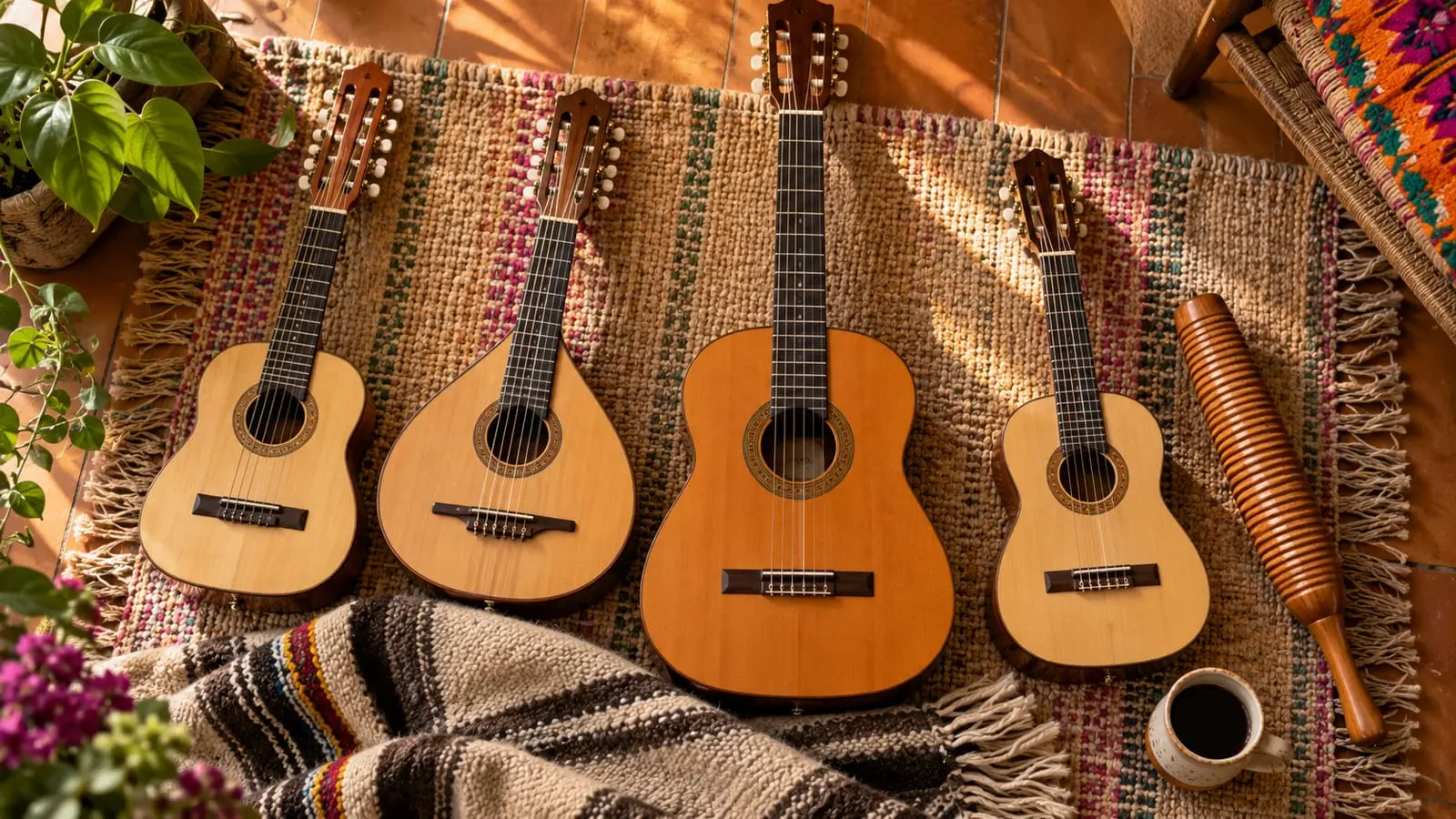
The instruments of Colombia's Andean region are mainly string instruments: the tiple, Andean bandola, and guitar, which together form the traditional trio. They are joined by the requinto, a high-register tiple that carries the melody in the rural folk music of Boyacá and Santander, and simple percussion: guacharaca, chucho, spoons, and esterilla.
These instruments bring bambucos, pasillos, guabinas, torbellinos, danzas, and carrangas to life. Here's a table for review, followed by what each instrument does, how they form trios and estudiantinas, and which genres they play. If any of this makes you want to play, you can start with tiple lessons at home in Bogotá or online.
In short
- The traditional Andean trio consists of bandola (melody), tiple (harmony and rhythm), and guitar (bass lines and harmony).
- The tiple has 12 metal strings in four courses of three, tuned D, G, B, and E; it is the region's most recognizable musical symbol.
- The Andean bandola is played with a pick and is known for tremolo: rapidly repeating a note to make it sound sustained.
- In Boyacá and Santander, rural folk music and carranga use tiple, requinto, guitar, and guacharaca.
- The main styles are bambuco, pasillo, guabina, torbellino, and danza; almost all grew out of a mix of European, Indigenous, and African traditions.
Andean instruments in a table
Colombia's Andean region covers the mountainous areas in the center of the country: Antioquia, the Eje Cafetero, Cundinamarca, Boyacá, Santander, Tolima, and Huila, among others. The same family of plucked string instruments is found throughout, with local variations in percussion.
| Instrument | Family | What it does | Where you'll hear it |
|---|---|---|---|
| Tiple | Plucked strings, 12 metal strings | Harmony and rhythm through strumming patterns; sometimes picking | Traditional trio, estudiantina, duo, rural folk music |
| Andean bandola | Strings plucked with a pick | Melody, ornamentation, and tremolo | Traditional trio and estudiantina |
| Guitar | Plucked strings, 6 strings | Bass lines that move between chords, plus harmony | Almost every ensemble type |
| Requinto (tiple requinto) | Plucked string instrument, 12 strings | Melody in a bright, high register | Rural folk music and carranga from Boyacá and Santander |
| Guacharaca | Scraped percussion | Marks the beat with a dry sound | Carranga and rural folk music |
| Chucho | Shaken percussion (rattle) | Rhythmic texture, accompanying torbellino | Torbellino and other rural folk styles |
| Spoons | Struck percussion | Marks the rhythm by striking them together | Rural folk music, torbellino |
| Esterilla and alfandoque | Scraped and shaken percussion | Rhythmic accompaniment; names and shapes vary by area | Traditional music from several areas |
The strings: tiple, bandola, guitar, and requinto
The tiple
It has twelve metal strings grouped into four courses of three, tuned D, G, B, and E, and a body smaller than a guitar’s. In three of the courses, the middle string sounds an octave lower than the outer strings, giving it that shimmering, overtone-rich sound. Many people consider it the country’s most representative instrument. It is played with strumming patterns that give each style its character, and with plucked notes in solos. To tune it, see how to tune the tiple and the tiple tuner.
The Andean bandola
It is the melodic voice of the trio. It is played with a plectrum, and its most characteristic technique is tremolo: repeating the same note very quickly so it sounds sustained, almost sung. It is tuned in fourths across six courses (G, D, A, E, B, and F♯), and most commonly has 16 strings arranged in two double courses and four triple courses; 14-string versions also exist. You can try the Andean bandola tuner. Learn more about studying it in why learn tiple and bandola.
The guitar
It came from Spain and became the harmonic foundation of Andean music. In the trio, it does two things: plays the bass lines that move from chord to chord and fills out the harmony. It's also the instrument most people play before moving to tiple, since the two are related: see guitar or tiple. If you'd like to start with it, we offer acoustic guitar lessons.
The requinto
The tiple requinto, or Colombian requinto, uses the same notes as the tiple’s outer strings (D, G, B, and E), but unlike the tiple, its strings are usually tuned in unison within each course, without octave strings. The result is a focused, bright sound suited to carrying the melody. It has its own requinto tuner. Do not confuse it with the requinto of other Latin American traditions: that is a different instrument.
Mountain percussion
Andean music is mainly string-based, but rural traditions add simple percussion, sometimes made from materials found in the countryside. Names and shapes vary from area to area, so if your assignment asks for a definition, use the one taught at your school.
- Guacharaca: a ridged tube scraped with a stick or pick. It marks the beat in carranga and also appears in other Colombian music, such as vallenato.
- Chucho: a rattle that is shaken to add rhythmic texture; it accompanies torbellino, for example.
- Spoons: struck together like castanets to mark the rhythm.
- Esterilla and alfandoque: scraped or shaken instruments found in different regions, with uses that vary by tradition.
If you're interested in percussion as a way to learn music, our percussion lessons work on the beat and patterns used to play any of these styles.
How they form ensembles: trio, duo, estudiantina, and carranga group
| Format | Instruments | Typical repertoire |
|---|---|---|
| Traditional trio | Bandola, tiple, and guitar | Instrumental or sung bambucos and pasillos, danzas, guabinas |
| Vocal duo | Two voices with guitar and tiple | Sung bambucos and pasillos |
| Estudiantina | Several bandolas, tiples, and guitars; sometimes other instruments | Andean repertoire and ensemble arrangements, common in schools and universities |
| Carranga ensemble | Tiple, requinto, guitar, and guacharaca | Rural folk music and carranga from Boyacá and Cundinamarca |
Playing together is essential to this music, and the best way to understand how the instruments fit together is to hear a live trio. Events celebrate Colombian music, such as Festival Mono Núñez in Ginebra, Valle del Cauca; check current dates and programming before going. To understand how the roles are shared, read Colombian Andean music: a getting-started guide.
Many Andean towns also have wind bands, with brass and percussion, that bring festivities and processions to life. They offer a different world of sound; if you're interested, see wind bands in Colombia: how to get started.
Genres played on these instruments
| Genre | Character | Featured instruments |
|---|---|---|
| Pasillo | In 3/4, descended from the European waltz; can be festive or slow and nostalgic | Traditional trio, duo, estudiantina |
| Bambuco | Combines a 6/8 pulse with a 3/4 pulse, creating its distinctive sway | Traditional trio, duo, estudiantina |
| Danza | Slow and romantic | Traditional trio and estudiantina |
| Guabina | A lyrical, sung style from Santander, Boyacá, Tolima, and Huila | Tiple, requinto, guitar |
| Torbellino | A rural folk style from Santander and Boyacá | Tiple, requinto, guitar, and simple percussion |
| Carranga | Festive rural folk music from Boyacá and Cundinamarca | Tiple, requinto, guitar, and guacharaca |
To get a feel for how to count them, open the bambuco metronome, the pasillo metronome, or the guabina metronome. For a closer look at the differences, see our guide to Colombian rhythms: bambuco, pasillo, and cumbia.
Instruments of Boyacá and carranga
When someone asks about the instruments of Boyacá, the short answer is tiple, requinto, guitar, and guacharaca. Boyacá has a strong rural string tradition, with coplas, torbellinos, and guabinas. It is also the birthplace of carranga, a festive, humorous music popularized by Boyacá composer Jorge Velosa and his group Los Carrangueros de Ráquira.
In a carranga ensemble, the requinto carries the melody, the tiple and guitar provide accompaniment, and the guacharaca keeps the beat, while the singer sings verses about rural life. Rhythms such as merengue carranguero and rumba criolla are part of its repertoire.
What about the quena and zampoña? The southern Andes
To avoid confusion: the quena, zampoña, and charango belong mainly to the Andean music of Peru, Bolivia, and the Altiplano. In Colombia's southern Andes, departments such as Nariño and Cauca share traditions with Ecuador, and you'll hear panpipes and other instruments with that sound. But when schools refer to “Colombia's Andean region,” they almost always mean the center of the country and its strings: tiple, bandola, and guitar.
The southern Andean region also hosts celebrations such as Carnaval de Negros y Blancos de Pasto, inscribed on UNESCO's Intangible Cultural Heritage list. Check current information on UNESCO's official website if you need it for an assignment.
Want to play them? Where to start
You can learn all three of the trio's string instruments from scratch, and each gives you a different role: melody on bandola, strumming on tiple, and bass lines on guitar. If you already play guitar, tiple is a natural next step. See how long it takes to learn tiple for a realistic idea, and how to choose a tiple or bandola before buying.
At A medio tono, you can take tiple lessons and Andean bandola lessons at home in Bogotá and nearby areas, depending on each teacher's availability, or online from anywhere. A teacher helps with strumming patterns, muting, and each style's character, which are best learned by listening and playing with someone who knows them. If you're still unsure which instrument to choose, message us on WhatsApp and we'll guide you. For an overview of the whole country, see traditional instruments of Colombia.
Frequently asked questions
What are the instruments of Colombia's Andean region?
The main instruments are tiple, Andean bandola, and guitar, which form the traditional trio. Rural folk music from Boyacá and Santander adds requinto and percussion such as guacharaca, chucho, and spoons.
What are the traditional instruments of Boyacá?
The tiple, requinto, guitar, and guacharaca, the instruments of carranga and the rural music of Boyacá.
What's the difference between the tiple and the Andean bandola?
The tiple has twelve strings in four courses of three, is played with the fingers, and provides rhythm and harmony. The bandola is played with a pick, has six courses, and carries the melody using tremolo.
Is the quena an instrument of Colombia's Andean region?
It isn't the characteristic instrument of the country's central region. The quena belongs to the Andean music of Peru and Bolivia. Colombia's southern Andes have flutes from traditions shared with Ecuador, but the traditional trio consists of tiple, bandola, and guitar.
Which Andean instrument is easiest to learn?
If you already play guitar, tiple is the most natural choice because its tuning is related to the guitar's first four strings. Bandola requires learning pick technique. The most important thing is to listen closely and often to the style as you practice.
Sources
We checked the facts in this article against these sources on October 22, 2026.
- Universidad de Antioquia, Grupo Músicas Regionales: music for the Colombian Andean string trio (1954-2013)
- Transactions of the ISMIR: sesquialtera in Colombian bambuco (tiple, bandola, and guitar)
- Wikipedia: Colombian Andean bandola (tuning, courses, and plectrum)
- Canal Trece: Jorge Velosa, biography and carranga (requinto, guitar, tiple, and guacharaca)
- UNESCO: the Carnaval de Negros y Blancos de Pasto (inscribed in 2009)