Instruments of Colombia’s Pacific coast: marimba de chonta, cununos, bombos, and guasá
Marimba de chonta, male and female cununos, bombos, guasá, cantaora voices, and northern chirimía: the instruments of Colombia’s Pacific coast and how they sound together.
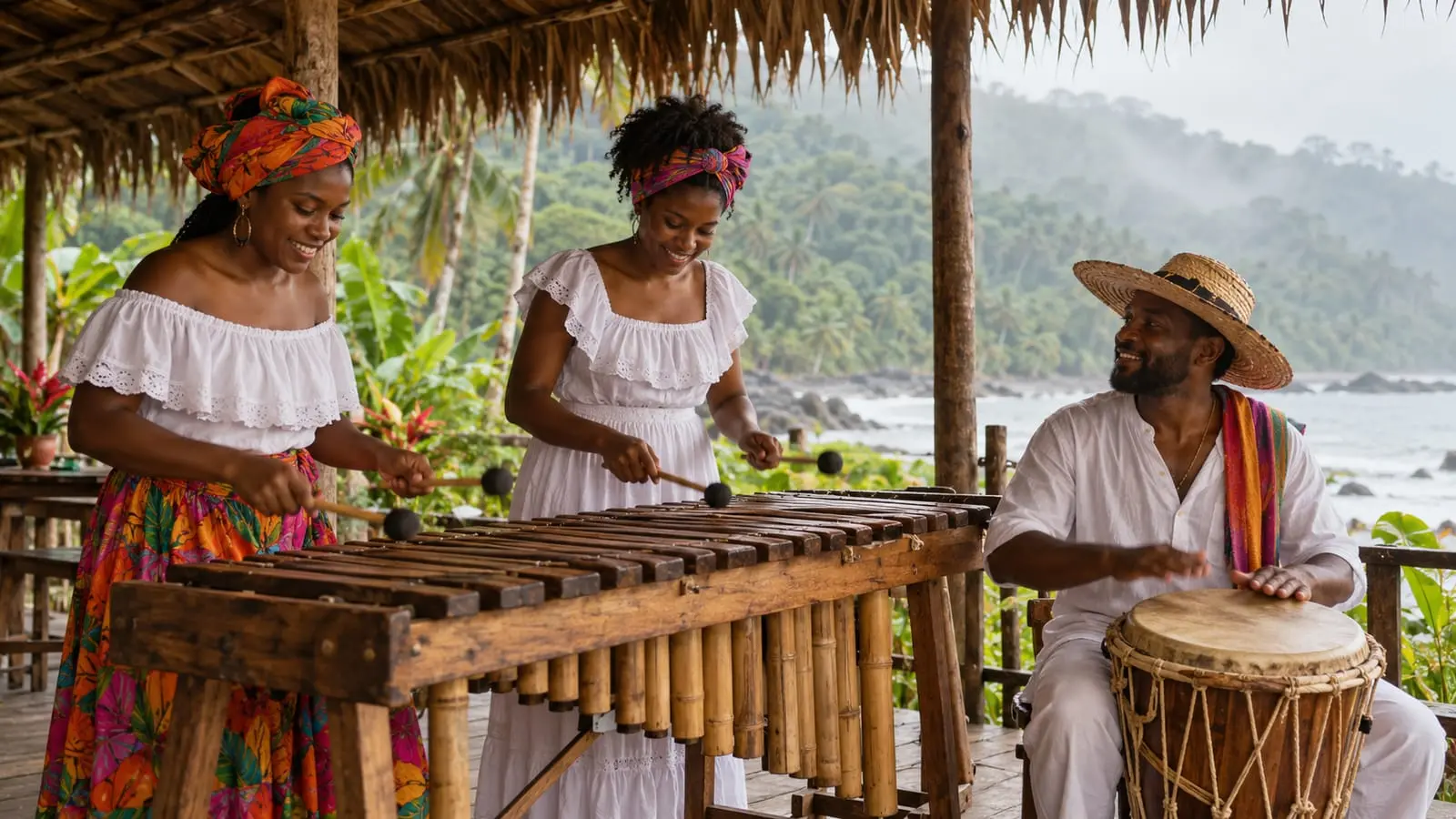
The musical instruments of Colombia’s Pacific coast are mainly percussion and voices: the marimba de chonta, cununos (male and female), bombos (golpeador and arrullador), guasá, and the singing of the cantaoras. Together, they bring currulao, bunde, and arrullo to life in the south of the region. In the north, in Chocó, chirimía bands play the music, with clarinet, euphonium, snare drum, cymbals, and bass drum.
Understanding who does what in the ensemble changes how you listen to this music and how you learn rhythm in general. If you’d like to turn that listening into hands-on practice, percussion and drum lessons cover the pulse, subdivisions, and the 6/8 time signature used in currulao. Here’s the full picture, from the instruments to the celebrations where they’re played.
In short
- The sound of the southern Pacific coast comes from the marimba de chonta, two cununos, two bombos, guasás, and voices; together, they play currulao.
- The marimba de chonta has chonta palm wood bars above guadua bamboo resonators and is played with mallets, usually by two marimba players.
- Male and female cununos are single-headed conical drums played with the hands; bombos are double-headed drums played with mallets: the golpeador and the arrullador.
- The guasá is a guadua bamboo tube filled with seeds that you shake; it’s often played by the cantaoras, who lead the call-and-response singing.
- In the northern Pacific region, in Chocó, chirimía brings together clarinet, euphonium, snare drum, cymbals, and bass drum; the marimba music of the south is UNESCO-recognized intangible cultural heritage.
A map of sounds: marimba in the south, chirimía in the north
Colombia’s Pacific coast, stretching from Chocó to Nariño, has two main musical traditions. On the southern Pacific coast (Buenaventura, Guapi, Timbiquí, Tumaco, and surrounding areas), instruments of African heritage take the lead: marimba, drums, guasá, and voices. On the northern Pacific coast, especially in Chocó, chirimía, an ensemble of wind instruments and band percussion, is well known.
A listening tip: almost nothing is melody alone. Pacific music is rhythm, response, and chorus: the marimba and voice sing, the drums drive things forward, and the guasá sustains the texture. To compare this ensemble with those of other regions, explore Colombia’s traditional instruments by region.
| Instrument | Family | How it is played | Role in the ensemble |
|---|---|---|---|
| Marimba de chonta | Melodic percussion (idiophone) | With two mallets, played by one or two marimba players. | Melody, bass, and ornamentation; the heart of the sound. |
| Male cununo | Single-headed membranophone | With the hands. | The larger, lower-pitched one: adds fills and variations over and between the beats of the rhythmic foundation. |
| Female cununo | Single-headed membranophone | With the hands. | The smaller, higher-pitched one: lays down the rhythmic foundation. |
| Bombo golpeador | Double-headed membranophone | With a mallet. | The larger one: can improvise within the rhythmic framework. |
| Bombo arrullador | Double-headed membranophone | With a mallet. | The smaller one: keeps a steady rhythm with few variations. |
| Guasá | Shaken idiophone | Shaken with both hands. | A steady texture, like a cushion of sound. |
| The cantaora’s voice | Voice | Call-and-response singing. | Leads the singing; the chorus responds. |
The marimba de chonta, the heart of the ensemble
The marimba de chonta is an instrument with wooden bars: the bars are made from chonta palm, a hard, durable wood, and suspended from a frame above guadua bamboo resonators, bamboo tubes cut to different lengths that amplify the sound and give it a warm tone. It’s played with two mallets, one in each hand. Each bar produces a note; longer bars sound lower, and shorter ones sound higher.
It’s common for two marimba players to play at the same time: one handles the bass, or bordón, and the other the melody and ornamentation, sharing the bars of the same marimba. The conversation between each player’s hands and between the two musicians is part of its magic.
To get to know its sound, first listen to a currulao recording and follow only the marimba; then follow only the bombo. It’s a good exercise in selective listening, the same skill practiced in Latin percussion and drumming lessons.
Cununos and bombos: the drums of the Pacific coast
Male cununo and female cununo
Cununos are cone-shaped drums with a single animal-skin head, played with the hands. They always come in a pair: the cununo macho, larger and lower-pitched, and the cununo hembra, smaller and higher-pitched. In currulao, they share the work: the hembra lays down the rhythmic foundation, while the macho adds fills and embellishments over it.
Bombo golpeador and bombo arrullador
Bombos are double-headed drums played with mallets. They are also played in pairs. The bombo arrullador, the smaller one, keeps a steady rhythm with few variations; the bombo golpeador, the larger one, can improvise within the rhythmic framework according to the intensity of the music.
Currulao is in 6/8, a compound duple meter, with a distinctive polyrhythm in the drums that you can practice with the currulao metronome. If 6/8 still feels confusing, time signatures explained will give you the basics.
The guasá and the cantaoras
The guasá is a sealed guadua bamboo tube filled with seeds, shaken from side to side. It looks simple, yet it’s essential: it sustains the rhythm’s continuous motion, creating a texture that supports the other instruments. Usually two or more are played at once, often by the same women who sing.
These women are the cantaoras, whose voices take center stage rather than provide backing. The singing follows a call-and-response structure: a lead voice starts a phrase and the chorus answers, while the drums and marimba sustain the foundation. The tone is often open and powerful, without a microphone, because it comes from a tradition of singing outdoors, at home, and at celebrations.
For singers, listening to the cantaoras is a lesson in phrasing, breathing, and volume control. If you want to develop your own voice, singing lessons focus on technique and sustaining your singing comfortably, and your voice type helps you understand the range where you sing best.
Currulao, bunde, and arrullo: what these instruments play
The same group of instruments serves music with very different purposes, from celebrations to rituals:
- Currulao: festive marimba music and dance in 6/8. It’s the best-known rhythm and lends its name to the whole ensemble. Some versions are faster and others more lilting, depending on the place.
- Juga: another festive form of dance and singing from the region.
- Bunde and arrullo: religious songs with voices and drums, accompanying celebrations of saints and the Christ Child.
- Chigualo and alabao: farewell songs at wakes; chigualo is for a child who has died, and alabao for an adult.
The fact that one community uses the same ensemble to dance, celebrate, and say goodbye to its dead shows the role this music plays: it’s memory, faith, and daily life all at once. To compare it with rhythms from other regions, see bambuco, pasillo, and cumbia explained.
Chirimía of the northern Pacific coast
In Chocó, another family of instruments comes together in the chirimía. This village band ensemble usually brings together clarinet, euphonium, snare drum, cymbals, and bass drum, sometimes with other wind instruments. They play dances and ballroom styles adapted to the coast, such as contradanza, polka, mazurka, and jota, as well as the region’s own rhythms.
| Marimba ensemble (south) | Chirimía (north) | |
|---|---|---|
| Main instruments | Marimba, cununos, bombos, guasá, voices | Clarinet, euphonium, snare drum, cymbals, bass drum |
| Melody | Carried by the marimba and singing | Carried by wind instruments |
| Origins of the repertoire | Songs and dances of African heritage | Popular dances reinterpreted in the region |
| Where you’ll hear it | Celebrations, arrullos, and festivals | Patron saint festivals and parades |
Compare the two ensembles and the difference is clear: chirimía emphasizes wind instruments and a clear melody; in the south, it’s the drums’ polyrhythms and collective singing. Two sides of the same coast.
Heritage and festivals: Pacific music today
In 2010, UNESCO added “Marimba music and traditional chants and dances from the Colombian South Pacific region” to its intangible cultural heritage list; in 2015, the inscription was expanded to include Ecuador through the province of Esmeraldas. It recognizes the communities that pass this music on. For details of the inscription, visit the UNESCO website and check the current information.
To hear this music live, the main stage is the Festival de Música del Pacífico Petronio Álvarez, in Cali, which brings together marimba ensembles, chirimía bands, Cauca violin groups, and traditional singing each year. It’s named after Petronio Álvarez, a composer born in Buenaventura. Check official channels for dates and programming, since they change from year to year.
How to explore these rhythms
Marimba de chonta and cununos are best learned from teachers rooted in the tradition; if that’s your goal, look for Pacific music schools and groups. A music teacher can help you build the foundation that makes everything easier: a steady pulse, reading 6/8, hand coordination, and an ear for following several lines at once. That preparation helps with currulao and any other rhythm you want to play.
At A medio tono, every teacher is evaluated on musicianship, teaching skills, and personal qualities before their first lesson. You can take percussion and drum lessons to work on rhythm and coordination, or singing lessons for phrasing and voice, at home in Bogotá and surrounding areas (depending on each teacher’s availability) or online from anywhere.
Frequently asked questions
What are the instruments of Colombia’s Pacific region?
In the south, the marimba de chonta, male and female cununos, golpeador and arrullador bombos, guasá, and the voices of the cantaoras. In the north, Chocó chirimía with clarinet, euphonium, snare drum, cymbals, and bass drum.
What is the marimba de chonta?
It’s a melodic percussion instrument with chonta palm wood bars suspended above guadua bamboo resonators. It’s played with two mallets and is the central instrument in currulao.
What instruments are used in currulao?
Marimba de chonta, two cununos, two bombos, guasás, and voices. It’s played in 6/8 time.
What is the guasá?
A sealed guadua bamboo tube filled with seeds, shaken to produce a continuous sound that sustains the rhythm. It’s often played by the cantaoras.
Where can you hear Pacific music live?
The Festival de Música del Pacífico Petronio Álvarez, in Cali, is the main stage, along with local celebrations in coastal towns. Check official channels for current dates and programming.
Sources
We checked the facts in this article against these sources on October 22, 2026.
- Smithsonian Folkways: ¡Arriba suena marimba! Currulao, notes on the marimba and drums of the southern Pacific coast
- UNESCO: marimba music and traditional songs and dances of Colombia’s southern Pacific region and Esmeraldas (Ecuador)
- Alberto Londoño (Dialnet): currulao, characteristics of the music and dance
- Radio Nacional de Colombia: the marimba of Nariño’s Pacific coast
- Cancillería de Colombia: the chirimía of Chocó travels to Cuba
- Radio Nacional de Colombia: Festival de Música del Pacífico Petronio Álvarez, 2023 schedule