Music lessons for adults in Bogotá: options, schedules, and how to start from scratch
Cajas de compensación, university extension courses, academies, and private lessons: what each offers working adults, plus a 90-day plan to start from scratch.
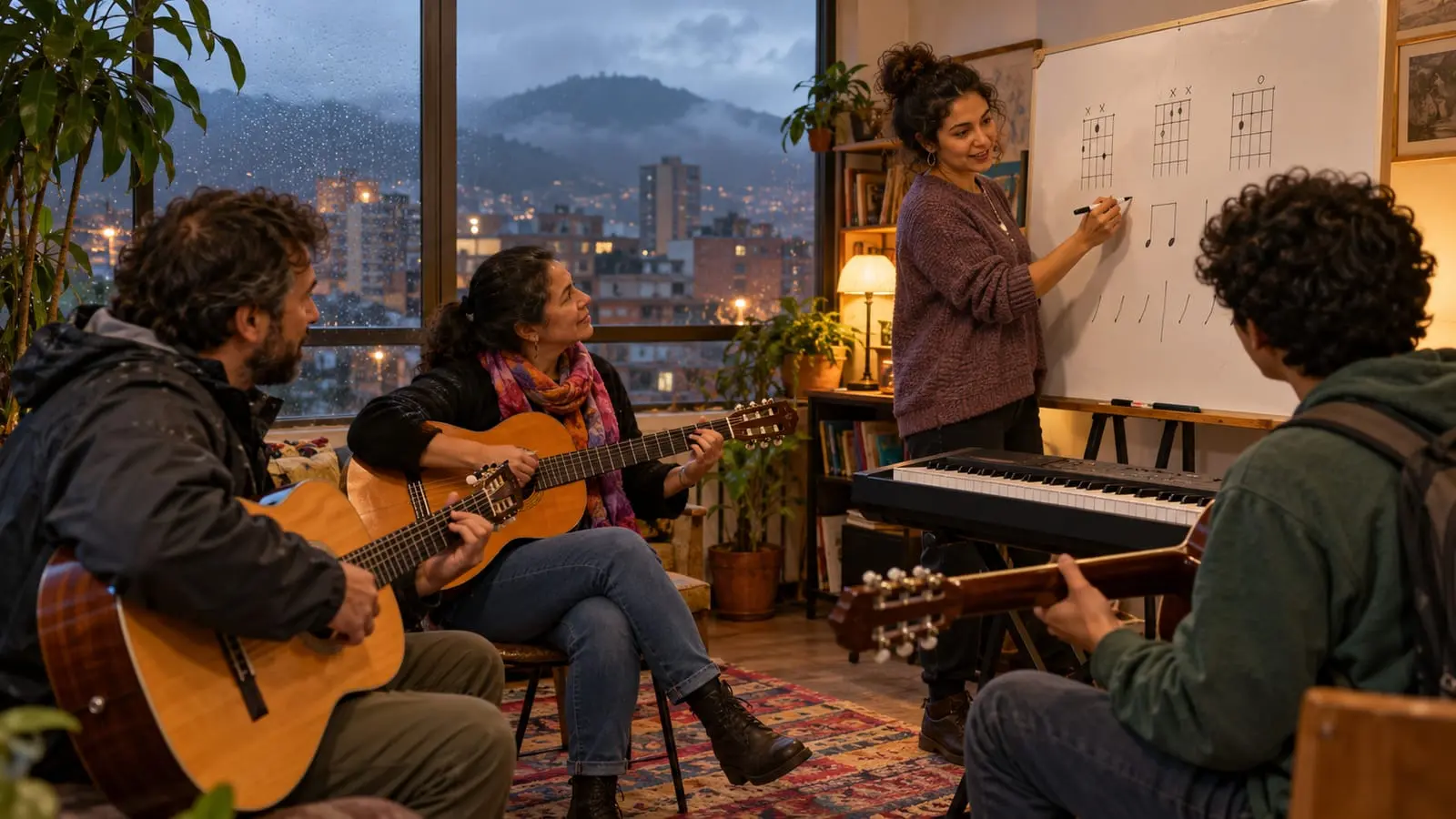
In Bogotá, adults who want to learn music have four real options: courses offered by family compensation funds (cajas de compensación), university extension courses, academies, and private lessons. The best choice depends on your schedule and how much individual attention you need: if you work changing hours or spend hours commuting, in-home music lessons in Bogotá or online lessons are often a good fit; if you want community and a steady pace, a group course makes sense.
You don't need any prior knowledge or your own instrument on the first day. Here, we compare the options honestly, including their limitations, and share a 90-day plan for people who work, have a family, and fit practice into the gaps in their week.
In short
- Cajas de compensación and university extension courses offer groups with fixed schedules, limited spots, and term-based programs; always check each institution's current offerings.
- An academy offers structure, ensembles, and fellow students; private lessons offer individual attention and schedules that fit your week.
- For an adult with a demanding workday, logistics matter more than the instrument: travel time, lesson time, and where you practice.
- A specific goal (accompanying a song, playing at a party, singing in a choir) gives learning more direction than “learning music.”
- In 90 days, with 15 to 30 minutes of practice almost every day, you can go from scratch to playing or singing your first complete pieces.
The four real options for adults in Bogotá
Before choosing an instrument, choose a format. Each meets different needs, and what follows is a general overview: offerings, schedules, requirements, and costs change each term, so always check each institution's current information.
| Cajas de compensación | University extension | Academies | Private teacher | |
|---|---|---|---|---|
| Format | Term-based group courses | Open-enrollment or extension courses, sometimes with faculty members | Group or individual, with a level-based plan | Individual, tailored to you |
| Schedule | Fixed, as set by the program schedule | Fixed, by semester or cycle | The academy's time slots | You agree on it with your teacher |
| Travel | You go to the course location | You go to campus | You go to the academy | The teacher comes to your home, or you take the lesson online |
| Pace of progress | The group's pace | The program's | The level's | Your own |
| Ensembles and fellow students | Yes, it's a group | Yes, depending on the course | Yes, there are usually ensembles | No, unless you add it separately |
| Individual attention | Limited by group size | Limited | Depends on the format | Full |
| Ideal if… | You want to try learning with others and can fit a fixed schedule | You're interested in a university setting or theory | You want structure and a musical community in one place | Your schedule changes or you want to progress at your own pace |
Some family compensation funds (cajas de compensación), such as Compensar, Cafam, and Colsubsidio, offer or have offered music and arts workshops for members and, in some cases, the general public. Some universities in the city offer non-degree or extension courses open to people who are not enrolled there, and Idartes offers free music workshops at Crea centers. We don’t list schedules or prices because they change: check their official websites before deciding.
What group courses offer and where they fall short
A group course has real advantages: it gets you to show up, you meet people with the same interest, and the cost is shared. For many adults, that commitment to a group is exactly what they need to keep going.
There are also limitations worth knowing before you enroll:
- One pace for everyone. If you progress faster or slower than the group, or miss a week because of work, it can be hard to catch up.
- Little individual feedback. In a large group, the teacher doesn't have time to look closely at your posture, breathing, or right hand.
- Fixed schedule. If your work hours change, it's easy to miss lessons.
- Commuting. After a workday in Bogotá, getting to a lesson at 6 pm can take more effort than the lesson itself.
For a closer comparison, read music academy or private teacher and private or group music lessons.
Private lessons: why they often fit a busy schedule
When your week is unpredictable, flexibility matters more than almost anything else. With a private teacher, you adjust the schedule and pace, skipping what you already know to focus on your goal, whether it's accompanying songs on guitar, playing ballads on piano, or singing without fear.
| Format | When it makes sense | What to consider |
|---|---|---|
| At home in Bogotá | You want to skip the commute and practice in your own space, with your instrument | A corner with a chair and good lighting; the teacher comes to your home, depending on their availability |
| Online | You work from home, travel, or live outside Bogotá | A stable connection and headphones; the teacher gives feedback by video |
| Mixed | You want the personal connection of in-person lessons and the convenience of online lessons during busy weeks | Arranged with your teacher; read more in hybrid lessons |
If you're deciding between in-person and online lessons, see the comparison in in-home or online music lessons. And if you're choosing a teacher for the first time, how to choose a music teacher gives you specific questions to ask.
Which instrument to choose when starting as an adult
There's no “perfect” instrument; there's the one that excites you and fits your life. These are the most common paths for adult beginners:
| Instrument | Why people choose it | What you should know |
|---|---|---|
| Piano | It's visual, organized, and lets you play melody and chords at the same time | With a digital piano with weighted keys, you can practice with headphones. More in learning piano as an adult |
| Acoustic guitar | Accompanying songs is the most common goal | Your fingertips hurt for the first few weeks, then develop calluses. More in learning guitar as an adult |
| Singing | Singing better, staying in tune, and becoming comfortable with your own voice | You don't need an instrument, but you do need consistent breathing exercises and warm-ups. Discover your vocal range with the voice type test |
| Violin | It's a challenge that appeals to people who love the sound of strings | The beginning is demanding: intonation depends on your ear and hand. More in learning violin as an adult |
| Saxophone | It's very expressive and can sound good early on | It takes breath control and patience with your embouchure; it's a loud instrument, so it's worth agreeing on practice times with your neighbors |
If you're still unsure, you can start with theory through music theory and solfège lessons, which help with any instrument. And if you live in an apartment, see how to play an instrument in an apartment without disturbing your neighbors: it may change your choice of instrument.
Define your goal and find time
Adults learn well when they know why they're learning. A specific goal with a deadline sustains practice better than a vague intention. Some examples:
- Accompany three songs at the next family gathering.
- Read a simple piano score in three months.
- Sing a complete song in tune in front of someone else.
- Play at a party or in a small group within six months.
As for time, you don't need hours. Between 15 and 30 minutes almost every day goes further than one long session on Sunday. Tie practice to something you already do: after coffee, before your shower, when you get home from work. How to practice music at home and how many hours to practice a day offer more ideas, while is it too late to learn music at 30, 40, or 50? answers the question almost everyone has when starting out.
Your first 90 days: a plan for working adults
This plan assumes one lesson a week and short practice sessions between lessons. Adjust the timing with your teacher:
| Period | What to do | Signs you're on track |
|---|---|---|
| Days 1 to 14: lay the groundwork | Define your goal, choose a format and schedule, and get your instrument and a dedicated practice corner ready. First lessons: posture, basic sound production, and beginning music reading. | You have a fixed weekly appointment and a place to practice |
| Days 15 to 30: build the habit | Practice for 15 minutes almost every day. Learn your first chords, notes, or breathing exercises. Use the metronome at a slow tempo. | You can do the basic exercises without looking as much |
| Days 31 to 60: your first piece | Choose a simple piece or song you like and work on it in sections at a slow tempo. | You play or sing the first complete section with few mistakes |
| Days 61 to 90: play it from start to finish | Put the sections together, record yourself on your phone, listen, and make corrections. Play for someone you trust. | You perform a complete piece and choose the next one |
How an A medio tono teacher supports you
Every teacher is evaluated on musicianship, teaching skills, and personal qualities before giving their first lesson. With adult learners, that shows up in concrete ways: asking about your goals and availability before starting, building a repertoire around music you enjoy, and explaining the purpose of each exercise without treating you like a child.
You can choose in-home music lessons in Bogotá, depending on each teacher's availability, or online music lessons from any city. Book through WhatsApp: tell us your instrument, level, and availability, and we'll help you find the right person.
Frequently asked questions
Can I learn music as an adult if I've never played anything?
Yes. Many adults start from scratch and go on to enjoy playing or singing. What matters most is a specific goal, short and regular practice, and a teacher who adapts lessons to your pace and tastes.
How long should I practice as an adult beginner?
Between 15 and 30 minutes almost every day goes further than one long session a week. During busy weeks, five minutes keeps the habit going.
What's better for an adult: a group course or private lessons?
It depends on your priorities. A group course gives you fellow students and a schedule that gets you to show up; private lessons give you individual attention and flexibility. If your schedule changes a lot or you want to progress at your own pace, private lessons are often a better fit; you can also combine both.
Do I need to buy an instrument before starting?
Not necessarily. In your first conversation with your teacher, you can decide which instrument to buy and what kind. A digital piano or a reasonably good acoustic guitar is enough to start; ask for advice before spending.
Can I take online music lessons from Bogotá?
Yes. Live online lessons are a useful option if you work from home or want to avoid commuting. You need a stable connection, headphones, and a quiet space.
Sources
We checked the facts in this article against these sources on October 22, 2026.