Colombian December songs on guitar: chords and rhythms for the holiday season
With four or five open chords and a strumming pattern for each rhythm, you can accompany the novena and December celebrations. We explain which ones to use, in what keys, and how to practice them starting in November.
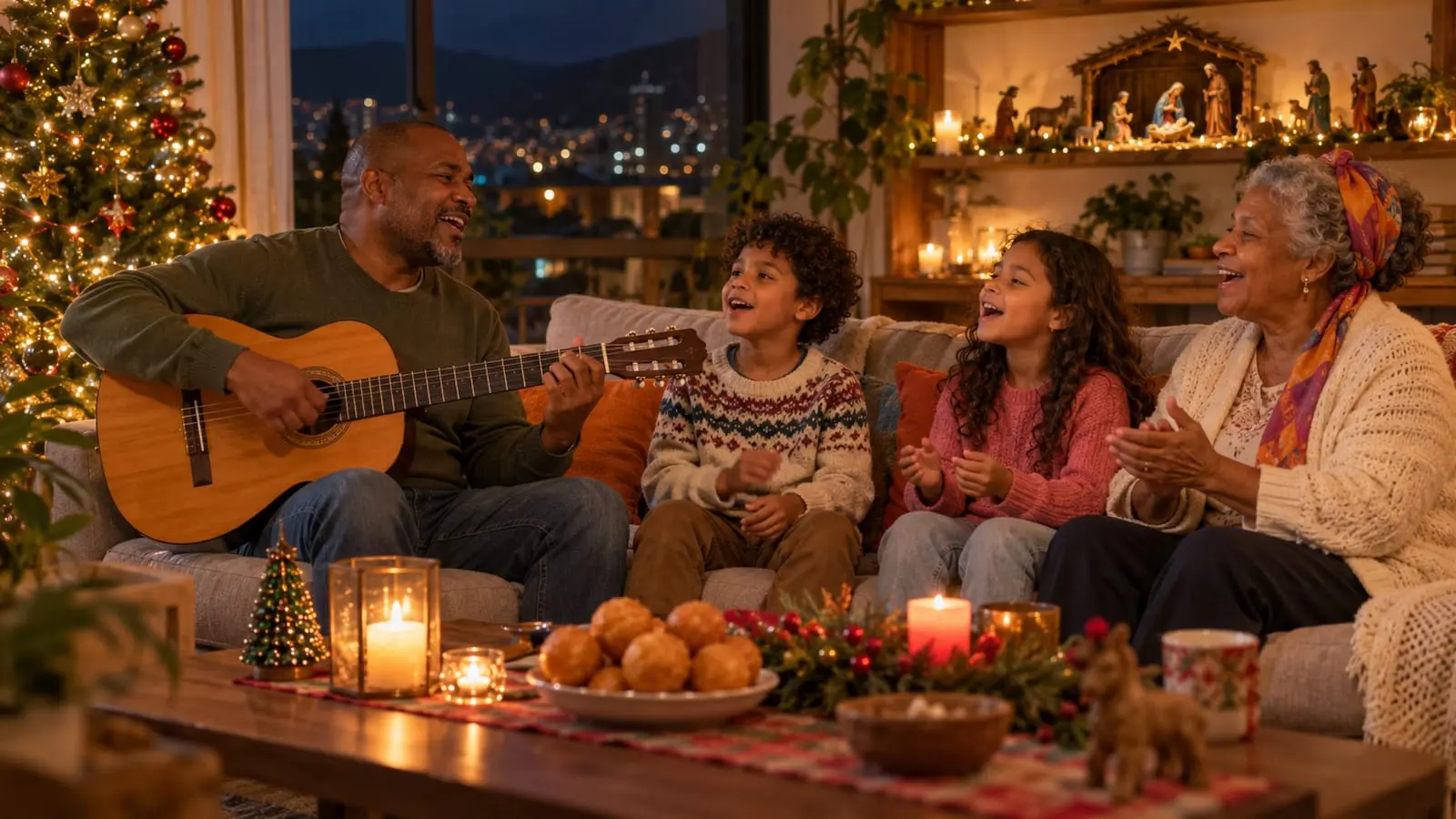
To play Colombian December songs on guitar, you need two things: a few open chords, such as G, C, D7, E minor, and A minor, and the strumming pattern for each rhythm. The novena's Christmas carols use a simple pulse and almost always three chords; the merengue, paseo, porro, and cumbia heard at parties call for stronger, more rhythmic strumming.
Here we group them by rhythm, with the easiest keys and chords for each, plus a practice plan to have a repertoire ready for the novena from December 16 to 24. If you're starting out, guitar lessons at home in Bogotá or online can help. We don't include lyrics or chord charts for copyrighted songs: we teach you to work out the key and chords of the songs you like yourself.
In short
- Traditional Christmas carols use three chords (I, IV, and V7); in G major, these are G, C, and D7.
- There are four rhythm families in December: Christmas carols, merengue, paseo (vallenato), and porro or cumbia; each calls for a different strumming pattern.
- The most comfortable guitar keys are G, C, D, and A minor because they use open chords.
- If the key doesn't suit your family's voices, a capo raises it without changing the chord shapes.
- With about 20 minutes of daily practice from mid-November, it's reasonable to expect to play three or four songs confidently by the novena.
Four rhythm families for December
December in Colombia brings music from different origins. The novena's Christmas carols and gozos come from religious and folk traditions; merengues and paseos are danced at parties; porro and cumbia come from the Caribbean region. Once you identify a song's family, you know which strumming pattern to use.
| Family | Repertoire examples | Time signature and feel | Comfortable keys |
|---|---|---|---|
| Christmas carols and gozos | Tutaina, Los peces en el río, Vamos pastores, Noche de paz | 2/4, 4/4, or triple feel (6/8 or 3/4), relaxed pulse | G, C, D, and A minor |
| Merengue | Songs by tropical dance bands for holiday parties | 2/4, fast and danceable | G, D, and C |
| Paseo vallenato | Christmas songs in vallenato style | 4/4, moderate, with alternating bass and chords | C, G, and D |
| Porro and cumbia | El año viejo (by Crescencio Salcedo) and other party songs | 2/4, swaying and danceable | C, G, and A minor |
The chords you need
These open chords cover almost the entire Christmas repertoire in comfortable keys. If switching between them is still difficult, start with basic guitar chords for beginners.
| Key | I | IV | V7 | Common additional chord |
|---|---|---|---|---|
| G major | G | C | D7 | E minor |
| C major | C | F | G7 | A minor |
| D major | D | G | A7 | B minor |
| A minor | A minor | D minor | E7 | C |
Roman numerals indicate a chord's degree within the key: I is home, IV is the next main support, and V7 wants to resolve back to I. These three let you get started with almost any Christmas carol. To understand why they work, the circle of fifths shows it visually.
The strumming pattern for each rhythm
These are the basic versions of each strumming pattern; performers add embellishments, but this is the starting point. Use ↓ for a downstroke and ↑ for an upstroke. Practice each one with the metronome set slow before increasing the tempo.
Christmas carol with a duple feel
Count 1, 2, 3, 4 and play ↓ on 1, ↓↑ on 2, ↓ on 3, and ↓↑ on 4. It's cheerful, simple, and works for Tutaina, Vamos pastores, and most upbeat Christmas carols. If the carol is in 2/4, play half the pattern: ↓ on 1 and ↓↑ on 2.
Christmas carol with a triple feel (like Noche de paz)
Some Christmas carols, such as Noche de paz, have a triple feel: they're written in 6/8 or 3/4 depending on the version. The simplest pattern is a bass note from the chord on 1 and the full chord on the next two counts; count “bass, chord, chord.” In 6/8, feel two groups of three: bass-chord-chord, bass-chord-chord. It's the same “waltz with bass” we explain in guitar rhythms: basic strumming patterns.
Merengue
December merengue is fast and danceable. In 2/4, play continuous eighth notes ↓↑ ↓↑ and mute the strings with your right hand on the offbeat for a dry, accented sound. Start very slowly: the challenge isn't the chords but keeping a steady pulse without speeding up.
Paseo vallenato
Alternate bass and chord: bass on 1, chord on 2, another bass note on 3, and chord on 4, with a ↓↑ stroke at the end of each measure. It has a relaxed sway, not a fast feel. Find the details in how to play vallenato on guitar, and use the vallenato metronome as a reference.
Porro and cumbia
For porro in 2/4, you can play the bass on the first beat and ↓↑ on the second: a repeating “boom, ta-ta.” Cumbia is slower and sways more; alternating bass and chord with gentle muting on the second beat also works. To feel the groove, try the porro and cumbia metronomes. Read more about their roots in Colombian rhythms: bambuco, pasillo, and cumbia.
The novena's Christmas carols: how to accompany them
The novena de aguinaldos is prayed from December 16 to 24, with Christmas carols and gozos sung each night. Most are traditional: they have no known composer, and you can harmonize them freely. This table is a starting point, not an official chord chart: if your version sounds different, trust your ear or ask your teacher.
| Christmas carol | Key for guitar | Basic chords | Strumming |
|---|---|---|---|
| Noche de paz | G major | G, C, D7 | Triple feel: bass, chord, chord |
| Los peces en el río | A minor | A minor, E7, and D minor if needed | Duple feel, steady and accented |
| Tutaina | G or C major | I and V7 of the key | Duple feel, cheerful |
| Vamos pastores, vamos | G major | G, C, D7 | Duple feel, accented on 1 |
For more repertoire and the novena's other instruments, see easy Christmas carols to learn. If you play tiple, the same shapes carry over with its own strumming pattern; Colombian songs to learn on tiple or guitar has ideas for both.
Songs with known composers: work them out yourself
“Mi burrito sabanero,” “El año viejo,” and December dance-band hits have known composers, so we don't provide their chord charts. You can learn to work them out, though, and that skill applies to any song:
- Find the home note. Play the song in your head and find the note it settles on at the end. That's the tonic.
- Try I, IV, and V7. In that key, try the three chords from the table above and listen for where each one fits.
- Notice the changes. Chords almost always change on the first beat of the measure or every two measures.
- Identify the rhythm. Does it sound like a Christmas carol, merengue, paseo, or porro? Choose the corresponding strumming pattern.
- Check a licensed source. If you want the exact version, use a licensed chord chart or score.
Ear training makes this easier over time: how to train your musical ear and the ear training tool give you practical exercises.
A comfortable key for singing: the capo
A key that feels easy under your fingers may be too low or too high for the singer. Before asking your family to strain their voices, raise the key with a capo: place it on a fret and play the same shapes, which now sound higher. Each fret raises the pitch by a half step. For example, G shapes with a capo on fret 2 sound in A.
If you need to lower the key or change to one a capo can't reach, see how to transpose a song. To find each voice's comfortable range, try the voice type test. Before any rehearsal, tune up: here's the guitar tuner.
A practice plan and how a teacher can help
| Week | Goal | Tip |
|---|---|---|
| 1 | Switch between three chords in one key without stopping the strumming pattern. | Use a slow metronome and a single rhythm. |
| 2 | Accompany a complete Christmas carol with a duple feel. | Change the chord on the first beat of the measure. |
| 3 | Add a Christmas carol with a triple feel and try singing with the capo. | Sing while you play: it's a separate skill. |
| 4 | Rehearse with a family member and choose a party piece (paseo, porro, or merengue). | Decide who starts and how to end. |
Playing as a family adds so much: one person sings, another plays maracas or tambourine, and you accompany them. To get everyone involved, see learning music as a family or couple.
At A medio tono, a guitar teacher helps you move from theory to strumming: refining your technique, teaching each rhythm, and building a repertoire for your level, at home in Bogotá and nearby areas depending on each teacher's availability, or by video call. If you also want to sing, singing lessons work on pitch and range, while the tiple offers another way to accompany Colombian music.
Frequently asked questions
What chords do I need to play December songs on guitar?
G, C, D7, E minor, and A minor cover most Christmas carols and party songs in comfortable keys. Add F, A7, and E7, and you'll have a broad repertoire.
What's the easiest strumming pattern for a Christmas carol?
The duple pattern: ↓ on 1, ↓↑ on 2, ↓ on 3, and ↓↑ on 4. For carols with a triple feel, such as Noche de paz, play bass on the first count and a chord on the next two.
Can I find chord charts for “Mi burrito sabanero” or “El año viejo”?
These songs are still under copyright, so we don't publish their chord charts. You can work them out by ear following this article's steps, or consult a licensed chord chart or score.
What if the key doesn't suit my family's voices?
Place the capo on the fret you need, or transpose the song to another key. Each capo fret raises the pitch by a half step without changing the chord shapes.
How much should I practice to be ready for the novena?
About 20 minutes most days from mid-November is usually enough to feel confident playing three or four songs. Short, frequent practice is better than one long session.
Sources
We checked the facts in this article against these sources on October 22, 2026.