What is the easiest instrument to learn? Easy to start vs. easy to master
Piano, recorder, and percussion get you playing quickly; guitar and tiple require building calluses; violin takes patience. A comparison chart and a checklist to help you decide.
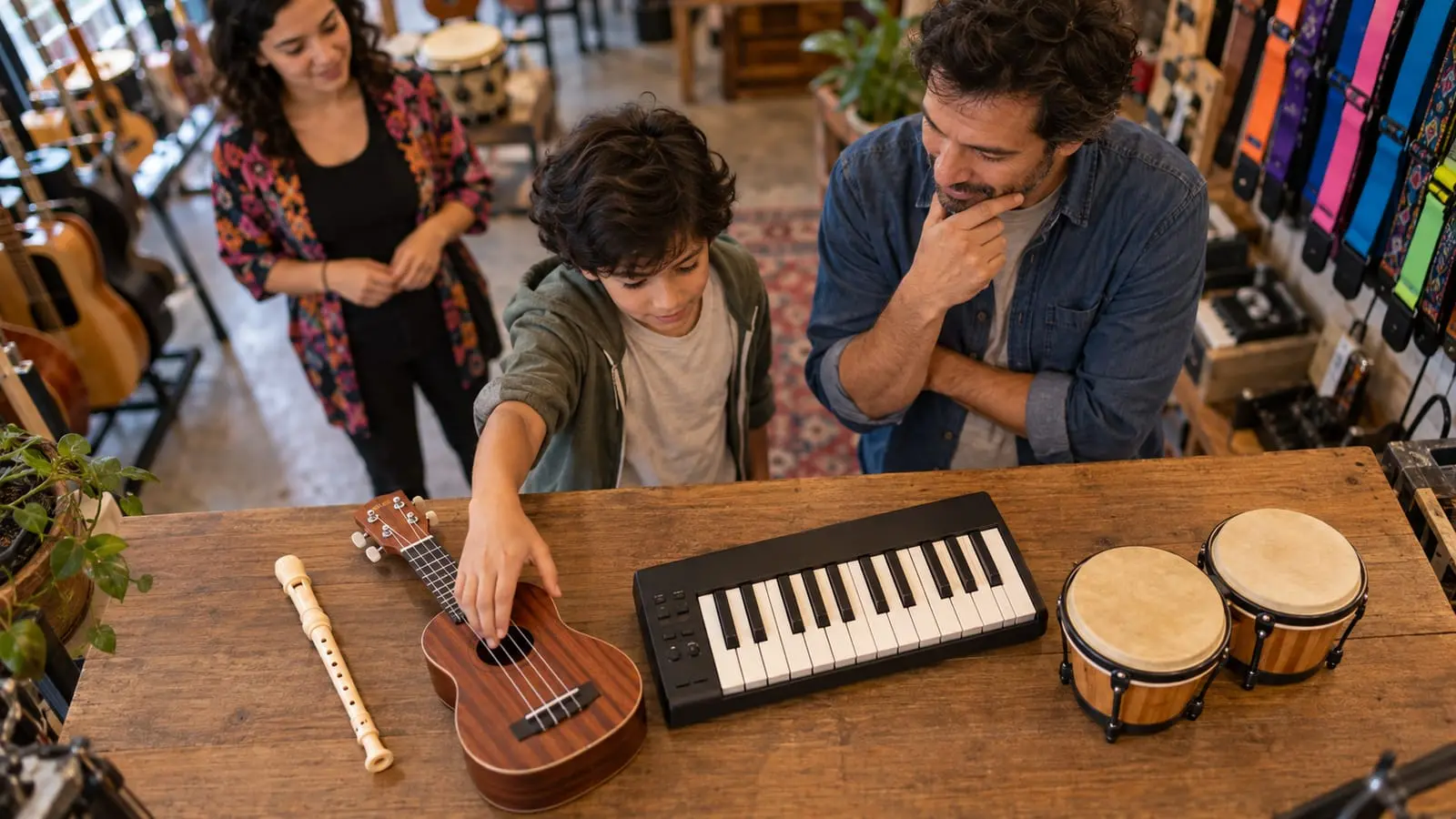
The easiest instruments to start with are piano or keyboard, recorder, and percussion (cajón or drums): within a few sessions, you can play a recognizable melody or rhythm. Guitar, tiple, and bass feel a little harder on your fingers during the first few weeks, but they offer great results. Singing requires no purchases. And none of them is easy to master: what changes is where the difficulty lies.
So the useful question is not which is easiest, but which is easy for you and your situation: your age, space, budget, and musical taste. If you already have an idea and want some guidance as you try it, see our in-home guitar lessons in Bogotá or online lessons and piano lessons. Otherwise, this guide compares instruments in a chart and ends with questions to help you decide.
In short
- Piano or keyboard, recorder, and percussion are the quickest to sound good: each key, each fingering, or each strike produces a clear sound from day one.
- Guitar, tiple, and bass are easy to start, though they cause some initial finger discomfort that fades with short daily practice.
- Violin and brass instruments are the most demanding at first because their sound depends on hand technique or embouchure.
- Easy to start does not mean easy to master: every instrument has its hurdles, and knowing them ahead of time helps prevent frustration.
- The easiest instrument is the one you will practice: choose one you love listening to and that fits your home.
Easy to start does not mean easy to master
When someone says “easy,” they often mean two different things. The first is how quickly you can play a simple song; the second is how far you can go before hitting a technical wall. An instrument can be excellent for the first and demanding for the second, or vice versa.
Piano is the classic example: playing a note means pressing a key, but getting your hands to do different things, reading two staves, and using the pedal is another story. With violin, it is the opposite: the first few weeks are tough because even the pitch comes from your ear and hand working together, but that same connection makes it so expressive.
Think about three factors: how long it takes to sound good, how much physical discomfort there is at first, and what your next obstacle will be. The chart below separates them so you can make a realistic comparison.
The chart: nine instruments compared
These timelines are estimates and vary from person to person. The cost column gives a general idea of the instrument cost alone for a beginner; if you are buying, see our guide to evaluating a new or used instrument.
| Instrument | First simple song | What gets harder later | Cost to get started | Good for |
|---|---|---|---|---|
| Piano or keyboard | First few sessions: a five-note melody with one hand | Coordinating both hands, reading two clefs, using the pedal | Medium (keyboard) to high (acoustic piano) | Children and adults; apartment living with a digital piano and headphones |
| Acoustic guitar | A few weeks: two or three chords and a strumming pattern | Barre chords, quick changes, strumming patterns with groove | Low to medium | Teens and adults; accompanying singing |
| Ukulele | First few sessions: chords with one or two fingers | Varied strumming patterns and melodies across multiple strings | Bass | Children and adults with limited space |
| Recorder | First few sessions: three or four notes | Breath control, high-register intonation, notes with sharps | Bass | Young children and a first introduction to reading music |
| Percussion (cajón, drums) | First session: a steady beat pattern | Hand independence, rhythm reading, dynamics | Low (cajón) to medium | Anyone drawn to rhythm; consider noise in an apartment |
| Singing | First few sessions: a short melody with guidance | Singing confidently in tune, breathing, caring for your voice | None | Any age; nothing to buy or store |
| Tiple | A few weeks: basic chords and a simple strumming pattern | Muted strumming patterns, tuning its twelve strings | Middle | Andean and Colombian music; anyone who already plays guitar |
| Electric bass | A few weeks: single-note lines along with a song | Groove, reading bass clef, hand endurance | Medium (requires an amplifier) | Teens and adults; playing in a band |
| Violin | Several weeks or months to produce a clean sound | Playing in tune without frets, bowing, vibrato | Medium (depending on size) | Anyone with patience and a good teacher from the start |
The quickest to sound good: piano, recorder, percussion, and singing
Piano or keyboard
Every note is visible and you do not have to tune it: press the right key and you get the right note. That makes it a great first instrument for understanding how music works, from scales to chords. With just one hand, you can already play melodies in five-finger position. The challenge comes when both hands join in, and by then it helps to have a solid foundation of hand independence exercises. For help choosing between piano and guitar, see the full comparison in piano or guitar as your first instrument.
Recorder
It is affordable and lightweight, and the first notes (B, A, G) use just a few fingers to cover the holes. That is why so many schools use it: it teaches music reading, breath control, and listening. Playing in tune in the high register and playing notes outside the C scale take longer, but for an elementary school child or anyone trying music for the first time, it is a welcoming introduction. If you are buying one, how to choose a recorder helps you avoid common mistakes, and recorder lessons take you beyond school repertoire.
Percussion and cajón
Rhythm comes naturally to us: almost anyone can keep a beat in the first session. Cajón and hand drums are quick to learn because there are no notes to read at first, just patterns. The hurdles come with independence between your hands or between hands and feet, rhythm reading, and control of dynamics. Practice with the metronome from the start. If this appeals to you, see how to choose a drum kit or cajón for beginners and our percussion lessons. Noise is the practical consideration: a cajón is loud in an apartment.
Singing
It is the only instrument you already carry with you. There is nothing to buy, and you can sing your favorite songs from day one. The challenge is that you cannot see where the note is: you rely on your ear, and singing in tune takes training. Most people can improve a lot with exercises and guidance; start with how to sing in tune and ear training. Caring for your voice matters from the start: never push your singing to the point of pain. Singing lessons adapt to your range and style.
The ones that require calluses: guitar, ukulele, tiple, and bass
Here, the initial challenge is physical. Your left fingertips hurt during the first few weeks, your hand takes time to stretch into chord shapes, and the sound is muted until you learn to press properly. It is normal, and it passes. Twenty minutes a day goes further than an hour on Sunday; for that discomfort, see finger pain when playing guitar.
Guitar
With just a few open chords, you can accompany hundreds of songs, which makes progress feel fast. These four are enough to get started:
Next come the F barre chord, fast changes, and strumming patterns with groove. We cover how long each stage takes in how long it takes to learn guitar, and acoustic guitar lessons guide you step by step. Nylon strings are gentler on your fingers; steel strings sound brighter and sting more at first.
Ukulele
It is small, has four nylon strings, and several chords use only one or two fingers, which is why many see it as the gentlest introduction to string instruments. It is an option to consider, though we do not offer lessons in it; if you later move on to guitar, you will already understand chords and strumming.
Tiple
It has twelve metal strings in four courses of three, tuned D, G, B, and E, like the four highest strings on a guitar. It is especially lovely if you want to play bambucos, pasillos, and Colombian repertoire. Your fingers may hurt a little at first, and the challenge is strumming with muted strokes and keeping it in tune: here is how to tune the tiple and the tiple tuner. If you are deciding between this and guitar, see guitar or tiple.
Electric bass
You play only one note at a time, so you can join a band quickly. The challenges come later: groove, precise timing, reading bass clef, and left-hand endurance. If you are choosing between bass and guitar, read guitar or bass: which should you learn?. It also needs an amplifier, which raises the starting cost a little.
The ones that take patience at first: violin and brass instruments
The violin has no frets, so pitch depends on where you place your finger, and the bow determines whether the sound is clean or scratchy. It is normal for the first few weeks not to sound pretty. In return, with good guidance and steady practice, it becomes one of the most expressive instruments. If it appeals to you, see how long it takes to learn violin and violin for children.
With brass instruments such as trumpet and trombone, the challenge is embouchure: producing sound with your lips requires muscles that develop gradually. They are good choices too; it simply helps to know this before buying, and guidance from the start prevents poor posture and blowing habits.
Your situation matters: children, adults, and apartment living
| Situation | Instruments that tend to work well | Things to consider |
|---|---|---|
| Young children | Recorder, piano or keyboard, percussion, singing | Instrument size and short attention spans set the pace; keep sessions brief and playful. See which instrument to choose for my child. |
| Preteens and teens | Guitar, bass, piano, singing, drums | Choosing what they listen to works well; playing their favorite songs keeps them motivated. |
| Adult beginners | Piano, guitar, singing, tiple | You have discipline and know what you like; what is missing is time. See learning guitar as an adult and learning piano as an adult. |
| Apartment or limited space | Keyboard or digital piano with headphones, guitar, recorder, singing | Volume is the deciding factor: a cajón or drum is more likely to disturb others. Find ideas in playing an instrument in an apartment. |
| You want to play Colombian music | Tiple, guitar, percussion | Start with chords and strumming; the rhythms are explained in Colombian rhythms. |
How to decide: a six-question checklist
Answer honestly and see which instrument comes up most often:
- What music excites me? If you want to play songs by your favorite artist, choose the instrument they use. It is the best source of motivation to keep going.
- Would I rather accompany or play the melody? Guitar, tiple, and piano work well for accompanying your singing; flute, violin, and bass have other roles.
- How much noise can I make, and where will I store it? A keyboard fits in a corner; a cajón or drum kit does not.
- What discomfort can I handle at first? Sore fingers (strings), tired lips (brass), or patience with the sound (violin).
- How much can I practice each week? With 15 or 20 minutes a day, you can make progress on almost any instrument; with one hour on the weekend, you cannot.
- Will I have someone to correct me? Most mistakes take root during the first few weeks; a teacher spots them before they become habits.
A teacher helps you get through the hard part sooner
A good teacher does not make the instrument easier, but does shorten the learning process: they show you how to hold it without hurting yourself, organize what to learn first, correct bad habits before they take root, and choose repertoire that keeps you excited. That matters especially with instruments that are “hard at first,” such as violin or tiple.
At A medio tono, lessons are one-on-one, in your home in Bogotá and surrounding areas, depending on each teacher's availability, or online from any city. All our teachers are assessed for musical ability, teaching skills, and personal qualities before their first lesson. You can tell your teacher what you like, how much time you have, and what frustrates you, and build a realistic plan together. Learn more about the experience in in-home music lessons in Bogotá.
Frequently asked questions
What is the easiest instrument for adults to learn?
Piano or keyboard, guitar, and singing tend to be the most approachable for adult beginners: piano because each key is already in tune, guitar because a few chords let you accompany many songs, and singing because there is nothing to buy. The best choice is the one that fits the music you want to play.
What is the easiest instrument for children?
Recorder, keyboard or piano, and percussion tend to be the most accessible because they give clear results quickly. Guitar works well once a child's hands can comfortably reach around the neck. What matters is that they enjoy it and that sessions are short and playful.
Which instrument should I learn first if I know nothing about music?
Piano provides a good general foundation because you can see notes, scales, and chords very clearly. If you want to sing and accompany yourself, guitar or tiple makes more sense. And if rhythm is your thing, start with percussion.
Is ukulele really easier than guitar?
To get started, it usually is: it has fewer strings, they are nylon, and several chords use only one or two fingers. But its range is narrower than a guitar's, and if you move on to guitar later, you will need to learn six-string chords. Some of what you learn, such as strumming and the concept of chords, carries over.
What is the hardest instrument to learn?
It depends on what you mean by hard. Violin and brass instruments are harder at first; piano and guitar are approachable at the beginning but become difficult at higher levels. Every instrument is demanding at a professional level, so choosing one that keeps you motivated to practice matters more.
Sources
We checked the facts in this article against these sources on October 22, 2026.